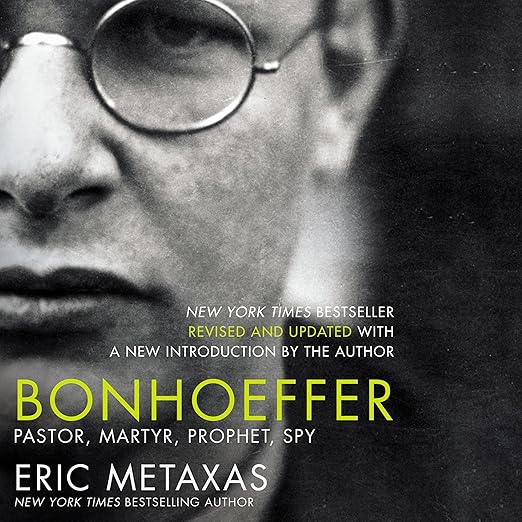
Eric Metaxas's biography of Dietrich Bonhoeffer is one of the genuinely important books published about World War II in the last two decades, and Malcolm Hillgartner's narration across twenty-three hours and twenty-three minutes makes that significance audible. The audiobook, a New York Times bestseller revised with new archival material, tells two stories simultaneously: the story of a theologian who developed one of the twentieth century's most searching critiques of cheap grace, and the story of a spy and saboteur who joined a plot to assassinate Adolf Hitler. Metaxas holds both strands without letting either simplify the other, and the result is biography at the level of moral philosophy.
The core argument of this biography is that Bonhoeffer's ethical life and his theological life were not separate tracks that eventually converged in dramatic action, but a single integrated commitment that made his trajectory inevitable given the circumstances. Metaxas builds this case through careful chronology, drawing on personal letters, detailed journal entries, and firsthand accounts that were not available to earlier biographers. The decision to return to Hitler's Germany from the safe haven of America, which Bonhoeffer made in 1939 while visiting the United States, is treated as the biography's moral fulcrum. Metaxas gives it the weight it deserves, exploring the letters and conversations that surrounded it in detail, and the reader understands by the end that this was not an impulsive act of conscience but the logical conclusion of everything Bonhoeffer had ever believed and written about the cost of discipleship.
The theological material is handled with what the Wall Street Journal called "passion and theological sophistication," which is the accurate assessment. Metaxas does not simplify Bonhoeffer's theology for a general audience; he explains it clearly, draws on primary sources, and trusts readers to engage with difficult ideas. The sections on Bonhoeffer's critique of the German Protestant church's accommodation to Nazism, its willingness to distinguish between the "spiritual" realm it claimed and the "worldly" realm it surrendered to the state, are as intellectually rigorous as they are morally devastating. Metaxas consistently frames the theological argument as the foundation that made everything else possible, rather than treating it as context for the more cinematic spy material.
Hillgartner's Restraint Makes the Execution More Affecting
Malcolm Hillgartner is the right narrator for this material. His voice has the measured gravity that twenty-three hours of biography about moral courage under totalitarianism requires. He does not dramatize the prison letters or the accounts of Bonhoeffer's execution; he reads them with the restraint that makes them more affecting rather than less. There is a temptation with biography narration to treat climactic moments as performance occasions, and Hillgartner consistently resists it. One reviewer noted the book is "both a book you can't wait to finish and yet will read slowly in order to digest," and the narration supports that dual rhythm: it is paced for sustained attention, not for the kind of propulsive consumption that a thriller invites.
The revised edition draws on previously unavailable documents, and Metaxas has used them to add dimensionality to the passages covering Bonhoeffer's involvement in Operation 7, the effort to smuggle Jews into neutral Switzerland, and the Valkyrie plot against Hitler. For listeners who read the original edition, these additions are the main argument for returning to the audiobook. The letters and personal accounts in particular make Bonhoeffer's relationships, with his fiancee Maria von Wedemeyer, with his family, with his co-conspirators, more fully drawn than they were in the first edition.
Bonhoeffer Scholars Don't All Accept This Reading
Metaxas's biography has attracted criticism from some academic theologians who argue that he reads Bonhoeffer too firmly through an American evangelical framework, selectively emphasizing certain aspects of the theology while downplaying others. That criticism has merit, and listeners engaged with Bonhoeffer's thought will want to read it alongside other scholarly treatments. Christianity Today praised Metaxas for presenting Bonhoeffer as "a clear-headed, deeply convicted Christian who submitted to no one and nothing except God and his Word," which is an accurate description of Metaxas's interpretation but not a universally accepted one among Bonhoeffer scholars.
The biography is long, and intentionally so. Metaxas is building a full-scale portrait, not a highlights reel, and the early chapters on Bonhoeffer's family background and theological formation are as important to the book's argument as the more dramatic wartime sections. Listeners who skip or skim the early material in search of the spy narrative will miss the scaffolding that makes the moral urgency of his later choices comprehensible. The early chapters on the Bonhoeffer family, its academic culture, its music, and its liberal Protestant milieu, are where Metaxas establishes the character who will later become the resistance figure.
Buy a Second Copy, Give It to Someone You Love
Readers interested in World War II biography, twentieth-century theology, or the history of moral resistance under totalitarian regimes will find this audiobook among the most rewarding in any of those categories. It works equally well for religious and secular listeners: the theological content is explained rather than assumed, and the biography's argument about moral courage in extreme circumstances does not depend on sharing Bonhoeffer's faith commitments. One reviewer's endorsement, Archbishop Charles Chaput's recommendation to buy a second copy and give it to someone you love, is the kind of praise that sounds excessive until you finish the book and find yourself wanting to do exactly that. For anyone who has wondered what it looks like when a person's beliefs and actions are genuinely aligned even at the cost of everything, this is the audiobook to reach for.
- Performance: Malcolm Hillgartner's measured gravity suits twenty-three hours of moral biography well - he resists dramatizing the most harrowing passages, which makes them hit harder.
- What it covers: moral courage under totalitarianism, the cost of theological conviction, resistance and complicity in Nazi Germany
- Feel: Serious and cumulative, with the weight of someone who knew exactly what he was choosing
- Our call: Bonhoeffer is one of the most complete portraits of a life lived at moral extremity available in audio form, and Metaxas earns his twenty-three hours.
Frequently Asked Questions
How does this audiobook handle the scholarly controversy around Metaxas's interpretation of Bonhoeffer?
It does not address the controversy directly, because it predates some of it and is not an academic text. Metaxas presents his interpretation confidently and with substantial evidence. Listeners interested in the scholarly debate will want to supplement with other Bonhoeffer scholarship, particularly Eberhard Bethge's older but still authoritative biography.
Is the revised edition of this audiobook substantially different from earlier versions?
Yes, meaningfully so. The new introduction from Metaxas provides updated framing, and the incorporation of previously unavailable documents adds dimension to the sections on Bonhoeffer's personal relationships and his involvement in the smuggling operation known as Operation 7. The prison correspondence in particular benefits from the new archival material.
At over twenty-three hours, how does this audiobook sustain engagement across such a long runtime?
The biography is organized chronologically with thematic chapters, and Metaxas varies the texture between theological analysis, family history, and wartime narrative. Malcolm Hillgartner's consistent pacing makes the shifts between registers smooth. Most listeners report that the length feels earned rather than indulgent, though the early formation chapters require patience before the wartime drama accelerates.