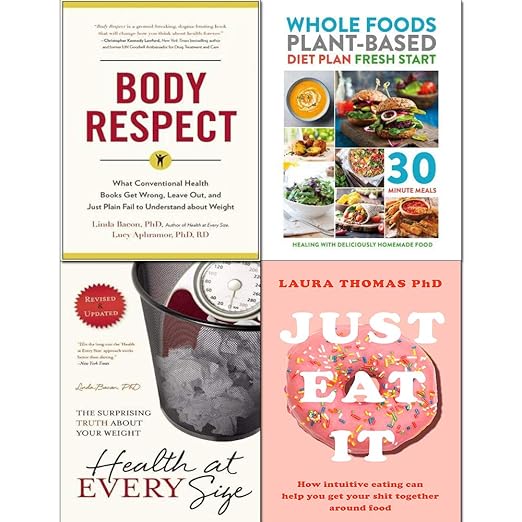
Body Respect arrives in an audiobook format that packages four distinct titles under a single collection umbrella, and context matters here before anything else. The four works gathered together are Health At Every Size, Body Respect, Just Eat It, and Whole Foods Plant-Based Diet Plan Fresh Start, a range that spans from foundational anti-diet theory through nutritionist-led practical guides to plant-based eating. Celeste Oliva narrates the collection, and across nearly five hours she handles the range of authorial voices these titles represent with the consistency of someone who understands that this material is aimed at listeners who are tired of being lectured about their bodies and are ready for a fundamentally different conversation. That tonal awareness is exactly what this kind of health content requires.
The thematic center of the collection, and the place from which the whole package draws its coherence, is the critique of weight-centric healthcare that Linda Bacon developed through years of research into what has become known as the Health At Every Size framework. The argument is direct: fatness is not a death sentence, the medical establishment's equation of thinness with health is not well-supported by evidence, and dieting as a weight-loss strategy demonstrably fails the majority of people who attempt it. These are not fringe claims; they represent a growing body of research in nutrition science, and the audiobook collection presents them with the authority of researchers who have spent careers building the case rather than popularizers simplifying someone else's work.
What the collection gets right is sequencing. Starting with the foundational framework of Health At Every Size before moving into Body Respect's more specific deconstruction of diet and exercise mythology, and then into Laura Thomas's practical Just Eat It guide on intuitive eating, creates a logical progression from theory to application. The listener who finishes the Health At Every Size section will arrive at the intuitive eating material with the conceptual scaffolding already in place to understand why the approach is structured the way it is. The Whole Foods Plant-Based component sits at the end as a more practical, recipe-adjacent guide, which is the appropriate placement given that it functions differently from the analytical content that precedes it.
Celeste Oliva's narration is steady and warm throughout without being sycophantic, a tone that matters considerably in content designed to push back against shame-based messaging. The anti-diet framework requires a narrator who can deliver corrective information about bodies and health without either triumphalism or defensiveness, and Oliva maintains that balance across the collection's nearly five hours. The material is, at its core, an invitation to reconsider something that many listeners have been told since childhood, and the narration respects the emotional weight of that invitation without performing it. That restraint serves the content well.
Oliva's Calm Voice Disarms Self-Criticism
The audio format is particularly suited to this kind of advocacy-rooted health content because the listening posture, receptive and conversational, mirrors what the material is asking the listener to do: set aside defensive processing and actually hear an argument on its merits. Reading similar content on a page can activate the same self-critical voice that the books are explicitly critiquing. Hearing it read by a calm, authoritative narrator shifts the dynamic in the listener's favor and removes a layer of internal resistance that the print version sometimes encounters.
The four-book collection structure provides considerable value for the runtime. At four hours and fifty-one minutes, this is a listening investment that delivers a complete ideological arc: here's the problem with weight-centric medicine, here's the specific evidence base, here's a practical guide to eating intuitively, and here's an accessible framework for incorporating plant-based foods into that approach. The coverage is broader than any single title in the collection would provide, and the sequencing makes the whole greater than the sum of its parts. For listeners coming to this material for the first time, the collection functions as an efficient orientation to an entire intellectual tradition.
Taking a Position Instead of a Survey
Listeners should be aware that this collection takes an explicit position. The Health At Every Size framework and the anti-diet movement from which it emerges are not neutral scientific surveys; they are advocacy positions backed by research but also driven by the conviction that current medical and cultural treatment of larger bodies causes measurable harm. Listeners who enter expecting a balanced debate between weight-centric and size-inclusive approaches to health will not find that balance here. This is a feature for listeners who have already concluded that weight-centric healthcare has failed them; it is a potential limitation for those who want to weigh competing frameworks side by side before committing to a position.
The Whole Foods Plant-Based section is also stylistically different from the rest of the collection, moving from critical analysis toward practical guidance in a register that may feel like a tonal shift for listeners settled into the more argumentative earlier sections. The transition is logical and the placement is appropriate, but listeners should expect a change of pace in the final portion rather than seamless continuation of the critical framework established at the opening.
Practitioners New to Size-Inclusive Care Start Here
This audiobook collection is most useful for listeners who have personal experience with diet culture and want a research-backed alternative framework for thinking about food, health, and their own bodies. Healthcare practitioners curious about size-inclusive approaches to patient care will find the foundational theory here useful as an entry point to a literature they may not have engaged with directly. Those who are skeptical of the Health At Every Size framework and want to test it against conventional medical wisdom should approach the collection as an advocacy text rather than an objective survey. Anyone who has felt that mainstream health advice about weight and dieting has been personally unhelpful or harmful will find this collection speaks directly to that experience with both intellectual rigor and appropriate compassion.
Quick Take
- Narrator: Celeste Oliva delivers the anti-diet framework with steady warmth and appropriate gravity, never pushing the corrective material into defensiveness or triumph.
- Subjects: Health At Every Size, diet culture critique, intuitive eating and body autonomy
- Tone: Affirming and evidence-backed
- Bottom line: A well-sequenced four-title collection that builds from foundational theory to practical application, covering the full arc of size-inclusive health thinking in under five hours.
A Few Questions About Body Respect
Does this audiobook collection require listening to all four books to get value, or can individual sections stand alone?
The four books build on each other sequentially, with Health At Every Size providing the theoretical foundation for the more practical content that follows. The collection is most rewarding listened to in order, but individual sections, particularly Just Eat It on intuitive eating, have enough internal coherence to be useful independently.
Is this audiobook appropriate for listeners who are not already convinced by the Health At Every Size perspective?
It's advocacy content that presents its arguments rigorously rather than a neutral survey of competing positions. Skeptical listeners will find the evidence presented, but the collection does not set out to offer the weight-centric counterargument. Going in with that awareness will help calibrate expectations.
How does Celeste Oliva's narration handle the emotionally sensitive content about body image and diet history?
Oliva's delivery is warm and steady without being performatively gentle. She reads the corrective content about bodies and health with calm authority, which is the appropriate tone for material designed to counteract shame-based health messaging rather than amplify it.
Is the nearly five-hour runtime adequate to cover four distinct books, or does the collection feel compressed?
The runtime necessarily means each book is presented in condensed form rather than at full length. Listeners who want the complete text of any single title will want to seek out that book independently. As an introduction to the ideas across all four works, the collection covers the essential arguments and frameworks effectively within the available time.