In Brief
- Voice: Eric Jason Martin is the credited reader across a long mid-series volume whose exposition is written as dialogue rather than stat blocks.
- Big ideas: Progression fantasy at a hard ceiling, political intrigue among gods, found family reassembled on a new world.
- Atmosphere: Busy and escalating, with the intrigue heavier than the combat.
- Worth it?: Strong fifth volume for listeners already in the series, and a poor place for anyone else to start.
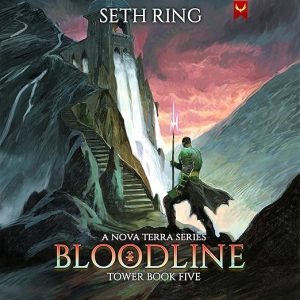
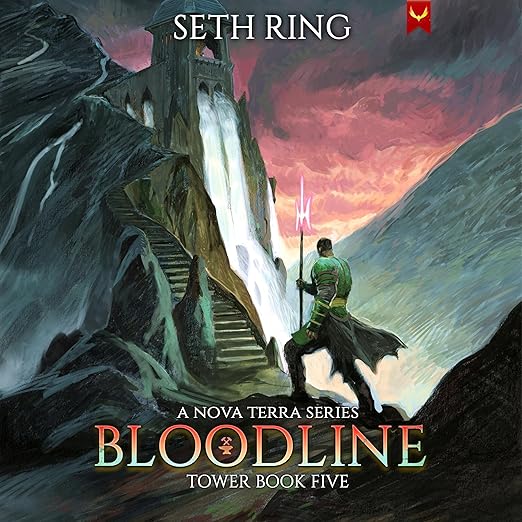
The name printed on this audiobook is not the name inside its own description, and that is the first thing a buyer needs to know. The byline reads Will Wight. The publisher copy underneath it states, without hedging, that Bloodline is the fifth book in the Tower series from Seth Ring, the author of Battle Mage Farmer and The Titan series, set in the world of Nova Terra. The series information sitting beside it agrees with the description and not with the byline: Tower, volume five. Two real authors, one page, and no way to tell from the listing which library the recording will land in.
Is Bloodline Worth Your Time?
Adam P Miller called it a tour de force of world building in March 2024 and spent the rest of the entry on the same point: depth, detail, and pathos accumulated across five volumes, with a lead who holds attention even while you are trying to recall concepts introduced books ago. That same response calls the writer Mr. Ring throughout, matching the description rather than the credit printed above it. That last clause about recalling concepts is the honest one. Thorn's story has reached the stage where the pleasure and the difficulty come from the same place, and the recording assumes you have been keeping up. Five volumes in, that accumulated weight is simultaneously the appeal and the barrier.
A puzzle box drives the plot. Urmag'Tal's Puzzle opens for the first time in a century, Thorn's connection to it makes absence impossible, and reaching the Temple of Man drops him into the political machinery of the city of the Saints. Alliances get built and enemies get made at roughly the same rate, with the Council of Gods working against him throughout. It is a structure that lets the book run two speeds at once: courtly maneuvering above, dungeon logic below. Political intrigue and dungeon crawling rarely share a volume without one of them turning into homework, and Ring keeps both alive.
What surprises is how little of the tension comes from combat. Elemental Emperors and god beasts capable of matching Thorn are, in the copy's own framing, the least of his problems. The real pressure is the tenth tier, the advancement he cannot reach by fighting harder, and thirteen and a half hours is exactly enough room to make that wall feel earned rather than arbitrary. The puzzle's century-long cycle supplies a clock without anyone having to invent a deadline. Eric Jason Martin carries the whole span as the credited reader.
Rieryn, in July 2024, described the moment the series pivots: Thorn meets the image of a Titan that is openly disappointed in his strength and progress, delivers criticism he cannot refute, and sends him back to reassess how he wants to fight and live. That is an unusual beat for a power-progression story, where the standard move is to reward the protagonist for grinding. Here the grind gets audited, and the audit is the best writing in the book.
The other reason to take this one in audio is that Ring writes exposition as conversation. Ethan Richardson noticed it from the other direction, praising twists and storybuilding and observing that the information dumps are woven in tightly enough that you only spot them if you go looking. Dense progression fantasy usually collapses in audio for the opposite reason, because stat blocks and tier tables do not survive being spoken. Very little of that survives into this volume.
And the ensemble helps. The Earth contingent reassembles for a new world, which gives the middle stretch a comedy of familiarity that pure escalation cannot provide. Friendship carries more narrative weight here than tier numbers do, and a listener who came for the system will stay for the group dynamic even if they arrived skeptical of it. Comedy is scarce in progression fantasy, and the reunion supplies most of what this volume has.
Where Will Wight Loses Some Ground
Start with the number above the reviews, because it cannot be right. The page shows 4.7 from two ratings, with five signed responses beneath it whose own average is 4.8. Two whole-star votes can only produce 4.0, 4.5, or 5.0, so 4.7 is not reachable from the count displayed, and the count is smaller than the number of people visibly writing. Treat the whole widget as decoration and read the entries instead. Two ratings would be thin evidence even if the arithmetic worked.
Genre placement is the second problem. This sits under science fiction and fantasy with a Fantasy tag, while the description calls it GameLit and LitRPG outright. Those are not interchangeable audiences. A listener who wants tiers, advancement thresholds and system mechanics will not find this page from the shelf it is on, and a listener who wants secondary-world fantasy without progression scaffolding may be unpleasantly surprised by the tenth tier. Buyers who filter by tag rather than by description will simply never see it.
Then the entry point. This is volume five, and nothing on the page says so except the series number and one line buried in the description. Reading in sequence is the only sensible route in, and the page does nothing to steer a newcomer that way. Starting here means meeting Thorn mid-ascent with five books of vocabulary already in play. The description also closes with a sales pitch inviting you to pick the book up today, a leftover from a storefront blurb rather than anything written for a catalog page. A single line saying plainly which volume this is would save a lot of returns.
Should You Listen to Bloodline?
Jd Hale's May 2025 verdict is the cleanest recommendation on the page: an exciting plot line that flows, an entire series binged, and every book better than the one before. That describes a specific listener, the one who wants a long committed run rather than a single evening, and who enjoys watching a system get more complicated rather than wanting it explained once and set aside.
Newcomers should start elsewhere, because thirteen hours of mid-arc political maneuvering is an expensive way to discover you needed four earlier books. Skip it if progression fantasy's numbers bore you, because the tenth tier is the spine of the plot and not a subplot. And approach with caution if you are shopping by author name, since the name on the byline is not the name in the copy.
For readers already deep in Nova Terra, this is the volume where Thorn stops being rewarded for effort and starts being measured against something that does not care how hard he tried. That shift is worth the running time on its own.
Frequently Asked Questions
Who actually wrote Bloodline, since the byline and the description disagree?
The description and the series details both point to Seth Ring, author of the Tower books set in Nova Terra. The byline on the page reads Will Wight, a different author entirely. Search under Tower and Nova Terra rather than by name to be certain you are buying the right recording.
Can I start the series with this audiobook?
Not comfortably. This is the fifth Tower book, and it opens with Thorn already committed to Urmag'Tal's Puzzle, the Temple of Man and a running feud with the Council of Gods. Anyone determined to begin here should expect the opening hours to feel like joining a conversation already well under way.
Is the audiobook LitRPG with visible stats, or straight fantasy?
Publisher copy uses both GameLit and LitRPG, and advancement to the tenth tier drives the plot. The mechanics are delivered through conversation and incident rather than tables, which is why the audiobook holds together. Listeners allergic to progression systems should still expect tiers to matter constantly.
Why is the rating 4.7 when only two ratings are counted?
It cannot be, arithmetically. Two whole-star votes average to 4.0, 4.5 or 5.0 and nothing between, and five signed responses are visible under a count of two. The written entries, which run four and five stars, are far more informative than the headline figure.