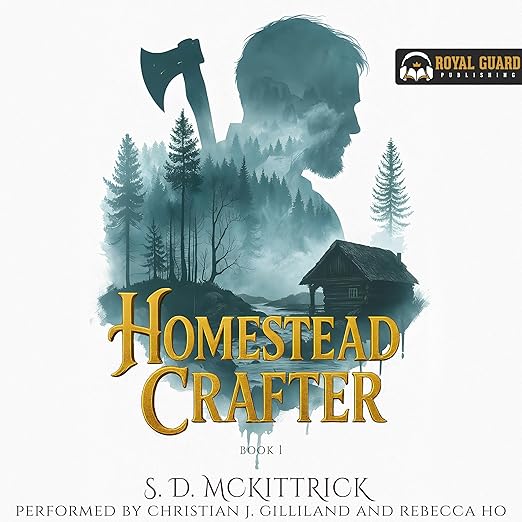
Quick Take
- Narration: Christian J. Gilliland brings warmth to Tanner’s slice-of-life progression; his tone suits the cozy fantasy register of the material.
- Themes: Rejection and self-determination, crafting as power, found community in the wild
- Mood: Warm and optimistic with light adventure tension
- Verdict: A debut series entry with solid bones and a genuinely appealing premise; the writing is lighter on descriptive detail than genre veterans may prefer, but the character and setup are worth following.
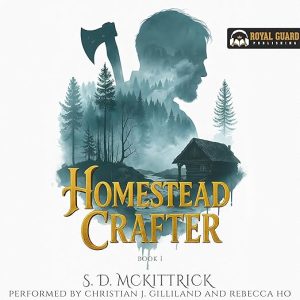
I have a soft spot for LitRPG that begins with exile. There is something satisfying about a premise that strips the protagonist of institutional support and says: now show us what you can do. Homestead Crafter opens with exactly that situation. Tanner, raised and trained by a powerful fighter-class father to inherit control of their estate, receives a crafting class when his abilities manifest. His father, who had plans requiring a combat class, essentially expels him from the family. Tanner leaves for the Wilds. The setup is compact and it works.
What follows is S.D. McKittrick’s debut series entry, and it reads like a debut: lighter on descriptive detail and world texture than more established authors in the genre, but built on fundamentally appealing bones. The crafting-class-as-power premise is well chosen for this moment in LitRPG publishing, where readers are actively seeking alternatives to pure combat progression. One reviewer described it as like playing World of Warcraft in a completely new way: same lethal dangers, same sprawling conflicts, but a radically different path to power. That framing captures something real about what McKittrick is doing here.
Our Take on Crafting as the Central Power System
The Master of Crafts designation that Tanner carries is appealing because it encompasses all professions simultaneously rather than locking him into a single trade. Forging, woodworking, enchanting, engineering: the class is a framework for comprehensive skill development rather than specialization. This creates a satisfying progression rhythm because each new profession Tanner explores represents a legible step forward. The homestead-building arc that structures the first book uses this system naturally, because every building decision is also a power decision and both register clearly for the reader.
The sapient forest denizens who are drawn to Tanner represent the found community element of the series. Reviewers consistently mentioned enjoying the slow accumulation of races gathering around him, the friends and family that are collecting. This is the cozy-fantasy dimension of what could have been a pure survival narrative, and McKittrick handles the balance reasonably well for a first novel. The light romance thread that reviewers mention is present with fade-to-black handling, keeping the book’s priorities clearly focused on the crafting and community arcs.
Why Listen to Christian J. Gilliland Read This Debut
Gilliland brings a warmth to Tanner that suits the material’s priorities. This is not a book that asks its narrator to sustain dramatic tension for twenty consecutive hours; it is a book that asks him to make a young man teaching himself to be a homesteader in dangerous wilderness feel like good company over eleven hours. Gilliland does that effectively. The fighting, which one reviewer described as just enough to be interesting and not overwhelming, lands clearly when it arrives without dominating the listening experience.
What to Watch For in the Homestead Construction Sequences
The progression of Tanner’s homestead from nothing to a functioning compound with allies and infrastructure is the book’s structural spine. Each construction milestone corresponds to both a physical achievement and a power development. McKittrick keeps the profession lists in separate chapters rather than embedded in narrative, which allows readers who want to skip stat-heavy content to do so without losing story continuity. For readers who enjoy examining character sheets, they are there in full and clearly organized. This structural choice reflects authorial awareness of different reader preferences within the genre.
Who Should Listen to Homestead Crafter, Book 1
This is a good entry point for readers newer to LitRPG who want a less combat-intensive introduction to the genre. The crafting focus, the found-community arc, and the light romance thread make it accessible without sacrificing progression mechanics entirely. More experienced genre readers should expect debut-level descriptive sparseness and adjust expectations accordingly: the author is compared to early Iron Druid in terms of good bones that still need development. If the premise appeals, the series appears worth following into future installments as the author’s craft develops.
Frequently Asked Questions
Is the crafting class system in Homestead Crafter mechanically detailed, or is it kept light?
The class system includes full character sheets available in separate chapters so readers can engage with or skip the stat content. The narrative integrates system details through Tanner’s decision-making rather than front-loading them as exposition.
Does the romance thread develop significantly in book one, or is it a background element?
Reviewers describe the romance as light and present with fade-to-black handling. It is not a dominant plot driver in book one but is noted as part of the cozy-fantasy texture of the series.
Are there combat sequences in this book, or is it entirely crafting and homesteading?
There is fighting, described by one reviewer as just enough to be interesting and not overwhelming. The Wilds setting requires Tanner to defend his homestead and himself, but combat is not the primary progression axis.
Is Homestead Crafter part of an ongoing series with subsequent volumes available?
Based on the series name and series number designation at book one, this is the beginning of an ongoing series. Listener reviews express anticipation for where the story goes, suggesting subsequent volumes are planned or in progress.