At a Glance
- Performance: Jeffrey Kafer holds the credit for a Podium Audio production that has to keep two full generations of a large cast distinguishable by voice alone.
- What it covers: Military space opera, generational succession, a returning enemy, found family under fire.
- Feel: Propulsive and a little melancholy, with the sadness of a handover running underneath.
- Our call: A strong late-run entry for committed listeners, and a closed door for anyone starting fresh.
Twenty-seven books into Backyard Starship, the interesting question is no longer whether the series can sustain itself but what it intends to do with the generation it raised. Forged in Stillness is J.N. Chaney's answer, an audiobook running just under ten hours that hands the helm of a warship to the children of the crew who earned it, then points an old enemy at them specifically. Whether that lands depends almost entirely on how long you have been aboard.
A Closer Look at Forged in Stillness
Chaney's setup arrives with unusual bluntness. The Stillness never went away; they waited, watched and planned, and they return reformed, repackaged and re-engineered. Against them stand Abel Tudor and a crew whose entire claim is that command is earned rather than granted. Van Tudor, older and described as unwavering in his commitment to justice, remains commander of it all, and the Fafnir and its crew are characterized as reloading rather than retiring, which tells you exactly what tone the book is reaching for.
Generational handover is the structural idea, and this deep into a run it is a genuinely risky one. Anyone who has followed Van, Torina and the rest for years is being asked to transfer that investment to a second cast at the precise moment the threat sharpens. The opening copy is explicit that the young are not protected by their parentage, and that sentence is where the premise gets its edge. It also promises a book willing to hurt, which is a promise late-series fiction makes far more often than it keeps.
David E., posting in May 2025, sketched the machinery in useful detail: the younger crew launching probes toward possible life on gas giants and liquid worlds, an enemy laying traps that expose its own nature in the laying, body doubles surfacing where they should not, and backdoor implants revealing security breaches across the Nexus. That is a substantial amount of plot for one volume, and it explains why this installment reads as a hinge rather than a resting place. Threads open faster than they close.
What Makes Forged in Stillness Worth Hearing
Most useful response on the page is the five-star filed in July 2025, which opens by admitting its author was close to walking away from the series. What reversed that was this volume stepping away from what the account calls a recent, somewhat repetitive storyline and spending its time on character instead, new and old. A reader on the verge of quitting who stays because of one book tells you more than five uncomplicated raves ever will, because the reversal is the evidence.
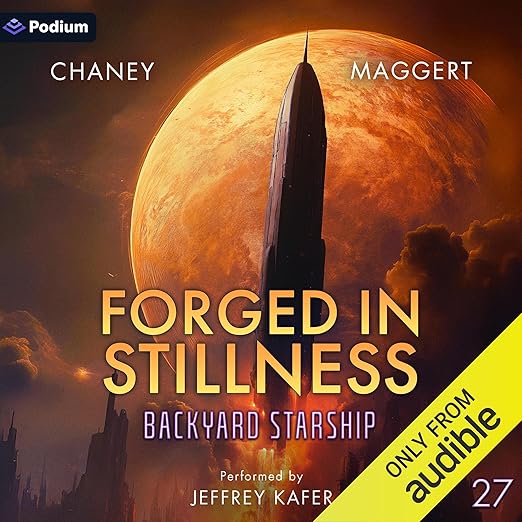
Podium Audio holds the production, with Jeffrey Kafer credited on the reading. In long-running military science fiction, continuity of voice does more work than in almost any other category, because a couple of dozen recurring names have to stay distinguishable across a full-length recording without the visual cues a printed page hands out for free. Ten hours is a long stretch in which to keep a fleet of young officers apart by ear alone, and that is the real technical demand here.
Format discipline counts for something too. This is a full-length entry rather than the compressed novella that long series sometimes shrink toward once the numbering climbs, and Podium has kept the packaging steady across the run. For listeners who consume Backyard Starship in order, that steadiness is a large part of the actual product. You know roughly what one of these costs you in hours, and volume twenty-seven does not renegotiate the terms.
Things to Know Before Starting Forged in Stillness
Arithmetic on this listing does not work. A 4.7 average sits above a rating counter reading 2, and two whole-star votes cannot produce 4.7 under any combination; they land on 4.5 or on 5.0 and nowhere between. That same counter of 2 also sits below the five written responses visible further down the page, so the number is not counting what you can read. Treat the 4.7 as a placeholder on a freshly posted listing rather than as a verdict.
All five written responses carry 2025 dates, running from late May through mid-July, while the recording carries a March 2026 date. Every reaction available to you was therefore written about the text, seven to nine months before the recording existed to be heard at all. None of that makes them less reliable about plot, pacing or the generational turn. It does mean the praise you are reading was earned on the page and belongs to the page.
Two responses register the cost of that generational shift. Just for Fun, writing in June 2025, calls this a heart-rending story of changing generations and says outright that the book is sad in places, which is not the register most people come to this series looking for. A four-star posted the day before is blunter about the run as a whole: ups and downs, still enjoying it, not ready for the ride to end. Neither reads as unconditional, and both are more informative for it.
Who It's For
RickC77, at five stars in mid-June 2025, framed the appeal precisely. The story was supposed to end a couple of books back; the new enemy is fighting dirty; the children are not off limits. That same account singles out the introduction of the next generation, naming the kids of Van, Funboy, Iky and Mandaville, as the best thing in the volume. If that sentence raises your pulse rather than your eyebrows, you already know you are the audience.
Starting here would be a mistake. Twenty-six volumes of accumulated relationships stand behind every reunion in this one, and the copy assumes all of them: Van's history, Torina's place in the crew, the significance of the Fafnir, the reason handing a warship to young officers is a statement rather than a plot convenience. Newcomers should begin at the first volume or pick a different series, because nothing here is designed to catch you up.
Long-running series survive on whether an author can change the subject without changing the deal. Twenty-seven entries in, Chaney has moved the camera onto a younger crew, brought back an enemy with both a grudge and an upgrade, and kept the veterans in frame rather than retiring them offstage. Listeners already invested will find the transition handled with more care than the volume number would lead anyone to predict. The Stillness and their upgrade belong to whatever comes next.
Before You Listen
How long is the Forged in Stillness audiobook, and how far into the series is it?
It runs nine hours and fifty-eight minutes and is the twenty-seventh Backyard Starship title, published by Podium Audio on March 3, 2026. The listing prints the series title alongside its volume number, which matters here because the numbering is the single most important piece of buying information on the page.
Does the Forged in Stillness audiobook follow the original crew or only the younger one?
Both. The description keeps Van Tudor at the center as commander, with allies it calls proven veterans of a galaxy gone mad, while Abel Tudor and the younger crew hold the helm of their own warship. The book is built on the two casts sharing scenes rather than one replacing the other.
How much danger are the younger characters actually in?
The description is unusually direct about it, closing on the line that space can be lethal, especially for the young, no matter who their parents are. That is a deliberate signal that inherited status buys no protection in this volume, and it sets the stakes for the entire generational premise.
What exactly are the Stillness?
They are the antagonist faction, and the opening line of the description defines them by their return: reformed, repackaged and re-engineered, having merely waited while watching and planning. They collide with an empire the copy describes as built on justice and action, which sets up the ideological shape of the conflict.