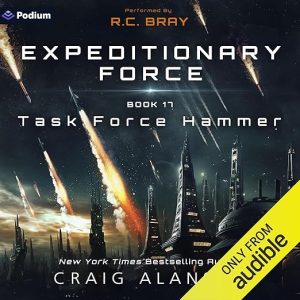
The victory party never happened, which is where this audiobook picks up. The Merry Band of Pirates stopped the enemy from stealing a Sentinel and destroyed its Elder starship, and instead of celebrating they are working out that the enemy was never the thing they believed it to be. It is considerably worse. Nobody has a plan for fighting it, or grounds for thinking a fight is even possible, and the one certainty is that the Pirates cannot do this alone.
The Review
Mariusz (February 2026, five stars) gives the clearest account of what a seventeenth volume still offers: full investment in the chaotic partnership between Joe and Skippy, an affection for Skippy dating back to Columbus Day, and a mix of tense strategy, sharp exchanges and a crew facing something a long way beyond its competence. That entry also flags being genuinely caught off guard by the ending, which is worth filing away.
Podium Audio credits R.C. Bray with the reading, on a September 2024 release running twenty-two hours and nine minutes. That is a long recording by any measure, and long even by the standards of a series that does not do short books. Series listeners will read that number as value; anyone weighing a first purchase should read it as the size of the commitment being asked.
A seventeenth book has to justify itself, and this one manages it. The premise resets the antagonist rather than escalating the same one, since the enemy turns out to be misidentified rather than merely underestimated. That is a harder trick than adding another fleet, and it gives a long-running series a genuine reason to keep going rather than a habit of doing so. It also raises the price of admission, since the reveal only means something to a listener who spent sixteen volumes believing the earlier version.
Why Task Force Hammer Works as an Audiobook
GlueFactoryBJJ, writing in June 2025, calls this both the best and the most tragic cliffhanger volume of the series, describes the Outsider trying repeatedly and unsuccessfully to kill Skippy until it very nearly succeeds, and rates the central operation as the most dynamic mission the Pirates have ever run, simultaneously their most successful and their worst. For a series this deep in, that is an unusually strong report.
Joe and Skippy remain the engine. Expeditionary Force works because a soldier of limited patience and an ancient intelligence of unlimited ego have to keep saving each other, and seventeen volumes have not exhausted the friction between them. Comic banter is also the material that benefits most from being heard rather than read, since timing does the work that punctuation attempts on a page.
Value is the other consideration, in a genre where nine-hour installments are common and this one runs more than twice that. Military science fiction of this kind lives on operational detail, briefings, contingencies and things going wrong at the worst moment, and the length gives all of that room to be built rather than summarized. A listener gets a full campaign rather than a single engagement, and the pacing has space to slow down between crises without the book feeling like it has stalled.
Resetting the stakes is the last of the reasons to commit. A series that has spent sixteen volumes teaching you the shape of its threat now says the shape was wrong, which retroactively changes what earlier books meant. Whether that is a thrill or a frustration depends on the listener, but nobody can accuse this installment of running the same play again. Long series usually fail by repetition rather than by exhaustion, and a mid-run reveal of this size is the cheapest insurance against that.
The Caveats
Kat (October 2024, four stars) delivers the sharpest criticism on the page, and it is about craft rather than plot. That entry credits Alanson with getting steadily better at building plots that pull a reader forward and confirms the humor survives, including a recurring line about rotten kitties, while objecting that commas are deployed almost at random, often stringing together two or three ungrammatical run-on sentences.
That objection is the interesting one for a buyer choosing a format, because punctuation is exactly the class of complaint that changes character when a performer handles the sentences. No response on this page comments on the reading in any way, so how those run-ons land aloud is the one thing the listing cannot tell you. A sample is worth more here than it would be on most titles, and a purchase this size should not rest on a plot summary alone.
The rating display is broken and should be ignored. The page shows 4.7 stars from two ratings while five signed responses sit directly beneath it, four of them at the top of the scale and one at four stars, averaging 4.8 between them rather than the figure on display. A counter reporting fewer ratings than the reviews it is displaying is a catalog fault, and it makes the headline figure meaningless as a signal either way.
Then the ending, flagged above and worth restating as a purchase decision. It is a long walk to a door that stays shut, and anyone who dislikes waiting between volumes should factor that in before starting rather than discovering it at hour twenty-one. Nothing in the publisher's copy signals it either, since the description stops on the problem rather than on the shape of the answer.
Should You Listen to Task Force Hammer?
Newcomers have no business here, and the description makes no attempt to accommodate them; it opens on a Sentinel and an Elder starship as though you were in the room. Readers who need clean prose will find the objection above applies at book length. Anyone who cannot tolerate an unresolved ending should wait for the next installment before beginning this one. Listeners looking for hard science fiction of the rigorous sort should also note that this series runs on personality and improvisation rather than on physics.
Its audience is obvious and large: listeners who have followed Joe and Skippy through sixteen previous volumes and want to know what the Outsider actually is. Greg Thompson (February 2026) sums up that constituency in a sentence, having enjoyed every book in the series so far. Newer converts who binged their way here quickly are equally well served, since the escalation lands hardest on recent memory.
Twenty-two hours ending on a locked door is the deal on the table, and listeners seventeen volumes deep already know whether they will take it.
At a Glance
- Read by: R.C. Bray holds the Podium Audio credit for volume seventeen, and that credit is all the production detail this page carries.
- At its heart: a misidentified enemy, an alliance the Pirates cannot avoid, comic partnership under pressure, escalation that rewrites earlier books
- Vibe: Wisecracking and increasingly grim, with dread underneath the banter
- Short version: A strong seventeenth volume for committed series listeners, and completely impenetrable for anybody else.