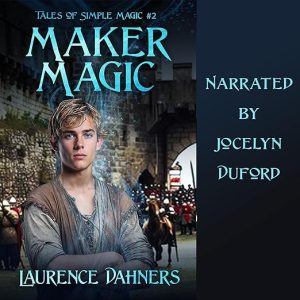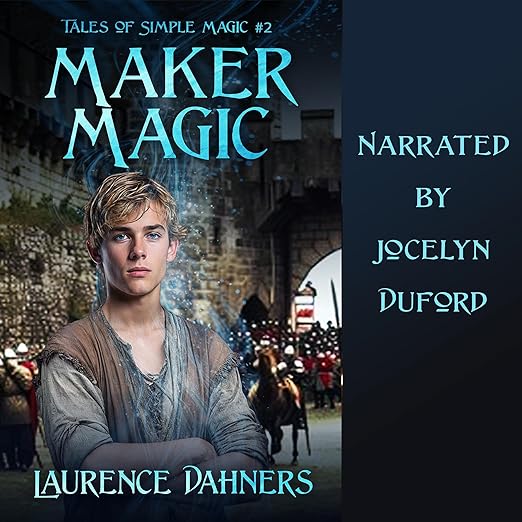
Certain magic systems earn their keeping not through spectacle but through specificity, and Maker Magic, the second audiobook in Laurence Dahners's Tales of Simple Magic series, builds on a premise that could easily have settled for charm and cozy atmosphere but keeps finding ways to make its magic feel genuinely consequential. Narrated by Jocelyn Duford across 8 hours and 33 minutes, the book follows Ky Vaux, a peasant boy from a poor family in a horse-powered world where magical ability is rare. His capacity to mend, make, and heal is not just personally significant. It is the economic foundation supporting his mother, his sister, and his extended family.
The Review
This second installment picks up Ky's story as he enters Cloet Mage Academy, giving the continuation the classic apprenticeship structure that the first book's more isolated setting did not fully provide. Academy settings in fantasy carry their own narrative logic: new peers, new challenges to existing skill, new institutional knowledge that reframes what the protagonist thought they understood. Dahners uses the academy context well, not as a prestige institution that validates Ky but as an environment where his practical approach to magic, rooted in supporting his family and helping those around him, encounters both new opportunity and genuine conflict.
The conflict with a sadistic noble, referenced in the synopsis, gives the book moral stakes that a purely cozy narrative would lack. Ky's desire to help poor children of the city and to protect people being harmed by someone with power is the kind of ethical engine that distinguishes this series from comfort reads that ask nothing of their protagonists. Reviewers describe Dahners as an author who takes time to model how to treat people fairly, which is an unusual compliment for fantasy fiction but points at something real in how the books are constructed. The magic system reflects the protagonist's values, and those values are tested rather than simply celebrated across the runtime.
One reviewer goes so far as to say Maker Magic is even better than the first book, which is the kind of second-installment compliment that suggests Dahners found his footing more completely in the continuation than in the original setup. The expanded cast, the academy setting, and the raised stakes all contribute to a sense that the series has hit its stride.
The Best Parts of Maker Magic
Jocelyn Duford's narration is central to why the audiobook format works particularly well for this series. The cozy slice-of-life pacing requires a narrator who can make the quotidian feel interesting without artificially inflating every moment into drama. Duford achieves this by keeping her delivery warm and curious, matching Ky's own intellectual enthusiasm for discovering new applications of his gift. When the narrative introduces genuine tension through the noble antagonist subplot, she adjusts without overcorrecting into thriller register. The book stays tonally coherent across both its comfort and its conflict, which is a harder balance to strike than it might appear.
At 8 hours and 33 minutes, the runtime gives the story enough space to develop at the pace it earns. Unlike some cozy fantasy entries that pad their length with repeated domestic scenes, this installment uses its runtime to add complexity to the magic system, introduce new characters who matter to the plot, and develop the ethical stakes of Ky's growing power. The addition of the academy context expands the social world around Ky in ways that make the series feel larger without abandoning the intimate family-focused core that gave the first book its appeal.
The Caveats
This is a series book, and the second installment assumes you have read or listened to the first. Ky's family relationships, his established skill level, and the social context of how magic functions in this world are all carried forward without substantial recapping. Listeners who start here without prior context will miss the emotional weight of Ky's development: the specific way his power has grown, the relationships he has built, and what the academy represents as a step forward from his origins. The Tales of Simple Magic series rewards sequential listening and does not function as a collection of standalones.
The series also occupies a specific niche within fantasy: it is not high-stakes epic fantasy, not LitRPG with progression mechanics, and not grimdark. Readers who came to cozy fantasy through a different subgenre and expect either strong romantic elements or cultivation-style power escalation will find the series's approach to magic and conflict understated by those standards. Dahners is interested in small-scale ethics and craft rather than world-altering power, which is the source of the series' appeal to its audience and its limitation for listeners who want different things from the fantasy genre.
The ethical dimension of Ky's magic practice is worth dwelling on because it is what distinguishes Dahners's approach from the majority of fantasy series published in the cozy and progression subgenres. Ky's power grows through application and understanding rather than through leveling or training montages, and the choices he makes about how to use that power are consistently framed as moral choices rather than strategic ones. When he decides to help the poor children of the city or to confront the sadistic noble, the question the narrative poses is not whether he can do it but whether it is right to do it and what the cost of doing it will be. That moral framing is the series' distinguishing characteristic and the reason the reviews consistently mention fairness and ethical treatment as the books' core appeal.
Who Should Listen to Maker Magic
Listeners who completed the first Tales of Simple Magic audiobook and responded to its combination of practical magic, family warmth, and ethical stakes will find this second installment a satisfying and expanded continuation. Fans of cozy fantasy who appreciate moral weight without graphic violence or romantically charged plots will find Dahners's world well-calibrated to that preference. Duford's narration is an asset throughout, and the audiobook format suits the series' meditative pacing particularly well for long listening sessions. New listeners should start with book one before attempting Maker Magic. The setup and character history from the first installment are necessary for the second to land with its full emotional effect.
Before You Press Play
- Read by: Jocelyn Duford brings warmth and forward momentum to Ky's story, handling the cozy slice-of-life pacing without losing the underlying tension when the narrative raises genuine stakes.
- At its heart: Magic as craft and care rather than combat, class mobility through skill, the ethics of power and protection
- Vibe: Cozy and expansive, with a moral seriousness that earns its warmth
- Short version: Maker Magic deepens everything the first Tales of Simple Magic book established. Ky's world grows more complex as his power grows, and Duford's narration keeps the 8-hour journey consistently engaging.
Do I need to have listened to the first Tales of Simple Magic audiobook before starting Maker Magic?
Yes. Maker Magic is the second installment in a series that carries significant character history and world context from book one. Ky's family relationships, his established magical abilities, and the social mechanics of the world are assumed knowledge rather than re-established in this installment. Starting here without book one will leave meaningful gaps in your engagement.
Is the Maker Magic audiobook appropriate for younger listeners, or is it primarily adult fantasy?
The series features a young protagonist, practical magic focused on healing and craft, family relationships as central emotional stakes, and conflict that does not involve graphic violence. The ethical themes are accessible to younger readers without being condescending. Adult fantasy readers who enjoy cozy, character-driven work will also find the series engaging and genuinely well-crafted.
How does the magic system in this audiobook compare to power-progression systems popular in LitRPG fantasy?
The Tales of Simple Magic system is about craft mastery and ethical use rather than numerical progression. Ky does not gain power levels or skill trees. He deepens his understanding of what his innate gift can accomplish through practice and problem-solving. Listeners who prefer the satisfaction of measurable progression mechanics will find this system more organic and less systematized than LitRPG conventions.