Quick Take
- Narration: Andrea Parsneau handles The Wandering Inn’s enormous cast and emotional range with a consistency that makes 37-plus hours feel coherent rather than exhausting.
- Themes: Displacement and belonging, the politics of survival, emotional consequence in a fantasy world
- Mood: Expansive and emotionally ambitious, alternating between heartbreak and warmth
- Verdict: The installment where many readers fully commit to this series; the Laken Godart introduction alone justifies the runtime.
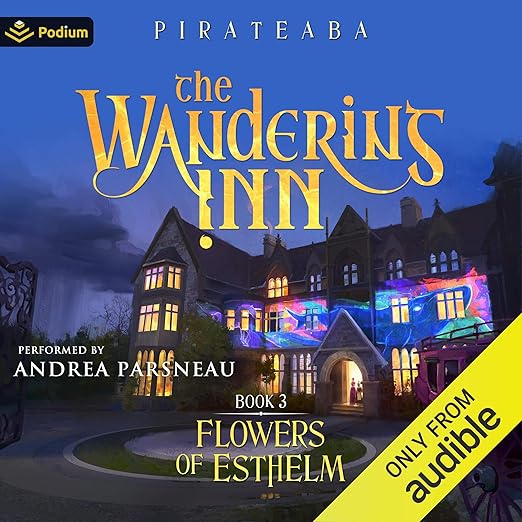
I spent part of a rainy weekend with Flowers of Esthelm, which is exactly the right conditions for a book described by listeners as beautiful and exhilarating and heartbreaking all in one. The Wandering Inn is one of those series that generates the kind of reader loyalty usually reserved for long-running television: people who have made it to book three are not casual fans. They have already absorbed two prior volumes of pirateaba’s extraordinary web serial, learned the rhythms of Izril’s magic and class system, and arrived at this installment prepared for their investment to be rewarded or tested.
Book three covers a wide geographic and emotional range. Erin is in Celum, separated from her inn, surrounded by familiar human faces but not quite home. Lyonette is squatting in Erin’s inn with unclear intentions. The Goblin Lord’s threat is expanding across the region, with the Redfang and Floodplains tribes navigating a complex alliance against a common enemy while disagreeing on fundamental strategies. And then there is Laken Godart, who arrives as a young man lost like all the others, except that he is naturally blind, and the world of Izril does not make accommodations for him. The winter settles over all of this with only snow, Goblins, magic, and iambic pentameter to mark the season.
Our Take on Laken Godart as a Series Addition
The introduction of Laken is what book three is remembered for by the readers who felt it pulled them fully into the series. One listener wrote that this installment pulled them in completely, naming Laken as easily their new favorite character. Another described his introduction chapters as captivating. These are not generic assessments. Laken navigating a fantasy world without sight, finding unexpected avenues of power and connection that do not require vision, is one of the more genuinely original character conceits in recent LitRPG fiction. His storyline carries the iambic pentameter reference in the synopsis, which is not a throwaway detail but a plot-level element that earns its presence.
The Florist storyline, which multiple reviewers singled out as heartbreaking, operates as a counterpoint to Laken’s quieter hope. Two out of the first three volumes had brought one reviewer to tears at specific moments, and the Florist material appears to be where this volume earns that response. pirateaba has a capacity for emotional consequence that is genuinely unusual in a genre more commonly associated with power scaling and stat optimization.
Why Listen to Andrea Parsneau Navigate This Scope
Parsneau narrates both this series and Azarinth Healer, and she is the right choice for long-form LitRPG with emotional ambition. The Wandering Inn’s cast is genuinely large, the POV shifts are frequent, and the tonal range runs from cozy inn-keeper comedy to genuine tragedy within the same volume. At thirty-seven hours, the narrator’s ability to maintain coherence across that range is not a minor consideration. Parsneau does it. The Goblin sections in particular, which could easily feel like separate books, benefit from her consistent approach to the non-human cast.
What to Watch For in the Goblin Tribe Politics
The Redfang and Floodplains tribes’ alliance against the Goblin Lord is among the more surprising narrative choices in this volume, because pirateaba asks the reader to hold complex sympathy for Goblin characters who are not straightforwardly heroic. The disagreements between the Chieftains carry genuine political weight. This is the section where the series’ moral seriousness is most evident, and where the emotional investment built through two prior books pays dividends that a new listener simply could not access without that foundation.
Who Should Listen to Flowers of Esthelm
Begin with book one. The Wandering Inn’s world is too specifically built and Erin’s relationships too carefully established for book three to function without that foundation. For readers already in the series who found books one and two engaging but not yet compulsive, book three is commonly identified as the tipping point. The Laken introduction and the Florist storyline represent pirateaba operating at peak emotional ambition, and Parsneau’s narration gives both the space they need to land.
Frequently Asked Questions
Is Laken Godart’s blindness handled with care in the audiobook format, or does it create any narration awkwardness?
Parsneau narrates Laken’s perspective with the same first-person clarity she brings to other POV characters. The audiobook format actually suits a blind character well in some respects, since the sensory detail in his chapters is primarily non-visual.
What is the Florist storyline, and why do reviewers find it so affecting?
The Florist appears to be a character introduced in book three whose story operates as an emotionally serious counterpoint to the broader adventure narrative. Reviewers describe it as heartbreaking without providing significant spoilers, suggesting it carries genuine consequence for a character the reader comes to care about.
Does the iambic pentameter reference in the synopsis indicate the book has poetry or is it a joke?
pirateaba has been known to use literary forms as plot elements within the series. The iambic pentameter reference appears to function as a genuine story detail rather than purely a comic aside, though the full context is best discovered within the text.
How does the pacing of book three compare to books one and two for listeners who found earlier volumes slow?
Reviewers describe book three as the entry point where the series pulled them in completely, suggesting the pacing tightens or the emotional investment accumulates sufficiently to make the runtime feel earned. Some filler elements noted in earlier volumes appear less prominent here.