In Brief
- Performance: Julian Elfer's controlled, authoritative delivery suits de Waal's hybrid of political analysis and on-the-ground reporting, maintaining clarity through complex multi-party history.
- What it covers: Ethnic conflict and territorial sovereignty, Soviet collapse and nationalist awakening, international community failure
- Feel: Measured and grave, with the weight of a conflict that shaped a region's entire modern history
- Our call: Thomas de Waal's Nagorny Karabakh study remains the definitive English-language account of a war that most Western listeners know almost nothing about.
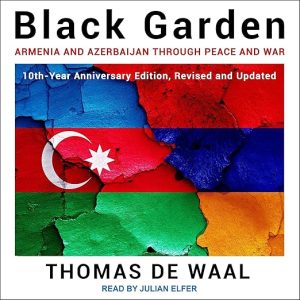
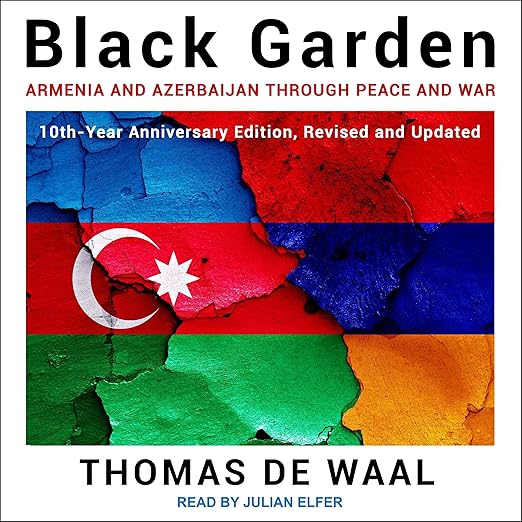
Nagorny Karabakh, the mountainous enclave that triggered one of the most consequential conflicts in post-Soviet history, is the subject of Thomas de Waal's Black Garden, and the audiobook narrated by Julian Elfer represents something genuinely rare: a scrupulously neutral account of a war in which both sides have compelling grievances and neither has clean hands. Since its publication in 2003, this book has become the definitive study in English of how Armenia and Azerbaijan, two southern Soviet republics, were pulled into a conflict that simultaneously accelerated the dissolution of the USSR and established the template for the frozen conflicts that would define the Caucasus for the next three decades.
De Waal brings a journalist's eye and a historian's patience to material that most writers on either side of this conflict would approach with a predetermined conclusion. He conducted more than 120 original interviews across the region, in Moscow and Washington, and worked from Politburo archives that were still inaccessible to most researchers when the book was first written. The audiobook runs thirteen hours and sixteen minutes, and that runtime reflects the scope of what de Waal is actually doing: part contemporary history, part travel writing, part political analysis, all held together by a commitment to showing how complicated a seemingly straightforward territorial dispute can actually be.
Neither Side Gets Cast as Hero or Villain
The book's structural honesty is its most valuable quality. De Waal does not identify heroes or villains in the conventional sense. Both Armenian and Azerbaijani communities experienced genuine atrocities; both governments exercised power in ways that made resolution harder; both international actors, including a Politburo that proved completely unable to manage the crisis when it first emerged in 1988, failed the people living inside the conflict. One reviewer described the book as presenting clear facts for both sides while stressing the humanitarian issues, which is an accurate characterization of de Waal's method but undersells the sophistication of his historiography.
The historical chapters, which trace how the conflict lay unresolved through the Soviet era before Armenian and Azerbaijani civil societies unfroze it, are among the audiobook's most illuminating sections. De Waal reconstructs the specific moments when escalation became likely, then inevitable, with the care of someone who understands that conflicts of this kind are not natural eruptions but constructed events. The Politburo's failure to cope with the crisis is detailed with a specificity that makes that failure comprehensible rather than simply attributable to Soviet incompetence.
Elfer's Restraint Serves Analysis and Testimony Alike
Elfer's narration is steady and precise throughout the 13-plus-hour runtime. This kind of material requires a reader who can move between analytical passages and reported testimony without signaling the transition through vocal theatrics. Elfer's approach is journalistic in the best sense: the material carries itself, and his job is to deliver it without imposing an interpretive layer that the author hasn't asked for. That restraint is the correct choice for a book whose entire intellectual value rests on its refusal to editorialize.
The travel-writing dimension of the book is where de Waal's prose becomes most vivid, and Elfer's delivery in those sections has a different quality than the analytical passages. The south Caucasus landscape, the specific character of Armenian and Azerbaijani cities and villages in the early 2000s, and the human texture of communities still living inside the conflict's unresolved aftermath are rendered with enough detail to make the abstract political history feel inhabited. Reviewer E. Alvarado described the book as depressing but fascinating, which captures exactly the emotional register the audiobook sustains.
Archives Reveal What the Politburo Knew, and When
The book's original publication date of 2003 means that listeners should come equipped with awareness of subsequent developments in the Nagorny Karabakh situation, particularly the 2020 war that fundamentally altered the territorial status quo and the 2023 developments that effectively ended Armenian control of the enclave. De Waal's account remains indispensable for understanding the historical and political roots of those events, but it does not describe them. Listeners who want the full contemporary picture will need to pair this audiobook with more recent reporting.
The account of the mysterious disappearance of Camilo Cienfuegos, that's in a different book; in this one, the equivalent moment of singular revelation is the reconstruction of specific events from Politburo archives that had not previously been available to researchers. Those archival passages, where de Waal can show precisely what Soviet leadership knew and when, are among the most damning and fascinating sections of the entire work. For listeners interested in how imperial bureaucracies fail when confronted with ethnic nationalism, this audiobook is a case study of unusual depth.
Caucasus Scholars Call This the Unbiased Standard
This audiobook is essential for anyone trying to understand the post-Soviet space, the mechanics of frozen conflicts, or the specific tragedy of the Caucasus region. It's relevant for listeners following contemporary geopolitics in Eastern Europe and Central Asia, for scholars of nationalism and ethnic conflict, and for anyone who has encountered recent news about Armenia and Azerbaijan without the historical foundation to make sense of what they're reading.
Listeners who need an emotionally engaging narrative with clearly delineated protagonists will find de Waal's rigorous neutrality demanding. This is not a book with heroes and a resolution; it's a book about a conflict that produced mostly suffering on multiple sides and remains unresolved in fundamental ways. The reward is a depth of understanding that no shorter or more partial account can provide. At 4.4 stars across 29 reviews, with multiple reviewers describing it as the only genuinely unbiased treatment available, the audiobook's reputation is well earned. For listeners who want to understand why the Caucasus continues to generate crises that the international community struggles to address, de Waal's thirteen hours of careful analysis and on-the-ground testimony provide exactly the grounding they need. The combination of archival depth and travel-narrative texture makes this audiobook unlike any other available treatment of this conflict in English.
Questions Listeners Ask
Does this audiobook require prior knowledge of the Soviet Union or Caucasus history to follow?
Some basic familiarity with Soviet history helps, but de Waal constructs his account carefully enough that listeners without specialist knowledge can follow the historical narrative. He explains the relevant Soviet institutional context as he goes. Familiarity with the geography of the Caucasus region is useful but not required.
Is this audiobook's account of the Nagorny Karabakh conflict still accurate given events after 2003?
De Waal's historical reconstruction through the 1988-1994 conflict period remains authoritative and has not been superseded by subsequent scholarship. However, the audiobook does not cover the 2020 war or the 2023 dissolution of Armenian control over the enclave. Listeners wanting the full picture should pair this with more recent journalistic sources on those developments.
Is Black Garden the audiobook genuinely neutral between Armenia and Azerbaijan, or does it favor one side?
Multiple reviewers, including those from the region, describe de Waal's neutrality as genuine and exceptional. He presents evidence of atrocities and political failures on both sides with equal specificity. Reviewer JT noted that the book couldn't be enjoyed because it contains war stories no one wants to live through, which is as accurate an assessment of the book's emotional weight as any.