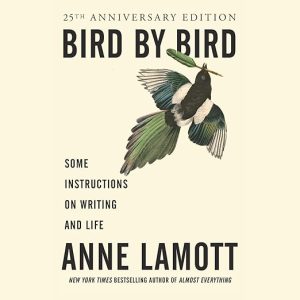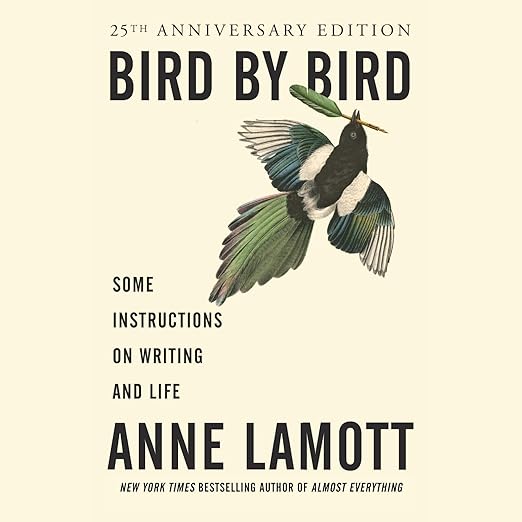
Anne Lamott's older brother once had three months to write a school report on birds and used exactly none of that time until the night before it was due, paralyzed at the kitchen table by 'the hugeness of the task ahead.' The Bird by Bird audiobook opens with their father's advice, take it bird by bird, buddy, and spends the next six and a half hours proving that one small piece of parental wisdom is really a complete philosophy of writing. Lamott narrates her own quarter-century-old classic, and that detail alone shapes everything else about how this book works in audio.
Lamott the Corner-Man, Preparing You for Hits
For a book routinely called one of the best writing guides ever written, Bird by Bird is remarkably light on craft mechanics. Lamott spends far more time on the psychological wreckage of trying to write, envy, perfectionism, the terror of the blank page, than on plot structure or sentence-level technique. The book's most famous chapter gives away the whole method: write badly on purpose, then revise, because waiting for a clean first draft is how most writing projects die before they're born. Reviewer Lisa calls it 'Anne Lamott's love song to the writing process,' which is a more accurate description than 'writing guide' for what the book actually does.
Reviewer Ken Goldstein makes an unusual comparison that turns out to be exactly right: Lamott is 'not a cheerleader,' he writes, more like a corner-man in a boxing ring who knows the fighter is going to get hit hard and prepares him for it rather than pretending otherwise. That's the register of the whole book. Lamott doesn't promise that writing gets easier or that publication solves anything; she's explicit that the real reward is the discipline itself, the practice of paying close enough attention to the world to write a true paragraph about it. Reviewer Morgan's account of being assigned the book in school and resenting it, only to be won over by the book's famous 'Shitty First Drafts' chapter specifically, is the most honest testimonial in the whole review set.
Bird by Bird arrived in 1994, sandwiched between Operating Instructions, her memoir of her son's first year, and Traveling Mercies, the essay collection that would make her a fixture of spiritual-but-not-religious nonfiction. The same confessional, self-implicating voice runs through all three books; Lamott has never pretended to have solved her own anxiety or ego, and Bird by Bird's writing advice works specifically because it's delivered by someone still visibly wrestling with the same jealousy and self-doubt she's describing, not a guru dispensing wisdom from above the fray.
Even the book's structure mirrors its argument: short, loosely connected chapters rather than a tight linear syllabus, which mimics how creative work actually gets made, in fragments, false starts, and accumulated small insights rather than one clean continuous line.
Her Real Voice Is Message and Medium
This is the rare audiobook where the narration decision isn't really a choice at all. Lamott's advice throughout is about finding and trusting your own voice on the page, and having her read it aloud makes that argument physically audible rather than just theoretical. A polished professional narrator would smooth over exactly the qualities, the digressions, the self-deprecating asides, the moments where she seems to be thinking in real time, that make Lamott's prose distinctive in the first place. Her real voice, imperfect pacing and all, is doing double duty as both the medium and the message.
Six and a half hours is a substantial commitment for a craft book, but Bird by Bird earns it by reading more like memoir-with-lessons than like a structured course. Listeners who've enjoyed Stephen King's On Writing or Natalie Goldberg's Writing Down the Bones will recognize the genre: personal history braided with permission-giving advice, more interested in getting you to sit down and write than in teaching you plot architecture. For a book pushing thirty years old, the voice still sounds current, less because the writing advice itself is revolutionary and more because Lamott's specific brand of self-aware, funny honesty about failure hasn't aged the way more technical writing guides often do.
Author-narrated craft books have a mixed track record in audio; a writer's insight doesn't automatically make them a compelling narrator. Lamott is one of the clearer success cases, in the same company as Stephen King reading portions of On Writing, where the specific, personal nature of the advice benefits directly from hearing it in the author's actual cadence rather than a neutral professional read.
An Unpolished Halting Quality by Design
Anyone hoping for a technical writing manual, chapters on three-act structure, dialogue tags, point of view, should recalibrate expectations immediately; Bird by Bird is far more interested in the writer's interior life than in craft mechanics, and readers looking for the latter will need a different, more prescriptive book alongside it. Some of the pop-culture references and publishing-industry commentary date the book to the early 1990s in ways a listener will notice, even though the twenty-fifth anniversary framing suggests a fully current text.
Lamott's narration, being a real author reading her own decades-old work rather than a trained voice performer, has an unpolished, occasionally halting quality that some listeners may need a chapter or two to adjust to. It suits the material, per the standing case for self-narration, but listeners used to the smoother, more produced pacing of professional audiobook narrators should know this sounds more like a gifted friend reading aloud than a studio performance. Reviewer Morgan's initial resistance to the book, being assigned it and resenting the assignment, is also worth flagging honestly: this can feel preachy or over-earnest to a reader not already motivated to write, before it wins them over.
Lamott's Christian faith surfaces at points throughout the book, mostly in passing rather than as an organizing framework, and secular listeners generally report it doesn't get in the way of the writing advice itself. Still, anyone particularly averse to any spiritual language at all in their nonfiction should know it appears here occasionally, woven into her broader observations about humility and surrender rather than presented as doctrine.
Anyone Afraid to Make Something Badly
Aspiring writers stuck in perfectionism or early-draft paralysis are the obvious audience, but the book's real reach is wider: anyone who has ever wanted to make something and been stopped by fear of doing it badly will find Lamott's permission-giving voice genuinely useful, not just writers specifically.
Readers after a structured, technique-first writing course, or anyone allergic to memoir-adjacent digression and personal essay, should look elsewhere first; Bird by Bird rewards patience with Lamott's voice and won't satisfy someone wanting a fast, prescriptive how-to.
Key Details
- Narration: Anne Lamott reads her own book, and the imperfect, unhurried honesty of her voice is inseparable from the material itself.
- Themes: writing as spiritual practice, perfectionism and creative fear, craft as permission-giving
- Mood: Funny, self-deprecating, occasionally moving
- Verdict: A genre-defining audiobook for anyone stuck in early-draft paralysis, though it teaches almost no technical craft.
Does the Bird by Bird audiobook teach specific writing techniques like plot or dialogue?
Not really. The book focuses on the psychological obstacles to writing, fear, perfectionism, envy, more than on technical craft mechanics.
Why does Anne Lamott narrate the Bird by Bird audiobook herself instead of using a professional narrator?
Her own unpolished, direct voice reflects the book's core argument about writing in your authentic individual voice rather than a studio-smoothed one.
Is the Bird by Bird audiobook the original edition or the twenty-fifth anniversary edition?
This is the twenty-fifth anniversary edition of Lamott's original book.