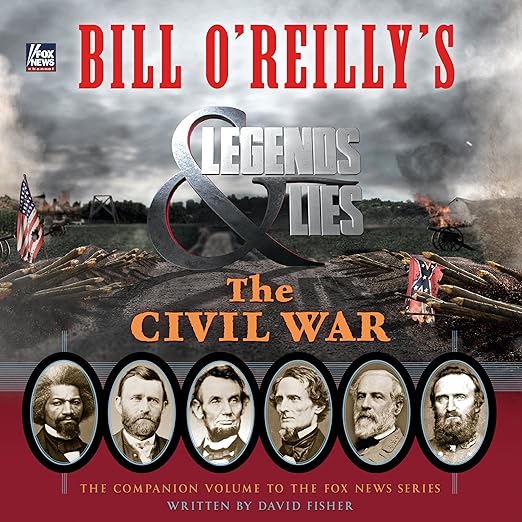
The Legends and Lies series has a clear mandate: take historical mythology, peel it back, and show the more complicated human story underneath. Bill O'Reilly's Legends and Lies: The Civil War is the audiobook adaptation of that approach applied to America's most consequential internal conflict, written by David Fisher and narrated by Robert Petkoff. At 10 hours and 32 minutes, it moves with the episodic momentum of the Fox docudrama series it companions, hitting the Underground Railroad, the Battle of Gettysburg, the Emancipation Proclamation, and Lincoln's assassination in a narrative register that prioritizes accessibility over academic depth.
Robert Petkoff is one of the more reliable voices in popular-history audio, and his work here is well-suited to the material. He handles the roster of figures, Abraham Lincoln, Robert E. Lee, Harriet Tubman, Frederick Douglass, Ulysses S. Grant, Jefferson Davis, Stonewall Jackson, John Wilkes Booth, and William Tecumseh Sherman, with enough distinction to keep them separate without tipping into caricature. The eyewitness accounts, which the book uses to bring specific moments to life, gain considerable power from his delivery.
Is Bill O'Reilly's Legends and Lies: The Civil War Worth Your Time?
Fisher's writing functions as popular history with a structural debt to journalism: short chapters, vivid set pieces, and a persistent focus on individual decision-making over structural analysis. The book's thesis, that the Civil War sought to fulfill the promise that all men are created equal while simultaneously decimating a generation and ushering in modern warfare, is stated plainly rather than argued at length. That's appropriate to the format. This isn't an interpretive academic history. It's a narrative survey that sweeps from the birth of the Republican Party to the Confederacy's first convention to Reconstruction's opening conditions.
What distinguishes it from a general Civil War survey is the consistent attention to lesser-known stories adjacent to the famous ones. John Singleton Mosby, the Confederate guerrilla commander often called the Gray Ghost, gets real attention. The Underground Railroad's operational complexity surfaces in ways that go beyond the broad strokes most listeners will already know. One reviewer specifically praises the human element the book brings to its figures, and that quality does come through in audio format, where Petkoff's delivery of individual voices and quotations gives the historical distance some immediacy. Another reviewer describes the account as emotionally charged on both sides, which reflects Fisher's consistent effort to render the war's participants as people making choices under pressure rather than as historical symbols.
The Best Parts of Bill O'Reilly's Legends and Lies: The Civil War
The audiobook format amplifies what this series does best. Petkoff's narration keeps the pace high enough that the episodic structure feels like a strength rather than a limitation. At 10 hours, it's substantial enough to give real coverage to the war's arc but concise enough to avoid the encyclopedic density that makes some Civil War audiobooks difficult to sustain. For listeners who have seen the docudrama series, this audio companion adds narrative depth and the eyewitness accounts that visual formats necessarily compress.
Listeners who haven't seen the show will also find this fully accessible. Fisher establishes context before each major figure and event, so the audiobook doesn't require prior familiarity with the Legends and Lies format. The scope covers both sides of the conflict with attention to the ideological stakes, and one reviewer notes specifically that the account feels unbiased, giving equal weight to the human dimensions on both sides of the war. Petkoff's ability to read eyewitness passages with the right amount of gravity, neither dramatizing them into theater nor reading them as flat history, is one of the audio version's clearest advantages over a silent reading of the text.
Before You Commit to Bill O'Reilly's Legends and Lies: The Civil War
The tone and approach are worth calibrating expectations around. This is popular narrative history, not historical scholarship. Listeners who want footnoted analysis, contested interpretations of military strategy, or sustained engagement with the historiographic debates around Reconstruction and its failures will want to supplement this with academic sources. Fisher writes for general audiences, and the framing of legends versus truth occasionally oversimplifies complexity into a cleaner before-and-after reveal than the historical record strictly supports.
The rating here reflects a small sample, just two listed ratings in the provided data. The print version of this series has a broader readership record, so audio-specific judgments are less thoroughly documented. Petkoff's track record across similar popular-history titles, however, is consistently strong, and his work here reflects that pattern.
The book also earns credit for its treatment of Harriet Tubman, who gets coverage that goes well beyond the standard Underground Railroad summary. Fisher tracks the operational specifics of her rescue missions with enough detail to convey what they actually cost and required. Petkoff reads those sections with appropriate gravity, and they stand as some of the strongest passages in the audiobook. The shift from the large-scale battle sequences to the intimate danger of a single extraction mission gives the audiobook a tonal range that prevents it from becoming repetitive.
Should You Listen to Bill O'Reilly's Legends and Lies: The Civil War?
Listeners who enjoy narrative-driven American history at an accessible pace, and who want the major figures of the Civil War rendered as specific humans rather than textbook abstractions, will find strong value here. Fans of the docudrama series will appreciate the audio companion's added depth. History teachers looking for an engaging first introduction to the period for adult learners will find the format and pacing useful in discussion contexts. Listeners seeking scholarly rigor, multiple interpretive perspectives, or extended treatment of Reconstruction and its long aftermath will need to look elsewhere, as this audiobook closes with the war's end rather than tracking its consequences into the following decades.
A Few Questions About Bill O'Reilly's Legends and Lies: The Civil War
Does the Civil War audiobook cover the full war from start to finish, or does it focus on specific episodes?
It covers the full arc, from the formation of the Confederacy and the Republican Party through Gettysburg, the Emancipation Proclamation, and Lincoln's assassination. It's structured episodically around key figures and events rather than as a strict chronological military history.
Is this audiobook connected to the Fox docudrama, and do I need to have seen it first?
The audiobook is the companion to the Legends and Lies TV series but works fully as a standalone. Fisher provides context for all major figures and events, so prior familiarity with the show is not required.
How does Robert Petkoff handle the large cast of historical figures in this audiobook?
Petkoff distinguishes figures through tone and emphasis rather than dramatic character voices, which suits the documentary register. He handles the eyewitness accounts with particular effectiveness, giving those passages the immediacy they need.
Does this audiobook address both the Union and Confederate perspectives, or does it favor one side?
Reviewers describe the account as balanced in its treatment of the human dimensions on both sides. The book is clearly anti-slavery in its framing of the war's central cause, but it gives emotional weight and specificity to figures on both sides of the conflict.