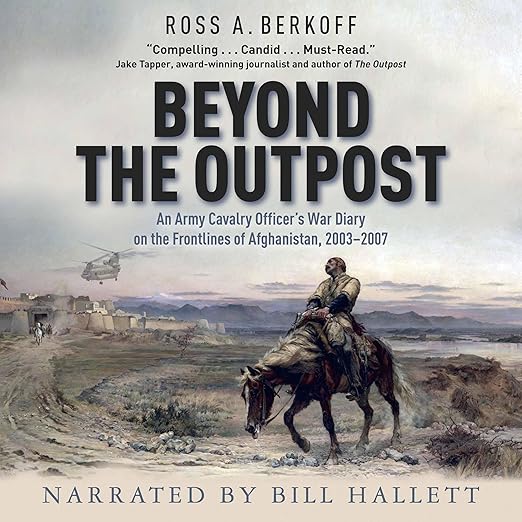
Ross Berkoff's war diary audiobook stands apart from the crowded shelf of Afghanistan memoirs for one specific reason: it is a daily chronicle written in real time, not a retrospective shaped by distance and therapy. That distinction matters more than it might initially seem, and Bill Hallett's narration of Beyond the Outpost earns that distinction by keeping the voice consistently raw and present-tense in feel, even when events are being described weeks after they happened.
The Same Terrain Through Two Different Tours
Berkoff was a Second Lieutenant in the 10th Mountain Division when he led his Scout Platoon on reconnaissance missions across more than ten thousand miles of Kandahar and Helmand provinces beginning in 2003. Those provinces were the birthplace of the Taliban, and the early months of Operation Enduring Freedom's ground phase were marked by the particular uncertainty of an enemy that had dispersed rather than surrendered. He returned in 2006 as a Military Intelligence captain, and by then the Taliban had reorganized with what the book describes as 'grown sophistication and deadly effectiveness.' Both tours are covered here, and the contrast between the 2003 and 2006 deployments is one of the most valuable structural elements of the text. You hear the same terrain through two different layers of experience and two different operational missions.
Reviewer Nick describes this as 'a true daily diary, raw and unfiltered,' and that phrase is accurate in a way that distinguishes Beyond the Outpost from memoirs written years after the fact. The book does not have the polished narrative arc of Sebastian Junger's Restrepo journalism or the retrospective emotional clarity of David Finkel's work. It has something different: the texture of not knowing what comes next, which is the actual experience of deployment and which most war narratives can only approximate.
Hallett Lets the Facts Carry Their Own Weight
Bill Hallett handles the diary format with intelligence. His voice stays in the register of a man in his late twenties writing under pressure, not a narrator performing heroism or tragedy. That calibration is essential for this material. War memoirs that arrive with too much vocal gravitas tend to impose a kind of emotional verdict on events that the reader should be allowed to reach independently. Hallett lets the facts carry their own weight, and in a book where the facts are frequently harrowing, that restraint produces more impact than emphasis would.
Reviewer Marcus Rheinberger writes that the book gives readers 'a powerful glimpse into that reality' through 'detailed journal entries' that convey 'daily intensity, uncertainty, and emotional weight.' That is a fair summary. The operational details are dense enough to satisfy readers with military background, but Berkoff writes with sufficient context that civilian listeners are not left behind. The eight-hour runtime covers a sprawling geography and timeline without feeling padded; the daily entry format creates natural pacing even when the pace of events is slow.
Close to Something Enormous Without Being Able to Reach
Berkoff's perspective is junior-officer throughout, which is both the book's greatest strength and one honest limitation. He documents what he sees, leads, and experiences; he does not have the command-level visibility that would allow him to situate individual missions within the broader strategic picture. Listeners who want a comprehensive account of the U.S. Army's approach to Operation Enduring Freedom in those early years will need supplementary reading. What Berkoff provides instead is granular and irreplaceable: the platoon-level experience of soldiers in territory where the enemy was learning to fight back in real time.
Reviewer Matt notes that the book is 'a must-read for young officers and leaders,' and that framing is accurate for the book's primary practical audience. But the human stakes of Berkoff's chronicle extend well beyond a professional military readership. The 2006 deployment, where he supported intelligence pursuits near the Pakistani border during the period when Osama bin Laden was still being actively hunted, gives the book a historical dimension that makes it genuinely essential reading for anyone trying to understand how the Afghanistan campaign evolved between 2001 and its eventual conclusion twenty years later.
The 10th Mountain Division, which appears in both of Berkoff's deployments, carries its own historical weight in American military culture, and the book makes productive use of that context without leaning on it for unearned prestige. Berkoff writes as a young officer who knew his unit's history and operated within its traditions, but he is more interested in documenting what his specific platoon and intelligence mission experienced than in situating himself within a larger institutional narrative. That restraint keeps the focus on the granular and the specific, which is where war diaries earn their value.
The intelligence dimension of the 2006 deployment adds a layer that distinguishes this volume from the straightforward combat memoir category. Berkoff's work as a Military Intelligence captain, supporting the pursuit of Osama bin Laden near the Pakistani border, gives him a perspective on what was not visible at the platoon level during his 2003 tour. The contrast between operating with incomplete information in 2003 and working specifically to collect and act on information in 2006 is one of the book's most instructive juxtapositions, and it gives the second deployment a different kind of tension from the first: the sense of being close to something enormous without being able to reach it.
The Audiobook Fits a Long Weekend or Commutes
Listeners drawn to first-person military memoir who want the junior-officer perspective on the Afghanistan conflict in its formative years will find Beyond the Outpost essential. Bill Hallett's narration keeps the material grounded without dramatizing it, which is the right call for diary-format nonfiction. Those who prefer retrospective memoirs with more emotional resolution or command-level strategic context will want to pair this with broader accounts of the Afghan campaign. At eight hours, the audiobook is completely manageable for a long weekend or a few commutes, and the daily diary structure means you can step away and return without losing the thread.
A Few Questions About Beyond the Outpost
Does this audiobook require prior knowledge of the Afghanistan conflict to follow?
No. Berkoff provides enough operational context for civilian listeners to follow the missions and timeline. Military readers will find additional layers of detail, but the book is written for a general audience interested in first-person war experience.
How does the audiobook handle the two separate deployments, 2003 and 2006?
Both tours are covered in sequence, and the contrast is one of the book's most valuable structural elements. The 2003 reconnaissance missions and the 2006 Military Intelligence deployment feel distinct in tone and operational context, which gives the listener a genuine sense of how the conflict evolved.
Is Bill Hallett's narration suited to diary-format military memoir?
Yes. Hallett uses a measured delivery that preserves the raw, present-tense quality of daily journal entries without adding theatrical gravity. That restraint is the right choice for material that carries its own weight.
Does Beyond the Outpost cover the strategic picture of the U.S. campaign in Afghanistan, or is it limited to ground-level experience?
It is deliberately ground-level and junior-officer in perspective. Berkoff documents what he sees and leads, not what commanders decided above him. Listeners wanting strategic analysis should supplement this with broader histories of the Afghan campaign.