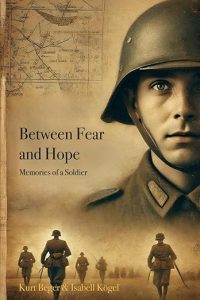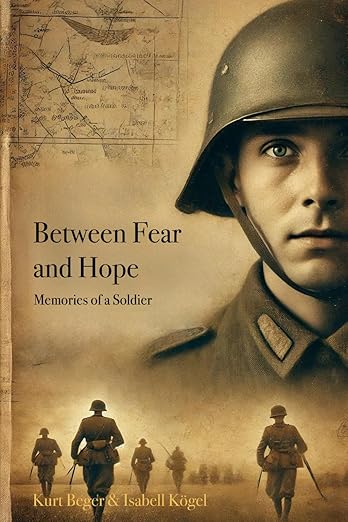
- At its heart: German conscript testimony, Eastern Front survival, memory recovered across generations.
- Vibe: Somber, intimate, reflective.
- Short version: A short, personal wartime testimony worth hearing for its intimacy and anti-heroic honesty, though listeners wanting tactical depth should pair it with denser classics like The Forgotten Soldier.
Framed as Testimony Against Forgetting
In 1942, a seventeen year old German conscript was sent to the Eastern Front's Caucasus Mountains, and eighty years later his granddaughter turned his long-silent account into this audiobook memoir. Between Fear and Hope is framed by its own synopsis as a testimony against forgetting rather than a tale of heroism, the raw, unfiltered account of a young soldier who never wanted to fight a war that consumed his entire generation.
Kurt Beger survived being wounded three times while living each day, by his own account, uncertain whether it would be his last. Like many veterans of his generation, he said almost nothing about the war for decades. Only later in life did he begin writing it down, and it is that writing his granddaughter has now brought into audio.
No Narrator Credited on This Listing
No narrator is credited on this listing, worth flagging directly. For a first-person memoir this intimate, vocal tone and pacing genuinely shape how the material lands, so listeners considering this title should confirm who narrates the audio edition before committing to it.
Family-history recovery projects like this one, a descendant transcribing and publishing a relative's long-unspoken wartime account decades after the fact, have become a recognizable and valuable strand of World War Two publishing generally, often surfacing exactly the kind of ground-level, non-strategic testimony that official histories and more polished memoirs tend to leave out.
The title itself names the book's central emotional tension directly: fear as the daily condition of a teenage soldier who never chose to be there, and hope as whatever kept him alive through three separate wounds and years he was never certain he would survive.
Raw and Unflinching, an Early Reviewer Says
TheAlaxCraft's review calls it a raw and unflinching testimony that draws you straight into the unimaginable reality of a young soldier's life on the Eastern Front in 1942, written with what the reviewer describes as brutal honesty about the fear, horror, and despair faced daily.
The book's real distinguishing angle is its anti-heroic framing. This is not a tactically detailed campaign narrative but a survival account from someone who states plainly he never wanted to be there, wounded three times over the course of a war that, in his own words, destroyed an entire generation before he was old enough to fully understand what he had lost.
The Eastern Front's Caucasus campaign is remembered historically as one of the war's most brutal theaters, marked by extreme cold and staggering casualties on both sides, general historical context that gives Beger's specific account real weight without requiring the book itself to supply the broader military history.
A third reviewer, writing under the name Charlie Chaplin, frames the book as the story of an ordinary young man becoming a soldier he never expected to be, and specifically praises how directly it puts a listener inside what that transformation actually felt like day to day, fear, disorientation, and the daily question of survival, rather than summarizing it from a safe historical distance.
First-person World War Two testimony has become genuinely rarer with each passing year, simply because the generation that lived it has almost entirely passed away, which gives any account like this one, recorded and preserved before it was lost entirely, a real historical urgency beyond its individual literary merits.
Comparatively Light on Tactical Detail
One reviewer, General Brett, compares this directly to The Forgotten Soldier and With the Old Breed and finds it comparatively light on tactical detail, describing it more as an emotional journal than a granular account of combat. That comparison is fair as far as it goes: this is a shorter, more impressionistic personal testimony than either of those dense, tactically detailed classics, not a substitute for them. Treat the difference as a matter of scope and intent rather than a shortfall to apologize for.
The 4.4 rating comes from just 4 ratings total, a genuinely small sample offering limited outside confirmation beyond the handful of full reviews attached to the listing. Weigh that accordingly rather than treating the average as a settled verdict.
No Translator Credit for a German Memoir
At five hours and fifty minutes for a full survival account spanning multiple years and three separate wounds, the pacing is necessarily closer to journal entries than a blow-by-blow campaign history, consistent with General Brett's read of it as an emotional journal rather than tactical narrative.
The listing gives no indication of a translator or original publication language, worth noting for a memoir originating from a German veteran's own writing; listeners who care about translation credit specifically may want to look for that detail before purchasing.
Five hours and fifty minutes is enough for a single sitting on a long drive or a couple of evening listens, a pacing choice that suits the book's own description of itself as testimony rather than comprehensive history, where a much longer runtime might have diluted rather than strengthened the impact.
A Gentle First War Memoir for Newcomers
Listeners interested in personal-testimony-level World War Two history, particularly the German conscript perspective, a considerably less commonly published angle than Allied memoirs, and anyone drawn to family-history or memory-recovery projects generally, will find real value here.
Pair this with The Forgotten Soldier or With the Old Breed if you specifically want dense tactical or operational military history; this audiobook is testimony, not campaign narrative, and works best when you approach it with that distinction already in mind.
The relatively small number of ratings so far also means this is a title still building its audience rather than an established word-of-mouth success, which is worth factoring in alongside the genuine strength of the three detailed reviews already attached to it.
Readers of other Eastern Front memoirs and letters collections will recognize the broader genre this book sits within, even as its specific angle, a very young conscript's unpolished, decades-delayed account, remains distinct from more tactically focused entries in that same category.
Its manageable length also makes it a realistic supplementary text for a history course, a family discussion, or a book club focused on World War Two memory and memoir, in a way that a fifteen or twenty-hour comprehensive campaign history simply is not.
For a listener who has never tried a war memoir before, the shorter, more personal shape of this one arguably makes it a gentler entry point into the genre than a dense, multi-volume campaign history would be, without asking for the same sustained commitment before deciding whether this kind of testimony is for you.
Before You Listen
Is this audiobook narrated by a professional narrator, or is the narrator unspecified?
No narrator is credited on this listing. Given how much vocal tone matters for a first-person memoir this personal, confirm the narrator before committing to the audiobook if that detail matters to you.
Does this audiobook focus on military tactics, or is it more of a personal account?
It is primarily a personal survival account rather than tactical or operational military history. One reviewer specifically describes it as reading more like an emotional journal than a detailed combat narrative.