At a Glance
- Narrator: Cia Court, a Kirkus Earphones Award winner for this title, builds Margo's unraveling with real control, never tipping her hand too early.
- Subjects: Housing-market obsession, unreliable narration, class anxiety played for dark comedy.
- Tone: Breezy and unsettling at once, propulsive despite the satire.
- Bottom line: A well-narrated, funnier-than-advertised debut about obsession, best for listeners who enjoy morally compromised narrators over pure thriller dread.
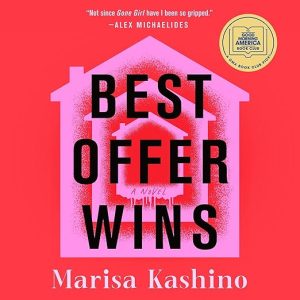
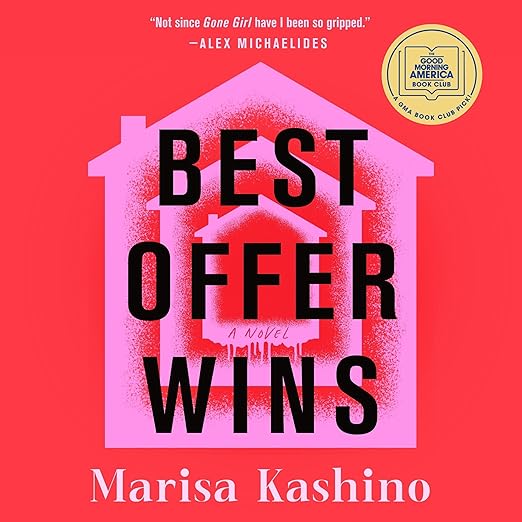
A year and a half of losing one bidding war after another finally breaks something loose in Margo Miyake, a thirty-seven-year-old publicist whose cramped apartment and stalled life plans have made her desperate enough to act the moment she hears about an off-market listing before anyone else does. This audiobook spends eight and a half hours watching exactly what that break looks like. Marisa Kashino's debut novel arrives with two strong signals stacked on the cover: a blurb from Freida McFadden calling it “a clever, twisted, and hilarious thriller” that she “finished it in a day” because she “couldn't stop reading”, and narration from Cia Court, whose work here has already picked up a Kirkus Earphones Award and a Booklist starred review.
Court's Kirkus-Praised Voice Powers Margo's Slow Unraveling
Court earns that attention. Kirkus praised how she “shines in her delivery of Margo's extensive inner monologues, projecting both her humor and desperation,” adding that “as she becomes increasingly single-minded, Court's voice builds on that sinister transformation” right alongside the character. Booklist went further, calling Court “an effusive, dexterous cipher, providing a riotously convincing performance of a desperate woman, and woe to anyone who gets in her way.” Both descriptions match what actually happens on the page: Margo narrates her own escalating behavior with a chatty, self-justifying energy that makes the listener complicit before they realize how far things have gone.
Structurally, this is a first-person unreliable narrator novel dressed up as suburban house-hunting comedy, and Court's control of that voice is the entire engine of the audiobook. A little stalking, a bit of trespassing, infiltrating a family's private life to engineer the perfect off-market deal: each escalation gets delivered with the same breezy, reasonable-sounding cadence as the last, which is exactly how Kashino wants the reader rooting for Margo even while gasping at what she is willing to do. Take away that vocal consistency and the comedy curdles into something far less fun to sit inside.
Kashino's own background as a journalist covering Washington real estate gives the housing-market satire real bite. The specific anxieties driving Margo, the bidding wars, the all-cash offers from buyers with deeper pockets, the sense that an entire life plan is hostage to one listing, will land as painfully familiar to anyone who has house-hunted in a competitive metro market in the last several years, which gives the comedy a foundation of real, recognizable frustration rather than an abstract setup.
Listeners drawn in by the McFadden blurb should recalibrate expectations slightly. That comparison signals a dark domestic thriller, and there is real tension and genuine unease built into Margo's spiral, but the book leans harder into comedy than dread throughout. The publisher's own copy puts it more accurately: “Dark, biting, and laugh-out-loud funny”. This is a satire of class anxiety and real-estate obsession first, with thriller mechanics used mostly in service of the jokes rather than the other way around.
Court Varies Margo's Self-Talk Without Losing Momentum
This production, released under the Macmillan Audio banner in partnership with Celadon Books, gives Court real room to work. Margo's inner monologue carries most of the eight hours, and a lesser narrator could easily make that much unbroken interiority feel exhausting well before the ending. Court instead varies the texture of Margo's self-talk just enough, sliding between wounded, calculating, and genuinely funny within single paragraphs, so the extended runtime plays as immersive rather than draining.
As a debut novel, Best Offer Wins also carries the particular energy of a writer testing exactly how far a premise can stretch before it snaps, and Kashino generally knows where that line sits even when Margo herself does not. The escalation from minor boundary-pushing to genuinely alarming behavior is paced deliberately enough that each new low feels earned rather than arbitrary, which is a harder balance to strike in a debut than the breezy tone might suggest.
Listener reviews split along a predictable line. MaggieJordan calls the book “engrossing from page one,” writing that she “laughed (A LOT), I gasped, and ohhh how I cringed.” A M Van Eaton frames it as “a fun read for anyone who doesn't mind, or enjoys, the slightly hinged behavior” of the main character. Not everyone connected with the pacing, though: reviewer bigW. felt Kashino “used so many unnecessary words, side stories and some never even connected,” calling it ultimately a disappointing use of time despite the strong premise.
Eight Hours Favor Interiority Over Propulsive Plotting
That criticism about padding and side stories is worth taking seriously as a caveat rather than dismissing it. Eight hours and thirty-eight minutes is a substantial commitment for a satire built on one escalating premise, and listeners who prefer tightly plotted thrillers with no digressions may notice the same slack bigW. points to, particularly in the middle stretch before Margo's plan hits its real complications.
It is worth noting that the criticism from bigW. is not an outlier take dismissed by every other reader; it points at a real structural choice Kashino made, prioritizing Margo's voice and interiority over a tightly plotted mystery-thriller pace. Readers who came in expecting propulsive plotting above all else are the ones most likely to feel the digressions bigW. describes, while readers more invested in character and voice tend to experience the same passages as texture rather than padding.
The ending, without spoiling specifics, earns its place in a satire built this carefully around escalation, resisting both an easy redemption arc and a purely punitive comeuppance in favor of something messier and more true to how Margo has been drawn from page one. Readers hoping for a tidy moral lesson may find the resolution more ambivalent than expected, which is consistent with a book more interested in understanding obsession than condemning it outright.
Bidding-War Survivors Will Feel Vindicated by Margo
The Macmillan Audio production values extend beyond Court's individual performance into pacing choices that keep an interiority-heavy novel moving at audiobook speed, with chapter breaks and scene transitions handled cleanly enough that the listening experience never feels like it is fighting the source material's structure. For a book this dependent on one character's unbroken internal voice, that kind of unobtrusive production competence is easy to take for granted and would be immediately noticeable if it were missing.
Readers who enjoy unreliable, morally compromised narrators in the vein of gone-too-far social satire, and anyone who has ever lost a bidding war in an overheated housing market and wanted to feel a little vindicated by fiction, are exactly who Kashino is writing for here, especially listeners who want their dark comedy delivered with genuine narrative tension rather than played strictly for laughs.
A likable, straightforwardly sympathetic protagonist is not really on offer here, and knowing that going in matters: Margo's charm is deliberately double-edged throughout. Readers seeking a straightforward thriller without comic distance from its own premise may also find the tonal mix, and the middle-section digressions bigW. flagged, more frustrating than fun.
Does this audiobook lean more thriller or more comedy?
More comedy, despite the Freida McFadden thriller blurb on the cover. Kashino's own description calls it dark, biting, and laugh-out-loud funny, and the tension serves the satire more than the other way around.
Is Cia Court's narration worth the listen over reading the print edition?
Yes. Her performance won a Kirkus Earphones Award specifically for how she builds Margo's inner monologue and controls the pacing of her descent, an effect that depends on vocal delivery in a way print cannot fully replicate.
Does the audiobook's slower middle section match reviewer complaints about padding?
Some listeners have flagged unnecessary side stories and digressions in the middle stretch, and at eight hours and thirty-eight minutes for a single-premise satire, that criticism is worth weighing before committing to the full runtime.
Do I need to be into true-crime or domestic thrillers to enjoy this audiobook?
Not particularly. It works better for listeners who like unreliable, morally gray narrators and social satire about ambition and class, since the thriller elements mostly support the comedy rather than deliver genuine dread.