Letting Franklin Implicate Himself, on the Record
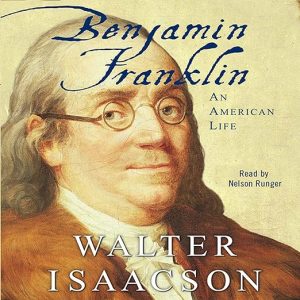
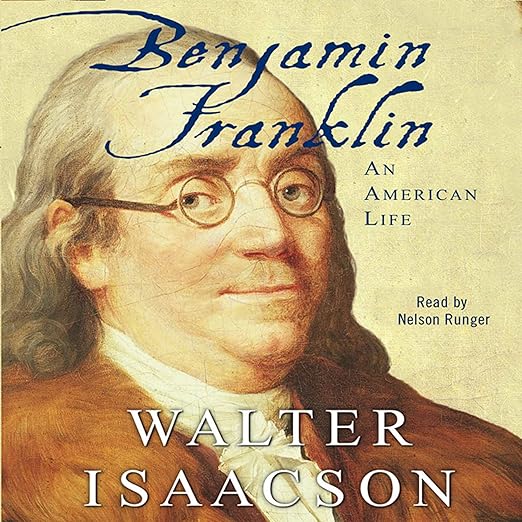
A runaway apprentice named Benjamin Franklin arrived in Philadelphia with almost nothing, and Walter Isaacson spends the next twenty-four hours and forty minutes of this audiobook tracing exactly how that teenager became, by turns, America's most widely read writer, its most inventive scientist, and one of its shrewdest diplomats. Nelson Runger narrates the full sweep, from Boston to Philadelphia to London and Paris and back, in a biography Isaacson built specifically to make Franklin feel like flesh rather than the marble monument later generations turned him into.
Isaacson's research draws on Franklin's own voluminous correspondence and autobiography, and the audiobook benefits from how much of Franklin's own voice, wry, self-aware, occasionally self-serving in his own retelling, survives the transition into Isaacson's narrative frame. Franklin is famously one of the few founders who wrote candidly about his own flaws and youthful mistakes, and Isaacson uses that candor as a structural gift, letting Franklin implicate himself rather than requiring the biographer to do it from the outside.
Snatched Lightning From the Sky, and Tyrants' Scepter
Franklin was once memorialized by a French statesman as the man who snatched lightning from the sky and the scepter from tyrants, and Isaacson's biography spends its considerable length earning that epigram from more angles than most readers expect. The wit behind Poor Richard's Almanac gets its own attention alongside the diplomatic maneuvering that secured France's alliance during the Revolution, the treaty negotiations that ended the war, and the compromises Franklin brokered at the Constitutional Convention.
Isaacson makes an explicit case for Franklin's twenty-first century relevance, arguing that Franklin's comfort with pragmatic compromise, transparency about self-interest, and belief in civic associations, founding libraries, fire departments, and philosophical societies alongside his political work, offers a usable model for a moment when compromise itself has fallen out of fashion. That argument runs underneath the narrative rather than interrupting it, surfacing most clearly in the book's closing assessment of Franklin's legacy.
Runger Favors Momentum Over Academic Distance
Runger's narration suits Isaacson's approach to biography, which favors narrative momentum over academic distance. Franklin's eighty-four years cover an enormous amount of ground, printer's apprentice, scientist, postmaster, diplomat, constitutional framer, and Runger keeps the throughline legible without flattening Isaacson's eye for the telling anecdote or the wry aside. The comic timing in the Poor Richard's Almanac passages gets space to land, while the diplomatic chapters in Paris carry the weight Isaacson clearly intends them to carry.
Readers who know Isaacson from Steve Jobs or Einstein will recognize his recurring interest in figures who moved fluidly between science and a more public, even performative, role in the world, and Franklin fits that pattern more completely than either of those later subjects, having genuinely excelled as scientist, businessman, writer, and statesman rather than primarily one with occasional excursions into the others. Runger's steady delivery keeps that range legible without over-selling any single facet of Franklin's career at the expense of the others.
Isaacson's throughline, that Franklin's practical, compromise-oriented temperament shaped American character as much as any founder's political philosophy did, comes through clearly across the full runtime. The book connects Franklin's scientific curiosity, his business instincts, and his diplomatic patience into a single coherent portrait rather than treating each career as a separate chapter of achievement.
The London years, when Franklin's scientific reputation was built substantially on his lightning and electricity experiments before he ever became a full-time diplomat, get enough space to establish why European elites treated him as a celebrity long before the Revolution made him a household name in his own country. Runger handles these science-heavy passages with the same even clarity he brings to the political material, neither over-explaining the physics nor rushing past it.
Credibility From an Aging, Ailing Franklin
At nearly twenty-five hours, this is a genuine commitment, closer to a full semester of dedicated listening than a weekend project, and Isaacson does not compress the material to make it a faster listen. Readers who want a shorter Franklin biography or a narrower focus on a single period of his life, the printing years, or the diplomatic years in Paris specifically, should know this is the full-scope version covering all eighty-four years in comparable detail.
The Constitutional Convention chapters late in the book carry particular weight, tracing how an aging, ailing Franklin used his accumulated credibility to broker compromises between delegates who trusted almost no one else in the room. Isaacson does not overstate Franklin's influence relative to Madison or Washington, but he makes a convincing case that Franklin's specific talent for finding the workable middle ground shaped the Constitution's final form in ways histories focused only on the more famous framers tend to underplay.
The density stays consistent rather than front-loaded, so listeners avoid a slow middle third to push through, but that same consistency means the audiobook rewards sustained attention more than background listening. A listener who drifts during the diplomatic chapters in Paris may find the compromises and treaty language harder to follow without rewinding, given how many overlapping political figures and interests Isaacson tracks simultaneously.
A Weak Fit for a Single Afternoon
This audiobook suits listeners who already enjoy Isaacson's other biographies, Einstein, Steve Jobs, and want the same narrative biography approach applied to America's founding era, as well as history readers looking for a single-volume Franklin that covers his full life rather than one narrow slice of it.
It is a weaker fit for casual listeners looking for a light introduction or a single afternoon's entertainment, since both the runtime and Isaacson's level of detail assume real commitment from the listener. Anyone who finishes it, though, comes away with a genuinely comprehensive understanding of Franklin across science, diplomacy, business, and politics that shorter biographies tend to compress or skip entirely.
How does Nelson Runger handle the large cast of historical figures in this audiobook?
He keeps the throughline legible across dozens of diplomatic, scientific, and political figures, though listeners may still want to rewind during the densest Paris diplomacy chapters.
Is this biography audiobook better suited to history buffs or general listeners?
Both, though its length rewards listeners who already enjoy narrative biography; those wanting a shorter introduction to Franklin might start with a more compact biography first.