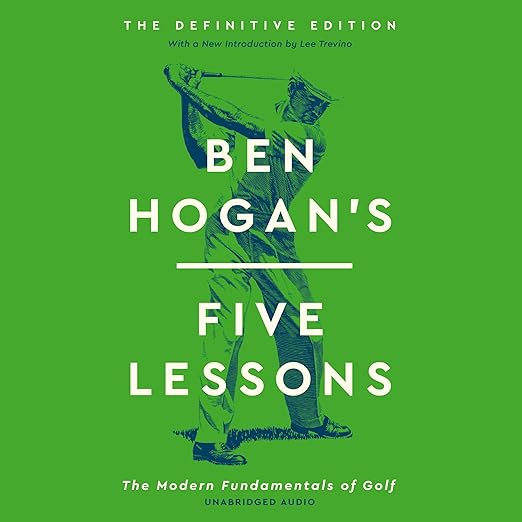
Golf instruction built on drawings raises an obvious question the moment it becomes an audiobook, and this listing never answers it. The book has sold for sixty-five years on the strength of one method: a single tested fundamental per chapter, explained and then demonstrated through clear illustrations, as though Hogan were giving a personal lesson. Simon and Schuster's definitive edition adds a major new introduction, expert commentary on the book's legacy, and unpublished photographs of a famously publicity-shy man. Five hours and twenty-five minutes of audio carries none of that visual apparatus with it.
A Document About How Golfers Learn Anything
Five lessons in a fixed order are the whole architecture: each chapter isolates one fundamental, explains it, and demonstrates it before the next one arrives. Hogan's claim, stated plainly in the copy, is that any golfer with average coordination can learn to break eighty. That is a large promise attached to a very small book, and the confidence behind it comes from where the method originated. He played early in his career with a hook that threatened to ruin his game, corrected it himself, and assembled the lessons out of what the correction taught him.
Nine major championships, and membership of the five-player group that has taken all four professional titles, is the record standing behind the instruction, and the copy leans on it hard. That matters more here than it would for most sports books, because the authority is personal rather than institutional: one player who fixed his own swing and then described the fix in detail. The definitive edition wraps that instruction inside commentary about the book's legacy, which turns a slim manual into something closer to a document about how golfers learn anything at all.
Carlson Builds What a Drawing Shows Instantly
Endurance is the strongest argument in its favor. Sixty-five years and millions of readers is not a marketing line here so much as the reason the book keeps getting reissued, and instruction surviving six decades of equipment change has clearly isolated something durable about bodies rather than about clubs. Hogan's fundamentals concern the swing itself, and none of them have been made obsolete by titanium. A golfer picking this up now works from the same material their grandparents worked from, which is either reassuring or alarming depending on temperament.
Caddying before golf carts existed is where an October 2016 five-star begins, describing a childhood spent learning the game by watching other people play it, until a parent handed over this book and the watching turned into golfing. That is a specific and rather touching account of what the book actually does, and it points straight at the mechanism: Hogan replaced imitation with explanation. A learner who could previously only copy what they saw was handed, for the first time, a description of what was happening inside the movement.
Steve Carlson delivers the lessons aloud, and the translation problem is severe. A drawing shows a hand position instantly and completely; a sentence has to build the same picture one clause at a time, in an order the listener can hold on to while attempting the movement. Five hours and twenty-five minutes is generous for a short book, which suggests the added commentary and framing occupy real space in the file. Spend three minutes on a passage where a lesson describes what the hands are doing, rather than on the biographical material, because the instructional chapters are where this edition stands or falls.
Ravielli, the Illustrator Missing From the Byline
Photographs are a substantial part of what this definitive edition sells: unpublished images of a man who avoided publicity, archival material described as never before seen, and expert commentary on how the book came to matter. A September 2025 entry underneath the listing praises the book and its illustrations in four words, which is a compliment the audio format cannot honor. Nothing on the page mentions a supplementary document of any kind, so a buyer choosing audio is choosing the words and giving up the archive this edition was assembled around.
Credits on this listing name exactly one person. The description, meanwhile, says Hogan partnered in 1957 with Herbert Warren Wind, called the dean of American golf writers, and with the illustrator Anthony Ravielli, whose drawings are the delivery system for the entire method. Neither name appears in the byline. On a book whose instruction is inseparable from its pictures, leaving the illustrator off the credits is not a formality, and a listener who never learns Ravielli existed will not understand what has been taken out of the edition they bought.
Trevino's name turns up in the reception column and nowhere else on the page. A December 2024 five-star titles itself around a classic golf book with a new update by Lee Trevino, and calls it the best golf instruction book, still relevant after all these years. The description mentions a major new introduction and expert commentary without ever saying who supplied either. If a well-known player contributed the new material, that is exactly the fact a buyer would want stated outright, and this listing declines to state it.
Buying the Harder Half of the Original
Golfers who already own a printed copy are the safest buyers, because they can run the lessons through headphones while the diagrams stay available on a table beside them, and that combination is genuinely useful on a practice day. Anybody who wants the biographical and historical material added for this edition also gets fair value, since commentary on the book's legacy and the account of Hogan's career work perfectly well as spoken material, which is more than the instruction manages.
First-time buyers should think hard before choosing this format. The core of the book is a set of physical positions demonstrated on the page, and a learner meeting them through headphones is working with the harder half of the original. At five hours and twenty-five minutes the audio makes a decent companion and a poor substitute. Bought alongside the printed lessons rather than instead of them, the sixty-five years of accumulated recommendation start making sense.
Frequently Asked Questions
Can you learn the swing from this audiobook without seeing the drawings?
Partly. The copy promises a route from tee to green worked out step by step and stroke by stroke, and that verbal scaffolding survives the move to audio. What does not survive is the demonstration: each fundamental was designed to be shown and then explained. Expect to understand the principle and to need a picture for the position.
How much of this audiobook is instruction rather than history?
The instruction is the shorter part. Five lessons in a slim original are now framed by an introduction, commentary and archival material, so the added apparatus takes a meaningful share of the running time. Listeners who want only the fundamentals should be ready to skip ahead, and those who want the legacy material will find plenty.