
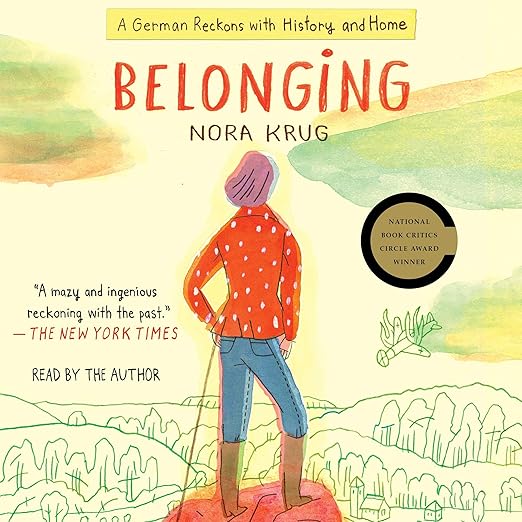
- Voice: Nora Krug reads her own memoir, and that ownership of a genuinely painful personal investigation is a real asset a hired narrator couldn't replicate.
- Big ideas: inherited guilt, family silence about the Nazi era, hybrid memoir-and-collage storytelling
- Atmosphere: Intimate and heavy, more excavation than narrative
- Worth it?: A powerful listen on its own terms, but readers drawn to this specifically for its visual form should treat audio as a companion to the print edition, not a replacement.
Four grandparents lived through Nazi Germany in Nora Krug's family, and not one of them ever spoke about it, an entire childhood and adolescence in Karlsruhe spent circling a silence she didn't yet have words for. This audiobook is Krug's own reading of Belonging, the National Book Critics Circle Award-winning graphic memoir she wrote after twelve years living in the United States made the unanswered questions impossible to keep setting aside.
Franz-Karl Died a Teenage SS Soldier
The investigation itself forms the spine of the book: archive visits, formal research, and interviews with surviving family members, all aimed at two specific figures. Her maternal grandfather worked as a driving instructor in wartime Karlsruhe, a seemingly ordinary job whose actual entanglement with the regime Krug has to piece together carefully. Her father's brother, Franz-Karl, died as a teenage SS soldier, and the book doesn't flinch from what that fact means for a family that spent decades not discussing it.
Krug's form is as much the point as her findings. The New York Times calls it an 'ingenious reckoning with the past,' and The Boston Globe writes that 'Krug erases the boundaries between comics, scrapbooking, and collage as she endeavors to make sense of 20th-century history, the Holocaust, her German heritage, and her family's place in it all.' That hybrid form, part memoir, part visual archive, is central to why the book won the awards it did.
The accolades attached to this book are substantial and specific: it won the National Book Critics Circle Award, took a Silver Medal from the Society of Illustrators, and landed on best-of-the-year lists from The New York Times, The Boston Globe, San Francisco Chronicle, NPR, Comics Beat, The Milwaukee Journal-Sentinel, Kirkus Reviews, and Library Journal. That breadth, across both literary and illustration-specific honors, reflects how genuinely the book bridges two different critical communities rather than succeeding narrowly in just one.
What 'Heimat' Means That 'Belonging' Doesn't Quite
One reviewer's title, invoking the German word 'Heimat,' points at something the book's own English title only partly captures; Heimat carries a specific, almost untranslatable weight around home, belonging, and inherited place that German has a single word for and English needs a whole sentence to approximate. Krug's title, simply Belonging, is itself a translation choice, and understanding that gap helps explain why the book reads as an interrogation of the concept rather than a comfortable arrival at it.
The visual language Krug developed for the book, official documents rendered alongside personal ephemera, family photographs paired with wartime propaganda, redacted-feeling archival material sitting next to her own hand-lettered questions, creates a kind of evidentiary collage where the reader has to do some of the same interpretive work Krug herself did. That specific structure, more than any single image, is what critics kept pointing to when the awards started arriving.
Krug trained formally as an illustrator before turning that training toward her own family's history, and that professional visual fluency shows in how deliberately composed each page is; nothing here reads as amateur scrapbooking, even when the content is deliberately raw.
Narrating Her Own Uncertainty Before Finding Answers
Self-narration matters enormously for a book built around this specific kind of painful family excavation. Krug isn't performing someone else's discovery process, she's narrating her own, and that ownership carries a weight and specificity that a professional narrator reading the same words secondhand simply couldn't replicate.
The reviews reflect how personally this material lands even for readers approaching it as strangers. One writes plainly, 'Astonishing, gorgeous, moving, absolutely original. YES to a beautiful treatment of some of our most troubling questions.' Another situates it within a broader tradition, noting that a whole genre of books and films by younger German generations investigating their families' Nazi pasts has existed since the 1980s, and calling this 'an excellent example of that type of book, with a good twist thanks to it being an adult illustrated title.'
What self-narration adds here isn't polish, it's stakes. Krug is reading aloud her own uncertainty about what she'll find before she finds it, her own discomfort interviewing family members who spent decades avoiding these exact questions, and that lived uncertainty is simply unavailable to a narrator encountering the material secondhand, however skilled.
Here the Collage Form Is Functionally the Argument
The book's own acclaim keeps circling back to its visual form, comics, scrapbooking, hand-lettering, collaged documents, and none of that survives the move to audio. This isn't the ordinary illustrated-nonfiction caveat where pictures are a nice supplement to prose; here the collage form is functionally the argument, the way Krug juxtaposes official documents against personal memory. Losing that is a bigger structural loss than usual.
The subject matter is heavy by design. Holocaust complicity, inherited guilt, and a family's decades-long silence are handled directly rather than gently, and at three hours and forty-four minutes, the runtime is concentrated rather than sprawling, so that weight arrives quickly and doesn't let up much once it starts.
Illustrated Doesn't Mean This Is for Children
Listeners should also know this reads as adult nonfiction despite its illustrated format; one reviewer specifically flags the 'adult illustrated title' distinction as a pleasant surprise, since illustrated books are so often assumed to be for children. Nothing here is aimed at younger readers, and the emotional and historical complexity assumes an adult audience throughout.
It's also worth knowing this was written primarily for an English-language audience despite its German subject matter; Krug lived in the US for over a decade by the time she wrote it, and the book explains German cultural context, Heimat, the specific weight of certain unspoken family roles, rather than assuming a reader already fluent in that world.
Those Collage Pages Can't Travel Through a Voice
Readers of Alison Bechdel's Fun Home and David Small's Stitches, both invoked directly by NPR's own praise for this book, along with anyone processing German or German-American family history and WWII history readers who want a personal-scale account rather than a macro one, are the clearest audience.
Listeners drawn to memoirs of inherited trauma more broadly, not specifically German or Holocaust-related ones, will likely still find real resonance in how Krug handles the specific mechanics of a family's protective silence and what it costs the generation left to break it.
It also rewards listeners with any personal connection to inherited family silence, regardless of the specific historical period involved, since the mechanics Krug uncovers, protective omission passed down without explanation, translate well beyond this one specific history.
Anyone who specifically wants the book's collage pages, scrapbook fragments, and hand-lettering, which reviewers keep singling out as central to why it won its awards, needs the print or ebook edition instead; those pages simply cannot travel through a narrator's voice, however committed that narrator is to the material.
A Few Questions About Belonging
Is this audiobook read by Nora Krug herself?
Yes. Krug narrates her own memoir, which matters particularly here since the book is built around her own family investigation rather than a detached historical account.
Does this audiobook work as well as the print graphic memoir, given the visual collage format?
Not entirely. Reviewers specifically praise Belonging's hybrid form, comics, scrapbooking, and collage, as central to its achievement, and none of that visual material is present in the audio-only format.
What does Belonging actually uncover about Nora Krug's family?
Her maternal grandfather's wartime role as a driving instructor in Karlsruhe, and her father's brother Franz-Karl, who died as a teenage SS soldier. The book traces how she pieced together both stories from archives, documents, and family interviews.
Is this audiobook a difficult listen emotionally?
Yes. It deals directly with Holocaust complicity and a family's decades-long silence about it, handled without softening, across a concentrated three-hour-and-forty-four-minute runtime.







