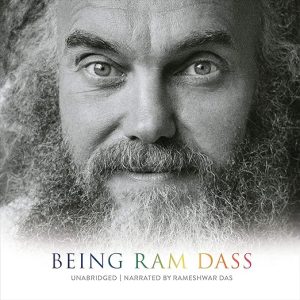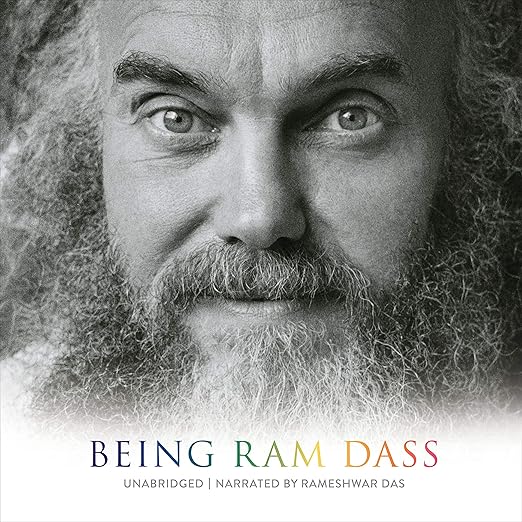
Five separate readers left full written reviews of this audiobook, and every single one of them rated it five stars. Put those five scores together and the average is a clean 5.0, yet the badge attached to the listing displays 4.8, built from a single counted vote instead of the five ratings actually visible on the page. An average pulled from one whole-star rating cannot land on 4.8 under any system, which means the number on display somehow manages to undersell a memoir that, by every visible account, nobody who reviewed it rated anything less than perfect.
What Rameshwar Das Delivers
Stacey's review captures the sheer range of one life in a single sentence, describing Ram Dass as a "university psychology professor, spiritual teacher, author of numerous best-selling books, raconteur, world-traveler and even stand-up comedian," before tracing his path from what that same review calls "an overweight and bullied child raised by a wealthy Jewish family" to a spiritual guide followed by seekers across the West. PW108's review places him in specific company, arguing that alongside George Harrison and Alan Watts, "there was probably no one more responsible for disseminating Eastern spirituality in the west during the 1960s and '70s than Richard Alpert slash Ram Dass," and calling him "a master spiritual communicator."
Pedro Ramos's review adds a more personal register, describing the journey "from Richard Alpert to Ram Dass" as something that "touched my heart like few others can," a reaction echoed by bb's review, which frames the book as a firsthand window into the beginning of the psychedelic movement alongside a broader spiritual perspective on life. Between the historical sweep PW108 and Stacey describe and the emotional resonance Pedro Ramos and bb report, this book seems to work on two levels at once, as cultural history and as something closer to a personal encounter.
The synopsis itself makes a direct pitch for who this book is for, stating plainly that "if you've ever embraced the phrase be here now, practiced meditation or yoga, tried psychedelics, or supported anyone in a hospice, prison, or homeless center, then the story of Ram Dass is also part of your story." That is an unusually wide net for a single memoir to cast, tying together spiritual practice, recreational and therapeutic drug history, and caregiving work as though they all trace back to one man's influence.
What Rameshwar Das Gets Right
Part of the draw here is the cast surrounding the central story. The synopsis lists Timothy Leary, Elisabeth Kübler-Ross, Allen Ginsberg, Sharon Salzberg, Aldous Huxley, and Alan Watts as figures who appear across the narrative, alongside George Harrison and a formative 1967 trip to India to meet the guru Neem Karoli Baba. That is a genuine cross-section of mid-twentieth-century spiritual and cultural history condensed into one life story, spanning a Harvard psychology career, psychedelic research, and the spiritual teaching that followed. Along the way, the synopsis describes taking friends on wild motorcycle rides on a Harley and testing "nearly every boundary, inner or outer," a detail that pushes back against any image of a purely serene guru and toward someone who lived restlessly before finding stillness.
Rameshwar Das both wrote and narrates this audiobook, which is worth being precise about: this is presented as Ram Dass's own life story, but the voice reading it to you belongs to Rameshwar Das rather than Ram Dass himself. Given how closely their names echo each other, that distinction is easy to miss if you are skimming the credits instead of reading them carefully, and it shapes how you should think about whose perspective is actually narrating eighteen hours and one minute of material, published under the Sounds True imprint.
Where Rameshwar Das Loses Some Ground
HS's review offers the one genuinely mixed note among these five reactions, admitting that "some of the names of people he mentions were very foreign sounding," making certain figures hard to track later in the story, though that same review adds it "did not hinder the rest" of the experience. For a book built around dozens of real historical figures across several continents and decades, that is a fair warning to listeners who prefer to follow every name over letting some wash past in service of the larger arc.
Scrutiny is exactly what the rating badge deserves here. Five reviewers, five perfect scores, and a badge that both undercounts those votes down to just one and still lands below what even that single vote could produce. Whichever number you trust less, the counted total or the displayed average, neither one matches the enthusiasm actually written out across these five reviews. At eighteen hours and one minute, this is also a substantial listen, long enough that the density of names HS flags is worth pacing yourself around rather than trying to absorb in a single sitting.
Who Should Pick Up Being Ram Dass
Anyone with an existing interest in Ram Dass's teaching, in the broader history of Eastern spirituality reaching the West, or in the psychedelic research scene of the 1960s should find plenty here, especially given how many named figures from that era populate the story according to these reviewers. Pedro Ramos's and bb's reviews both suggest this lands hardest on listeners who already have some personal connection to his work, whether through his books, his lectures, or the wider "be here now" ethos bb references directly.
Newcomers with zero background on Ram Dass can still follow the throughline Stacey and PW108 describe, though HS's warning about the density of names is worth taking seriously if detailed cultural history from this specific era is unfamiliar territory for you. And if you are drawn in expecting Ram Dass's own voice narrating his own memoir, know going in that the reading comes from Rameshwar Das instead. Given how directly the synopsis addresses readers who have practiced meditation, explored psychedelics, or worked in caregiving roles, that framing alone might be the clearest signal of whether this particular life story is going to resonate with your own.