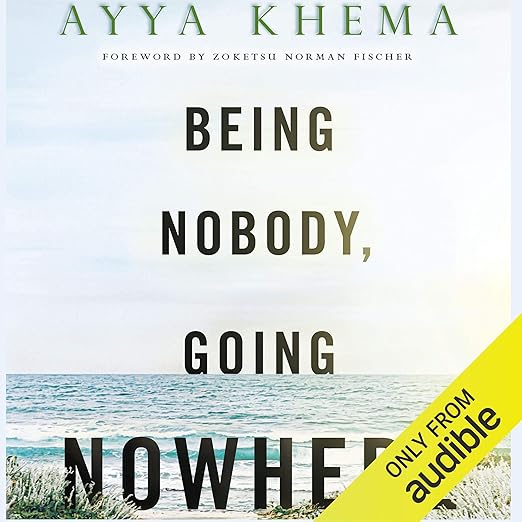
I came to Being Nobody, Going Nowhere late on a weeknight when I had about forty minutes before I needed to stop listening and actually sleep. I told myself I would put it on as background, the way you sometimes do with texts on meditation when you suspect you need the nudge more than you need the knowledge. That plan did not survive Ayya Khema's second chapter. By the time Khema was explaining the mechanics of karma in terms so stripped of mysticism that they felt like plain observation about cause and consequence, I had put down whatever I was doing and was simply listening.
Ayya Khema, born Ilse Kussel, was a German-born Theravada Buddhist nun who spent her life teaching across multiple continents. Being Nobody, Going Nowhere is considered one of her essential introductory works, and it earns that reputation by refusing to soften anything. She does not make the eightfold path sound achievable through wishful thinking. She makes it sound like serious, sustained work that is nonetheless available to anyone willing to try.
Is Being Nobody Going Nowhere Worth Your Time?
What separates this from the crowded shelf of Buddhist introductions is Khema's insistence on specificity. She does not settle for the inspirational summary. She addresses the hindrances to meditation by name, by mechanism, and by practical antidote. She explains compassion and sympathetic joy not as aspirational states but as practices with identifiable techniques. One reviewer described her style as a stern mother telling you the often-unpalatable truth without sugarcoating: that is exactly right, and it is also exactly what makes the book useful rather than merely comforting.
The title itself is worth sitting with. Being Nobody and Going Nowhere sounds like failure by the metrics most people carry around. Khema's argument is that both conditions are the point: the dissolution of a fixed self-concept, the release of attachment to destination. That is not a passive or nihilistic position in her telling; it is the precondition for genuine engagement with life. The inversion of ordinary ambition is the challenge the book asks you to accept.
The Best Parts of Being Nobody Going Nowhere
Claire Slemmer's narration is well-suited to this material. She reads with a steadiness that does not edge into reverence, which is the right call for a teacher who would likely have found excessive solemnity irritating. Khema's prose is already authoritative; Slemmer's job is to carry it clearly rather than dress it up, and she does that without affectation. The nearly eight-hour runtime means this is not a text to sprint through; it rewards pacing your sessions to allow reflection between chapters.
Compared to more contemporary Buddhist self-help texts, Being Nobody, Going Nowhere is noticeably more demanding. There is no concession to the reader who wants reassurance without rigor. But that rigor is exactly why listener after listener describes it as the most useful Buddhist text they have encountered: it treats the audience as capable of doing real practice, not just absorbing inspiration.
Before You Commit to Being Nobody Going Nowhere
One listener noted that the book started extremely strong but lost some momentum toward the end, awarding four stars rather than five on that basis. That observation is not entirely unfair. The final sections, which address more advanced meditation territory, assume a level of prior engagement that the early chapters do not require. If you are a complete beginner, the later material may feel more abstract than the opening chapters. That is not a flaw so much as a structural feature: the book begins where you are and moves toward where serious practice leads.
Readers coming from a secular mindfulness background rather than a Buddhist one will need to recalibrate slightly. Khema addresses karma and rebirth as genuine doctrinal positions, not as metaphors. She does not argue for them philosophically; she presents them as part of the framework. Whether that sits comfortably or requires some bracketing will depend on where you start.
Should You Listen to Being Nobody Going Nowhere?
Anyone seeking a serious, jargon-free introduction to Theravada Buddhist practice, particularly meditation, will find this one of the most substantive options available. It works equally well for those new to Buddhism and for practitioners who want to return to foundational principles with fresh attention. Listeners looking for a comfortable, affirming meditation companion should know this is more demanding than that genre, but the demand is precisely what makes it valuable.
Before You Listen
Is Being Nobody, Going Nowhere appropriate for someone with no prior knowledge of Buddhism?
Yes. Ayya Khema wrote it as an introduction and takes care to explain concepts clearly without assuming prior study. She avoids jargon and builds each idea from the ground up.
Does Claire Slemmer's narration work well for a text of this kind?
Yes. Slemmer reads with steady clarity rather than artificial reverence, which suits Khema's direct, no-nonsense teaching style. The narration does not impose mood on the text but lets Khema's words carry their own weight.
Is the book better in audio form or as a text to read?
The audio format works particularly well because the material originated as dharma talks and lectures, meaning Khema's voice and direct address translate naturally to the spoken form. Listening reinforces the sense of being taught rather than simply reading about practice.