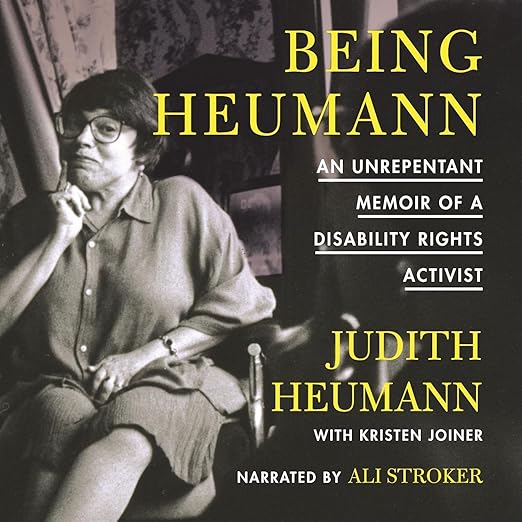
Judy Heumann was paralyzed by polio at eighteen months old, and Being Heumann traces the six decades that followed: fighting to attend grade school, winning a lawsuit against the New York City school system, and eventually leading the Section 504 Sit-In, the longest takeover of a government building in US history. Tony-award winning actress Ali Stroker narrates this audiobook, which runs six hours and thirty eight minutes and helped push the Carter administration toward protections that led to the Americans with Disabilities Act. The synopsis describes the memoir itself as "candid, intimate, and irreverent," an unusual combination of tones for a book that also functions as a piece of legislative history.
A Ramp Built Before Any Law Required It
Stuart M. Butler's review captures the book's dual nature precisely: part history, part personal story of empowerment, tracking how Heumann, working alongside other disabled activists, changed the world rather than just her own circumstances. Patricia Ford's review adds a detail that grounds the politics in something intimate: as a young child, Heumann's parents built a ramp at their own home so she could go outside and play with the neighborhood kids, a small act of accommodation years before any law required it of anyone. Stuart M. Butler's review makes a related point about scale: this is not a solo triumph story but an account of how Heumann, alongside a community Butler describes as including people both with and without disabilities, built something durable enough to outlast any one person's individual effort.
That same review also draws a connection between the loss of Heumann's grandparents in the Holocaust and who Heumann became, though the review itself cuts off before finishing that specific thought, so the exact connection it has in mind is not fully recoverable from the text. Jeanne Argoff's review insists this book is for everyone, not just people already connected to disability advocacy, from young people still discovering who they are to anyone who has ever felt vulnerable or excluded. AmethystWoman's review pushes that inclusiveness even further, arguing everyone should care regardless of current ability, since aging eventually makes temporarily able-bodied a description that stops applying to anyone. The same review calls what disabled activists accomplished herculean, a word choice that sits well against a memoir literally about physically occupying a federal building until the government listened.
Mistaken, in the Moment, for Heumann's Own Voice
One review offers narration praise sharper than almost anything else on this page: "I esp enjoyed the audiobook. Really well read by the non-author. I had to keep reminding myself it was not the author." That is about as strong an endorsement as a narrator who is not the memoir's actual subject can get, mistaken, in the moment, for Heumann's own voice. Ali Stroker, a Tony winner in her own right, is not just filling in for an absent author here; according to this review, she disappears into the part. R OMeara's four star review adds a craft observation that supports the same conclusion from a different angle, praising a conversational writing style and noting how well the book manages the many characters introduced across the memoir without losing track of any of them, exactly the kind of dense, name-heavy material that would expose a weaker narrator fast.
Beyond the performance itself, the historical weight of the material would carry a lesser narrator too: a woman who organized the longest occupation of a federal building in US history, pressured a sitting presidential administration into actual policy change, and lived to see that pressure become the Americans with Disabilities Act. Stuart M. Butler's review describes the book as instructing readers on how to build a movement that is inclusive and, somehow, still fun, a combination not every activist memoir manages to pull off. That same review calls the central protest a story that should never be forgotten and one more people ought to learn about, a sentiment that matches how much narrative weight the synopsis itself places on that single event.
The Boycott Number That's Probably a Slip
One review refers to "the 514 boycott" as the highlight of the book, where the synopsis and the historical record elsewhere on this page both point to the Section 504 Sit-In, so treat that specific number as a probable slip rather than a second, separate event, though nothing here fully resolves the discrepancy either way. A single counted vote behind the 4.8 badge is also worth knowing about, if only because it means the near-unanimous enthusiasm on this page has not yet translated into a large sample size.
One review frames current disability rights protections as under active threat, describing the ADA as being dismantled, which is that reviewer's own assessment rather than a claim this page can verify one way or the other. What is verifiable is the book's own account of how those protections were won in the first place, which the same review calls essential context regardless of where things stand today.
A Rare, Verifiable Reason to Choose Audio
Jeanne Argoff's review makes the strongest case for a wide audience: this is not a niche listen for people already inside disability advocacy circles, but a civil rights history that belongs alongside any other major movement's story. Listeners specifically curious about Ali Stroker's performance, after a review that mistook it for the author's own voice, have a rare, verifiable reason to choose audio over print here.
Anyone looking for a detached, purely academic history should adjust expectations, since this is a personal memoir first and a policy history second, filtered entirely through Heumann's own experience rather than a neutral outside account. For readers ready to sit with both registers at once, Being Heumann delivers a genuine civil rights education in under seven hours. Parents or teachers looking for material that connects disability history to the broader civil rights movement, rather than treating it as a separate, siloed topic, will also find the framing here does exactly that work.
At a Glance
- Voice: Ali Stroker narrates Being Heumann so convincingly that one review mistook the reading for Heumann's own voice.
- Big ideas: Disability rights history, memoir of activism, the fight behind the ADA
- Atmosphere: Personal and historically weighty, grounded in lived experience
- Worth it?: Essential listening for the history it carries, not just the disability rights niche.
What is the Section 504 Sit-In mentioned in this audiobook's description?
It was a real, extended occupation of a federal building that the synopsis calls the longest of its kind in US history, organized by Heumann alongside more than 150 fellow disability rights activists and allies to pressure the Carter administration into actually implementing protections.
Why does one review of this audiobook mention a '514 boycott' instead of the 504 Sit-In?
That looks like a numerical slip rather than a reference to a separate event: the synopsis and the rest of the page consistently describe the Section 504 Sit-In, and nothing else on the listing mentions a distinct 514 boycott anywhere else.
Would this audiobook appeal to listeners with no prior interest in disability rights?
Yes, according to the reviews: one specifically frames it as relevant to anyone who has ever felt vulnerable or excluded, not only readers already connected to disability advocacy, positioning the book as broader civil rights history rather than a niche interest title.