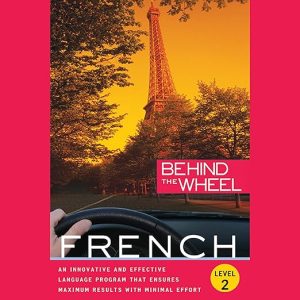
Commuters are the intended audience for this whole audio-course brand, and French 2 delivers exactly what that premise promises: over six hours of French instruction built to work with zero visual attention required. Behind the Wheel differs from most language-learning audiobooks in one structural way worth stating upfront: the audio itself is the primary product here, not a narrated companion to a textbook you're expected to have open. This second-level course reviews the fundamentals from French 1, then builds toward restaurant orders, shopping exchanges, and getting around a French-speaking town, using both English-speaking and native French instructors across the lessons.
Restaurant, Retail, and Directions Anchor the Lessons
The teaching method leans on repetition by design, and Orbiter's review lays out exactly how it works: 'everything is repeated twice, the speaker goes slowly,' followed by a faster-paced summary of the section. That structure, slow first pass, repeated pass, then a faster summary, is well suited to audio specifically, since it lets a driver or commuter absorb new vocabulary without ever needing to pause, rewind, or glance at a page, the exact scenario the series is named for.
French 2's content moves past French 1's basics into 'medium-length sentence combinations, versatile vocabulary, and extensive sentence building instruction,' per the synopsis, aimed squarely at conversation skills and listening comprehension rather than isolated vocabulary drills. Scenarios built around eating out, shopping, and navigating a town give the lessons real practical shape, the kind of everyday exchanges a traveler or new speaker actually needs, rather than abstract grammar exercises disconnected from real use.
Restaurant orders, retail exchanges, and directions around town aren't chosen randomly as the course's three anchor scenarios; they're the exact situations a traveler or new resident hits immediately and repeatedly, long before more abstract conversational topics ever come up. Building French 2 around genuinely high-frequency, high-stakes real-world exchanges, the kind where a language gap actually causes friction rather than mild embarrassment, gives the course a practical urgency that more academically organized curricula, built around grammar topics in the abstract, often lack.
The two-instructor design, an English-speaking host alongside a native French voice, mirrors how in-person language tutoring often works: one voice explains and translates while the other models authentic pronunciation, and hearing both roles distinctly across a lesson gives a solo learner something closer to a real classroom dynamic than a single-narrator course could replicate.
Frobose Narrates What Orbiter Calls the Best CDs
The synopsis promises both an English-speaking host and a native French instructor, and Orbiter's review confirms the native speaker comes through 'very easy to understand,' though only Mark Frobose is credited by name in this listing. For a program designed to be absorbed entirely by ear while driving, that clarity is the entire job: no dramatic flair required, just unhurried, precise enunciation a listener can follow without ever looking away from the road.
Orbiter calls these 'the best CD's I have ever found' for learning French, direct, enthusiastic praise from a listener actually using the format for its intended purpose. That kind of practical, results-focused endorsement matters more for a language course than a purely stylistic review would, since the test here isn't whether the delivery is entertaining but whether a listener actually retains and can use the vocabulary afterward.
Time itself is the real product Behind the Wheel is selling here: a daily commute that would otherwise be dead time becomes thirty, forty, sixty minutes of language practice without requiring a single additional minute carved out of an already busy schedule. That efficiency case is worth making explicitly, since it's the entire reason a driving-specific brand exists in a crowded language-learning market rather than just another general-purpose audio course that happens to also work in a car.
Worth noting separately: Orbiter's review still refers to the lessons as 'CDs,' language that signals a course built and refined over many years rather than a recent, untested release, the kind of format longevity that gives a language program real credibility regardless of which specific edition or delivery method a listener ultimately downloads.
Susan and Rubella Actually Reviewed the Italian Course
Two of the three reviews attached to this listing, from Susan L Schalk and Rubella, actually describe the Behind the Wheel series' Italian volumes rather than French 2 specifically, mentioning finishing 'Behind the Wheel - Italian 1' before moving to 'Italian 2,' and years spent 'dabbling in Italian.' Worth being transparent about that mismatch rather than presenting cross-language feedback as if it were French-specific, though it does speak honestly to the series' consistent format and reputation working across multiple languages, not just this one.
The synopsis notes 'this program includes a companion book to reinforce and enhance the audio experience,' but the framing matters: this is reinforcement material for an audio-first course, not the reverse. Unlike language programs where the audio simply narrates a companion textbook's contents aloud, Behind the Wheel is designed to work completely on its own, a genuine structural advantage for anyone who actually wants to learn while driving rather than at a desk.
Rubella's review, though describing the Italian edition specifically, names a genuinely useful pattern worth watching for regardless of language: describing years of dabbling that left her stuck in a rut with only surface-level familiarity, the exact plateau a structured Level 2 course like this one is designed to push a learner past. Anyone who recognizes that same stalled-out feeling in their own French, having picked up scattered words without ever building real sentence fluency, is precisely the audience French 2 is built to serve.
Worth a practical note: absorbing new vocabulary while actually operating a vehicle asks a driver to split attention in a way pure entertainment listening doesn't, and the course's own slow-then-repeat-then-fast structure seems built with exactly that constraint in mind, easing a distracted commuter back into full comprehension on the second and third passes rather than assuming undivided attention throughout.
French 1 Comes First for True Beginners
Commuters and drivers who want to use dead time behind the wheel productively are the series' whole design premise, and continuing French 1 students moving into French 2's more complex sentence-building are exactly the right level for this specific course, not a first exposure to the language.
French 1 is a real prerequisite worth taking seriously here: absolute beginners with zero foundation in French, or listeners who specifically want a fully print- or app-based visual learning method with text on a screen in front of them, should look toward French 1 first or a different, more visual program entirely.