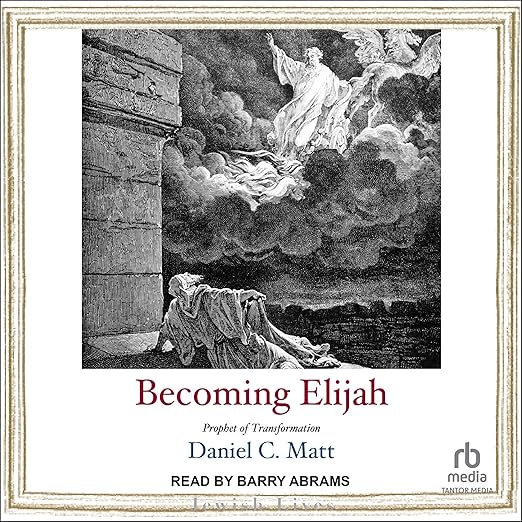
Every Passover seder leaves a door open for a prophet who never died, and this audiobook spends five hours and fifty-five minutes explaining how a figure who once called down fire on his enemies ended up as the guest everyone waits for. Daniel C. Matt starts in the Bible, where Elijah is a zealot attacking idolatry and injustice, and follows him out of it, into a whirlwind and a fiery chariot and then into centuries of afterlife in Jewish thought. The question at the center is put plainly in the description: was that a spectacular death, or did Elijah escape death entirely?
Sample It and Listen for the Quotes to Breathe
Transformation is the spine, and Matt treats it as a historical process rather than a paradox. The prophet who performs miracles and restores life in the biblical books is not the same figure who slips back to earth to help, rescue and enlighten, and the book tracks how one became the other through Rabbinic Judaism, through Kabbalah, and through the ritual practice that most Jews actually encounter. Christianity and Islam get their own passages, since Elijah travels into both. The argument closes on the present: a zealot turning compassionate is offered as something to think about in what the copy calls "our polarized, fanatical world."
Its hold comes from the way the argument keeps returning to the table. A four-star entry filed in April 2024 describes reading it in preparation for Passover and puts the reason cleanly: most Jews know Elijah primarily through the seder, where the door is opened and a cup of wine is offered near the end of the service. That same entry singles out a story about Elijah and the seder told by a Hasidic Rebbe as the kind of material the book is full of. Ritual is where a reader meets the prophet first, and the book keeps the ritual in view while the scholarship widens.
The reading credit on this record goes to Barry Abrams, with Tantor Media as publisher. The load is worth naming, because this is a book of specialized vocabulary rather than plain narrative prose: Hebrew terms, quoted scripture, rabbinic sources and the names of mystical texts, all delivered without the visual cue of an italicized foreign word or a footnote marker. A sample will tell you quickly whether the quoted material breathes or piles up, and that is the thing to listen for.
A Single Figure Crosses Five Traditions in Six Hours
Very few books walk a single figure from the Hebrew Bible through the Talmud into Kabbalah and out again into Christian and Islamic tradition, and fewer do it in under six hours. The compression means each stage is a chapter rather than a volume, which is a real advantage for a listener who wants the shape of the development rather than an exhaustive treatment of any one stage.
Israel Drazin, in a five-star entry from April 2024, calls the book "excellent and intellectually stimulating, as well as a balanced blend of scholarly depth and accessibility," and credits it with challenging how a reader thinks and pushing them toward self-improvement. That balance is the practical question for anyone deciding between this and a heavier academic treatment, and the entry is unusually specific about where it lands: scholarly depth, but readable, from an author the same entry describes as a leading authority on Kabbalah.
A second five-star, filed in October 2023, points at a different strength, praising the book for "objectively providing historical perspectives of the prophet's ministry from the Judaic, Christian and Islamic perspectives" and reporting that the conclusion pushed toward embracing a softer, more compassionate self. Two readers, two different reasons, and both land on the same structural feature: the book stays even-handed while moving between traditions that read the same prophet very differently.
A Linear Audio File Makes Slowing Down Awkward
One caution comes from a reader who is candid about being outside the target audience. A pastor writing in March 2022 enjoyed the book and found it "informative and well researched," then admitted to struggling with the chapter on Elijah and the mystics, because a Christian reader with no experience of Kabbalah has nothing to hold onto there. The stated remedy was to read that chapter slowly, and slowing down is precisely what a linear audio file makes awkward. That same entry carries a small oddity: it was filed roughly seven months before this recording was published in October 2022, so it describes the text in print.
Every other entry has the same character. One five-star praises the Talmud and Kabbalah material and signs off calling it "a great experience on kindle," which is about as explicit as edition evidence gets. Two entries say outright that they read the book, a third names the device it was read on, and nothing anyone has written addresses how this narration handles the quotation, the pacing or the Hebrew. The 4.6 average across sixty-eight ratings is a judgment on a text that exists in three formats.
The Subtitle Prophet of Transformation Goes Missing
Two metadata gaps are worth knowing before you buy. The title on this listing is the short one, while readers who write about the book consistently give it in full, as Becoming Elijah, Prophet of Transformation, so the subtitle that tells you what the book argues is missing from the page. The record also files it under a series called Jewish Lives with no volume number attached and no mention of any series anywhere in the description, which leaves the shelving unexplained.
A Figure Who, by the Book's Own Account, Never Finished
Anyone who has sat at a seder and opened the door without quite knowing why is the ideal listener, and so is the reader who wants one figure followed carefully from the Bible to the present rather than a survey of many. Clergy outside Judaism are served too, since the comparative passages give a Christian or Muslim reader a real way into the material. Students of Kabbalah will find the mystical sources treated as part of the argument rather than as decoration.
Skip it if you want narrative biography with scenes and dialogue, or a devotional treatment that stays inside one tradition. Listeners who dislike stopping to look things up should also weigh the vocabulary honestly, since the density of quoted and transliterated material is real and the format offers no glossary to glance at. For the right listener, though, six hours buys a genuinely unusual thing: the biography of a figure who, by the book's own account, never actually finished.
Frequently Asked Questions
Do I need background in Kabbalah to follow this audiobook?
No, though one section will ask more of you than the rest. Matt moves in historical order, beginning with the biblical Elijah and working forward through rabbinic literature before the mystical material arrives, so the groundwork is laid first. Listeners with no Jewish-text background will still meet a steady stream of Hebrew terms.
Who narrates it, and what runtime should I plan for?
Barry Abrams reads it for Tantor Media, and the file runs five hours and fifty-five minutes, which is roughly two long sessions or a week of shorter ones. The publication date on this recording is October 2022, and no abridgment is indicated anywhere on the record.
Is this a useful audiobook to hear before Passover?
It is one of the better-timed choices. The seder ritual of opening the door and pouring a cup for Elijah sits at the heart of the book, and the discussion covers that practice and the other Jewish rituals the prophet enters. Under six hours makes it feasible in the week before.