In Brief
- Narrator: Joe Hempel delivers J. Michael Straczynski's writing advice with clarity and appropriate pace, handling the tonal shifts between practical instruction and personal storytelling cleanly.
- Subjects: The discipline of professional writing, surviving the transition from aspiring to working writer, world-building and story-planning across media
- Tone: Direct and generous, like a candid conversation with someone who has nothing to prove and no reason to be vague
- Bottom line: Working and aspiring writers across film, television, books, and comics will find Straczynski's audiobook among the more practically useful and honestly framed writing guides available.
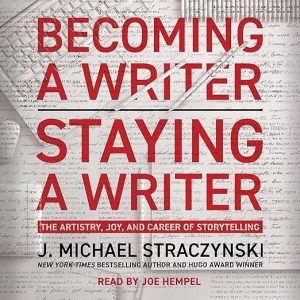
J. Michael Straczynski opens Becoming a Writer, Staying a Writer with Harlan Ellison's observation that the trick is not becoming a writer but staying one, and the entire audiobook is structured around that distinction. Narrated by Joe Hempel and running seven hours and two minutes, this is Straczynski's comprehensive account of the craft and career of professional writing across film, television, books, and comics, drawn from over thirty years of experience that includes Babylon 5, Thor, Amazing Spider-Man, and multiple New York Times bestselling novels. The book does something that writing manuals rarely attempt: it takes the two-stage problem seriously as two distinct challenges requiring different skills, different habits of mind, and different kinds of support. The first half addresses what beginning writers need to know to improve and sell their work. The second addresses how working writers stay disciplined, avoid stagnation, and survive the particular challenges of making writing a livelihood rather than an aspiration.
The book's authority comes partly from Straczynski's unusual cross-media career. Most writing guides are written by novelists for novelists, or screenwriters for screenwriters. Straczynski has worked at the professional level in all of those forms and several others, which gives him a perspective on the structural similarities and differences between them that most writing teachers cannot access. His chapter on world-building, for example, draws on what he learned constructing the Babylon 5 universe across five seasons of television, and then applies those lessons to the novel and comics work he has done subsequently. That cross-pollination produces insights that single-form writers don't encounter, and it makes the book genuinely useful to writers who are not sure which form will ultimately claim them.
Waiting for Inspiration Is the Wrong Strategy
The section on why writers should never wait for inspiration is the book's most useful contribution to the existing literature on writing discipline. Straczynski's argument is not the standard 'sit down at your desk every day' advice, though he includes that. It's a more fundamental claim about the relationship between the conscious and subconscious creative mind, and about why waiting for the muse to arrive produces writers who write infrequently rather than writers who write well. His own practice, which has included periods of extraordinary output by any standard, is evidence that the discipline he describes can be internalized rather than merely imposed. The personal anecdotes throughout the book are not deployed for inspiration. They're deployed as evidence for the claims being made.
The chapter on getting an agent and navigating personal relationships as a writer is unusually candid for the genre. Straczynski doesn't pretend that making writing your career is painless for the people around you, or that the industry is less arbitrary than it is. The practical mechanics of querying, manuscript preparation, and maintaining relationships with editors and publishers are presented with enough specificity to be useful, and with enough honesty about the rejection and uncertainty involved to be credible. One reviewer notes that the book is addressed to writers at any stage of their career, and the dual structure makes that claim meaningful rather than merely promotional: the advice for the aspiring writer and the advice for the working writer are genuinely different bodies of content.
Hempel Gives Space to Straczynski's Direct Prose
Joe Hempel's narration is a good fit for this material. Straczynski's prose has a direct, occasionally self-deprecating quality that Hempel preserves cleanly. The book doesn't adopt the inspirational cadence that some writing guides perform, and Hempel doesn't impose it. The practical instruction sections land as practical instruction. The personal anecdote sections land as personal story. The transitions between them, which the chapter structure makes frequent, are handled smoothly.
At seven hours and two minutes, the runtime gives sufficient space to develop each topic without feeling extended. Straczynski covers story-planning strategies, world-building methodology, revision and editing practice, reinvention as an artist at career inflection points, and the specific craft challenges of each major form. That's a substantial amount of ground, and the book moves through it efficiently without sacrificing depth on any individual topic. Several listeners note that the relatively short chapter length makes it easy to pause and process, or to return to specific sections, which is a practical virtue in a reference-adjacent book.
Babylon 5 Carries More Weight Than Publishing Advice
Straczynski's specific experience and success in television, particularly with Babylon 5, means the television sections of the book carry more concrete authority than the sections on publishing, which reflect a single writer's experience with a specific agent and publisher set. The advice on novel publishing and literary fiction careers specifically may reflect the particular circumstances of someone who arrived in those spaces from a strong existing media platform rather than from the standard first-novel trajectory. Aspiring literary novelists should read those sections with that context in mind.
The book is also clearly written from a practitioner's perspective rather than an academic one. There is no engagement with the craft theory literature or the MFA discourse around writerly technique. Straczynski writes from what has worked for him and his contemporaries, and while that experiential base is substantial, listeners who want their writing education situated within a broader conversation about craft and form may find the approach more anecdotal than systematic.
A Realistic Career Guide for Working Writers
Working writers across any form who are either establishing their career or navigating the specific challenges of sustaining a long one will find this audiobook more honestly useful than most writing guides. Aspiring writers who are serious about the professional dimension of writing, not just the craft, and who want a realistic account of what the career actually involves, will find Straczynski's thirty-plus years of experience across multiple media a genuinely rare resource. Listeners primarily interested in literary fiction craft or academic approaches to writing will find the book's practitioner orientation limiting. But for writers in the popular forms, and for anyone who has wondered whether the skills and habits that produce one kind of writing transfer to others, this audiobook is among the more illuminating accounts available.
Before You Listen
Is Becoming a Writer, Staying a Writer audiobook useful for writers working in just one form, or does it require multi-media ambitions?
The cross-media perspective enriches but doesn't restrict the book's usefulness. Straczynski's core arguments about discipline, inspiration, revision, and career navigation apply across all forms. The specific media chapters add depth for writers working in television or comics, but the book functions as a comprehensive guide for single-form writers as well.
How does this audiobook compare to Stephen King's On Writing as a resource for developing writers?
King's On Writing is more autobiographical and more focused on the specific craft of prose fiction. Straczynski's book is more practically structured around career stages and professional navigation, with broader cross-media applicability. Both are direct and personally grounded; Straczynski's book is more explicitly a two-stage guide to the profession rather than a memoir with craft observations.