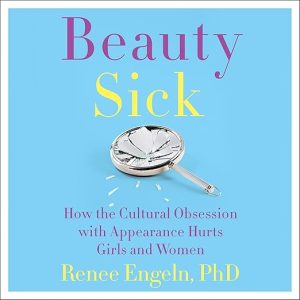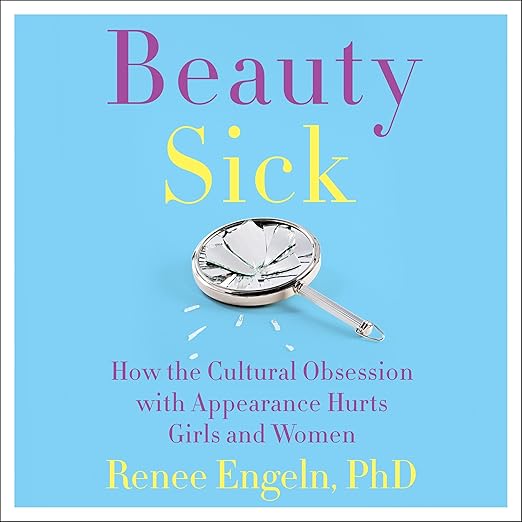
Renee Engeln builds Beauty Sick around a contradiction she has spent her career studying: young women who reject the Barbie-doll ideal in one breath and download an airbrushing app in the next, who mock Photoshopped images while still posing with a deliberately thinned 'skinny arm' for their own photos. As a psychology professor at Northwestern with a TEDx talk that has drawn a quarter million views, Engeln has the research credentials to back up an argument this audiobook makes across eleven hours and thirty-eight minutes, that appearance obsession functions less like a personal insecurity and more like a public health epidemic.
Data and Real Voices Share the Argument
The book's structural choice, pairing hard data on depression, eating disorders, and disrupted cognitive processing with the actual recorded voices of women describing their own beauty-related anxiety, gives Engeln's argument two different kinds of authority at once. Reviewer Davie Marin calls out this same combination directly, praising how thoroughly Engeln details the different hardships women and girls face daily because of appearance pressure. The synopsis places the book alongside Naomi Wolf, Peggy Orenstein, and Sheryl Sandberg, and that comparison holds up: like those writers, Engeln is translating academic research into a register general listeners can actually absorb without a background in psychology.
Reviewer Sixtus makes a sharper point worth sitting with: the book's central question, why appearance carries so much weight for women specifically and comparatively little for men, is not new, but Engeln's use of her own original research and studies gives that familiar complaint real evidentiary weight rather than leaving it as observation. That distinction matters for a genre where cultural criticism sometimes outruns its evidence. Engeln's academic background means claims about cognitive processing disruption or the financial cost of beauty maintenance come with citations behind them, not just conviction.
The term 'beauty sick' itself is a clinical-sounding coinage, treating appearance preoccupation as a diagnosable condition rather than a personality quirk or simple vanity, and that framing choice does real argumentative work before a listener even reaches the first chapter. By naming the phenomenon a sickness, Engeln positions her subjects as people experiencing something imposed on them by culture rather than something they chose or failed to overcome individually, a reframing that runs through the entire book's approach to blame and responsibility.
Schnaubelt Shifts From Romance to Research Data
A book this dependent on research and layered argument needs a narrator who can hold clarity across long stretches of data without letting the material flatten into monotone, and that is the central test for Teri Schnaubelt here. Her prior confirmed work sits in a very different register, character-driven historical romance, so this assignment asks for a different skill entirely: steady, trustworthy delivery of research findings rather than emotional range across a cast of characters. The genre shift is real, and worth naming honestly rather than assuming her romance-narration strengths transfer automatically to dense nonfiction.
What the audiobook format adds here is momentum. Engeln's writing moves between statistics and individual women's stories in a rhythm that works well read aloud, since the human voice naturally signals the shift from data to anecdote in a way a page sometimes has to earn through formatting alone. For a topic this heavy, hearing real women's testimony spoken rather than read silently arguably increases its emotional weight, which supports the book's larger argument that beauty sickness is not an abstract statistic but something lived by specific people.
Engeln's TEDx talk drawing more than 250,000 views is worth noting as more than a marketing credential: it suggests this material had already found a real audience hungry for exactly this argument before the book itself existed, and the audiobook essentially expands a talk that already proved its ability to hold a general audience's attention into a full-length, evidence-dense treatment. That track record is a reasonable signal that Engeln knows how to keep dense research accessible, a skill distinct from academic writing itself.
Diagnosis-Heavy, Light on Actual Prescription
Reviewer Amazon Customer's four-star review supplies the most useful caution here: the book is instructive and useful, but a genuinely tough listen, not because the writing is weak but because a reader already aware of the problem may find the sheer accumulation of evidence taxing to sit through in one stretch. Eleven and a half hours of sustained argument about a painful, familiar subject asks real stamina of a listener, and this reviewer is honest that it takes deliberate motivation to keep going even while affirming the book is worth the effort.
Listeners should also know this is diagnosis-heavy relative to prescription. The synopsis promises inspiration and workable solutions toward the end, but the bulk of the runtime is spent establishing the scope and mechanism of beauty sickness itself, evidence gathering rather than a step-by-step recovery plan. That balance is appropriate for the book's actual argument, which is that the problem is systemic and cultural rather than a personal failing to be solved with five easy tips, but anyone expecting a workbook-style self-help structure should recalibrate expectations toward cultural analysis instead.
Setting Engeln specifically alongside Wolf, Orenstein, and Sandberg is a useful way to locate her approach: closer to Orenstein's research-grounded reporting on girls and body image than to Wolf's more polemical Beauty Myth or Sandberg's corporate-leadership focus in Lean In. Listeners who found Wolf's book more manifesto than evidence, or Sandberg's more workplace-specific than culturally broad, will likely find Engeln's approach sits in a useful middle register, argumentative but consistently backed by cited research rather than personal essay alone.
A 4.6 rating across 554 reviews for a book this demanding, both emotionally and intellectually, is a meaningfully strong signal, since dense, uncomfortable nonfiction often sees ratings drop from readers who found the material more challenging than expected. That consistency suggests Engeln has calibrated the difficulty correctly for her actual audience rather than simply being rigorous for its own sake, even accounting for the handful of reviewers, like Amazon Customer, who found the density genuinely taxing.
Parents, Educators, and Therapists Will Find Grounding
Beauty Sick is built for listeners who want their instincts about beauty culture backed by real psychological research rather than op-ed-style argument, especially anyone who has felt the specific exhaustion of criticizing an unrealistic beauty standard while still, on some level, chasing it. Parents of teenage girls, educators, and therapists working with young women will find genuinely practical grounding here, and the audiobook format suits the material's blend of hard data and first-person testimony particularly well.
Listeners looking for a quick, breezy self-help listen, or something focused mainly on solutions rather than root causes, should expect a heavier experience than that framing suggests. Anyone already well versed in feminist media criticism may find the earlier chapters cover familiar ground, though Engeln's original research still adds real depth even for a well-read audience. Best approached in sections rather than straight through, given both its length and its subject matter.
- Voice: Teri Schnaubelt narrates with clear, measured authority, appropriate for dense research-backed nonfiction.
- Big ideas: Body image, beauty culture, self-worth, media literacy
- Atmosphere: Urgent and evidence-driven, occasionally heavy
- Worth it?: A genuinely useful, well-researched audiobook for anyone examining their own relationship with appearance, best absorbed in sections.
Questions Listeners Ask
Does the audiobook format work for a book this research-heavy, with citations and studies throughout?
Mostly, yes. The human voice signals the shift between statistics and personal testimony better than a silently read page does, though the sheer density means some listeners will want to absorb it in sections.
Is Teri Schnaubelt's narration engaging enough to sustain an eleven-hour nonfiction listen?
This is a genre shift for her, since her confirmed prior work sits in historical romance, but her steady, clear delivery is well suited to holding research-heavy material together.
Does this audiobook offer practical solutions, or is it mainly a diagnosis of the problem?
It leans diagnosis-heavy. The bulk of the runtime establishes the scope and mechanism of beauty sickness, with solutions arriving mainly toward the end.