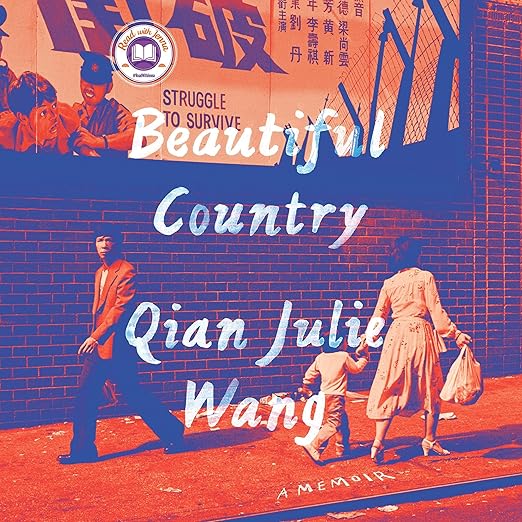
Qian Julie Wang appears twice on this page, once in the author line and once in the narrator line, which makes this audiobook a memoirist reading her own childhood back to us across 9 hours and 38 minutes. Random House Audio released it in September 2021. Self-narration is a decision with consequences in both directions, and it is the single most important fact about this recording, so it should be said plainly before anything else: the voice describing a seven-year-old in Chinatown belongs to the person who was that seven-year-old.
First, the Big Picture
Mei Guo, the Chinese word for America, translates directly to beautiful country, and the memoir sets that phrase against what a child actually found. Qian arrives in New York City in 1994 at seven years old, curious and then overwhelmed by fear and scarcity. Her parents had been professors in China. In America the family is undocumented, the parents labor in Chinatown sweatshops, and the stress of the new life comes out sideways in constant fighting. Classmates and teachers shun a child whose English is limited, so the library becomes the refuge.
Small pleasures are what keep the book from being unbearable, and it collects them with care. Mastering English through borrowed books, with The Berenstain Bears standing in as first American friends. A first bite of gloriously greasy pizza. Weekly shopping days spent finding treasures in the trash on Brooklyn streets. A Christmas visit to Rockefeller Center that confirms the city from the movies actually exists. Then Ma Ma collapses from an illness hidden for months out of fear of what a doctor would cost and ask, and Ba Ba turns inward with one refrain: say you were born here.
Start with the average, since it fails first. It shows as 4.4, and no arrangement of four whole-star grades produces that figure, whichever way you round. Underneath it, the page displays five written responses, one more review than the number of ratings it claims to hold. The grades attached to those five run 5, 4, 5, 5 and 3, so the shape of the reception is legible even though the arithmetic describing it is not.
Why Beautiful Country Works as an Audiobook
Author narration earns its place here more clearly than it does on most memoirs. The description promises a childhood perspective rendered with lyric clarity, which means the whole book depends on holding a seven-year-old's understanding steady while an adult's knowledge sits underneath it. A hired reader has to construct that double register from the outside. Wang built it in the writing and then performed it, so whatever pauses and emphases the recording contains were settled by the same person who chose the sentences. That consistency is not available any other way, and it is the reason a memoir built this way is often better heard than read.
Nine hours and thirty-eight minutes is a manageable length for a childhood memoir, and the episodic construction suits listening. Each chapter tends to sit around one incident, one discovery or one loss, so the book gives you natural stopping points without breaking its spell. The risk of the format is the same as its promise: a sustained child's-eye register can wear on a listener who wants adult analysis, and this memoir mostly refuses to supply retrospective commentary. What you get is the experience as it landed on a child, not the explanation an adult would later attach to it.
Readers keep responding to the book through their own histories, which is the clearest sign it is doing what memoirs are for. ASJ writes as an American Chinese reader who recognized a great deal of it, including a first memory of racism on a playground, and singles out the story of a man who set his dog on the author and was pleased about it. Kjonesy came for a different culture and ended up comparing a childhood as a dark-skinned Black girl to Qian's. Natalie Hable dwells on how the family was treated and what the trauma cost them for decades afterward.
A Few Reservations
Criticism on this page gets cut off at the moment it turns useful. A three-star reader grants that the story is remarkable and the writing engaging after a slow start, then argues that the plight is played up to the point of seeming tendentious and, in places, close to unbelievable. Fair or not, that is the only dissent on the page and it deserves a hearing. The body breaks off mid-sentence at the words where she lost me, so the specific objection never arrives. The single most informative sentence in the column has been severed at the comma before its verdict.
Two fragments of print packaging have been left in the audio description. A starred Publishers Weekly quotation calling the memoir a new classic, and, at the very bottom, a credit reading cover photograph Bud Glick. Neither belongs on a recording, and the photograph credit in particular is jacket furniture that traveled across from a physical edition without anyone stopping it. Both are harmless in themselves, and both are a reminder that this copy was written to sell a hardback and then handed to the audio page unedited.
None of the five responses says a word about the reading, and that silence costs more here than it usually would. When the author performs the book, the performance is a substantial part of what a buyer is choosing, and every written account on this page treats the recording as though it were a printed text: read for a book club, finished in two days, discussed as prose. Content is heavy throughout, including racism directed at a child, an animal attack, medical fear and family disintegration.
Who Should Pick Up Beautiful Country
If you want the immigrant childhood told from inside the child, without an adult explaining it to you afterward, this is precisely that book and the author's own delivery makes the case for the format on its own. Readers of literary memoir, anyone who arrived somewhere young and had to learn a language fast, and listeners who value a first-person voice will find it worth 9 hours and 38 minutes. Those who need analysis, historical framing or emotional distance will struggle with a book that offers none of the three. Hearing the author say those sentences is the reason to choose this format.
How does the author's own narration change this audiobook?
It removes a layer of interpretation. The memoir holds a seven-year-old's understanding in front of an adult's knowledge, and a hired reader would have to reconstruct that balance from outside the text. Here the person who wrote the double register performs it, so emphasis and hesitation come from the same source as the sentences.
Why does the rating not match the reviews on this page?
Because the two figures describe different things. Only four ratings are counted, yet five written responses appear, so at least one review carries no vote behind it. Separately, no set of four whole-star grades averages out to 4.4 however you round it. The grades you can see run 5, 4, 5, 5 and 3.
What content should I be ready for in this audiobook?
Poverty, sweatshop labor, and an undocumented family living in fear of doctors and officials. One reviewer highlights an episode in which a man sets his dog on the author and is pleased about it. Racism directed at a child, a parent's hidden illness and a marriage under strain run throughout.