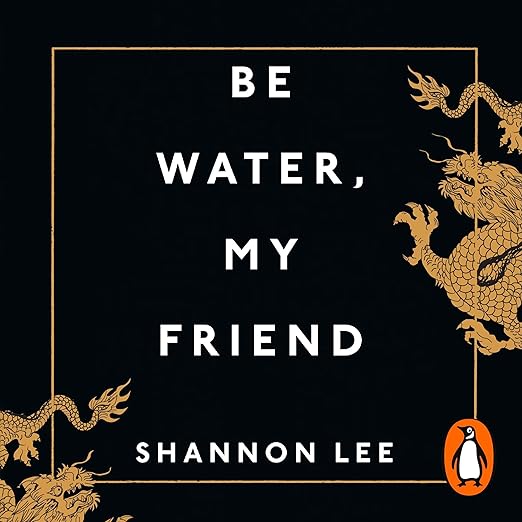
Penguin Audio credits Shannon Lee as the reader of her own book, and that one line in the metadata is the most useful thing on this audiobook listing. Seven hours and twenty minutes of a daughter reading her father's philosophy in her own voice is a different proposition from seven hours of a hired reader doing it, and nothing on the page says so out loud. You have to notice it yourself, which is a shame, because it is the single strongest reason to choose this edition over the printed one.
Empty Your Mind, Be Formless Like Water
The book itself is straightforward. Bruce Lee is remembered for the films and the martial arts, and the publisher's copy is careful to add that he was also a deeply philosophical thinker who treated martial arts as, in its own phrase, a perfect metaphor for personal growth. Shannon Lee takes that premise and builds chapters on it. Each one draws a lesson from her father and expands outward from the line that everyone already half knows: empty your mind, be formless, shapeless like water. The copy quotes it before anything else, and the whole structure hangs off it.
Opposite Readers Land in the Same Place
What the description does not tell you is how much of this is memoir. The publisher promises previously untold stories from her father's life alongside the concepts at the core of his teachings, which reads on paper like an even split. Richard Kimble, writing in December 2025, arrived with a shelf of Bruce Lee books already read and came away naming Shannon Lee and her storytelling as the thing that stuck, along with the material about growing up with him. Martin, whose review opens by admitting to never having watched a single one of the films, took the opposite road and landed in the same place.
That convergence is the useful signal in a small column. Five people wrote, and they came from opposite ends: the long-standing reader and the complete newcomer both finished recommending it. Milyvanily's response runs two sentences and garbles one of them, but the shape does not change. Chris D., the one dissenter on grade, is recommending it in the same breath. Whatever this book is doing, it does not need you to arrive already caring about Bruce Lee, and it does not seem to reward prior expertise either.
Saying My Father and Meaning It Literally
Self-narration is the argument for the audio edition, and it is a strong one. A book about a parent, read aloud by the child who wrote it, gets something a hired professional cannot supply: the person saying my father means it literally. Seven hours and twenty minutes is a comfortable length for that shape of book. Long enough to hold the biographical detours without rushing them, short enough that the philosophy chapters do not thin into repetition, which is the failure mode of almost every book built on a single central image.
Ratings back the impression up without proving much. The badge reads 4.8 across five votes, and five written responses are visible, so those five grades are the entire population rather than a sample of it: four fives and a four, twenty-four points out of a possible twenty-five. One star short of a sweep, and unusually, you can see exactly where that star went.
Chris D. gave four and explained the missing one in the final sentence, which complains that the purchase carried no free digital backup for a Kindle reader. The paragraph above it calls the content inspiring and recommends the book to any martial arts fan or practitioner. So the only grade below top marks on this page is a complaint about fulfillment. It is not about the writing, and it is certainly not about the recording, which Chris D. never mentions.
Every Written Response Describes a Physical Object
Which raises the thing a browser ought to know before clicking buy. Every one of the five written responses under this audiobook is describing a physical object. Chris D. opens with Arrived on time, Quality Paperback Book. Juanita Sofge's entire contribution is one line ending in great Birthday gift. Martin, Richard Kimble and Milyvanily all reach for the word read or reading, and Milyvanily promises you will read it again. Not a sentence in the column could have been typed by somebody who listened to it.
None of that is a reason to skip the audio edition. It is a reason to read the 4.8 as a verdict on the text and nothing more. Nobody in this column has heard Shannon Lee say a word. If the self-narration is why you are here, and on this title it probably should be, you are buying it on faith rather than on evidence, and the page does nothing to warn you.
One further mismatch is worth flagging. Martin's headline and opening sentence both name the book as Be Water, My Friend: The Teachings of Bruce Lee. The title field on this listing stops at My Friend. Either the subtitle was dropped when the audio edition was catalogued, or this edition never carried one, and the page offers no way to settle it. Publishers trim subtitles for audio catalogs all the time, and search does not forgive it. If you have been hunting for it under the longer name without success, that is the reason.
Buy It for the Voice on the File
Anyone curious about Bruce Lee as a thinker rather than a fighter is the obvious audience, and Martin's entry is the proof of concept: no prior interest, none of the movies seen, convinced by the end anyway. Readers who already own a stack of the philosophy titles will recognize a lot of the ground, though Richard Kimble suggests the value shifts for them toward the family material and the person delivering it. And listeners who want a daughter's account of a famous father, in the daughter's own voice, get something here that no printed edition can hand them.
Pass on it if you want the martial arts technically, or a conventional biography with the dates and the fights in order. The publisher's own framing calls it a call to action, and the chapters organize around lessons rather than chronology. Pass on it too if a review column carries real weight in your buying decisions, because this one is describing a paperback that arrived on time. Buy it for the voice on the file, which is the one thing seven hours and twenty minutes of Shannon Lee can give you and a printed page cannot.