
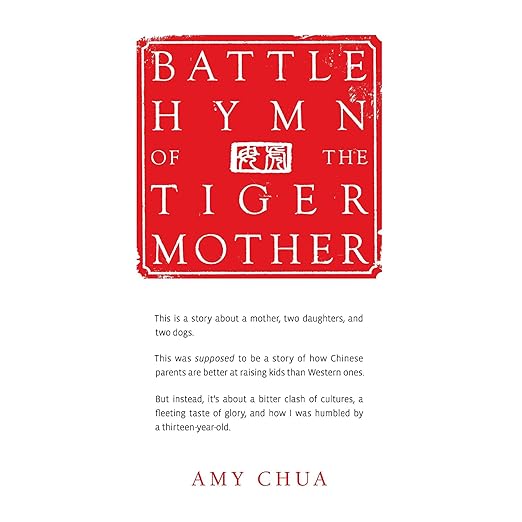
Amy Chua's name became shorthand for a certain kind of parenting debate almost the moment Battle Hymn of the Tiger Mother was published, and that notoriety has followed this audiobook ever since. Listening to it now, narrated by Chua herself, the experience is stranger and more interesting than the culture-war version of the book you may have encountered secondhand. It is funnier than you expect, more self-critical than the headlines suggested, and considerably more honest about failure and love than any simple "Chinese mothers are superior" slogan could contain.
The audiobook runs just under six hours, which turns out to be exactly the right length. Chua is not padding. She is telling the story of raising two daughters, Sophia and Lulu, according to what she describes as the Chinese parenting model: no playdates, no sleepovers, no school plays, no instrument other than piano or violin, always the top student, always the best performance. And then she is watching that model fracture against the particular personality of her second daughter, with consequences she did not anticipate and cannot fully control.
First, the Big Picture
The self-narration is central to what makes this audiobook work. Chua's voice carries a natural authority and energy, but it also carries something more complicated: you can hear her laughing at herself, catching herself, occasionally wincing at what she is describing. One reviewer who read all of Chua's books after the controversial Wall Street Journal excerpt notes that the main argument is stated plainly in that piece: Western parents equate love with acceptance; Chinese parents equate love with equipping their children with skills and inner confidence. What the audiobook adds to that framing is the lived reality of what happens when the philosophy encounters an actual human child who refuses to cooperate.
Lulu becomes the book's moral center without the narrative ever quite framing it that way. Sophia absorbs the pressure and channels it into achievement. Lulu pushes back, and Chua's account of those confrontations, some of them genuinely alarming, some darkly funny, ultimately forces her to reckon with the limits of iron will as a parenting tool. The book is most interesting in the gap between what Chua set out to argue and what her own story reveals.
The audiobook format genuinely serves this material. Chua's self-narration turns the memoir into something close to a monologue, and the effect is of sitting across from her while she tells you a story she is still processing. She does not soften the parts that reflect badly on her. The scenes where she refuses to accept less than perfection from Sophia and Lulu, demanding piano passages be played again and again until they are right, are rendered without apology but also without the triumphalism the tabloid summaries implied. She is describing what she did, not entirely certain it was right.
The book also functions as a genuinely useful cultural document. Chua's argument about the difference between Western and Chinese approaches to parenting is made with precision and backed by her own experience as an immigrant and a Yale law professor. Whether you agree with her conclusions or not, the audiobook gives you the fullest version of those arguments rather than the flattened version that circulated online. One reviewer described it as "achingly honest and profoundly challenging," and those two adjectives are both accurate.
Weak Spots in Battle Hymn of the Tiger Mother
The book's subtitle positions it as "a memoir," and that classification matters. Chua is not writing a parenting manual or a how-to guide. She is writing about her own experience, with its specific cultural inheritance, its specific family dynamics, and its specific failures and successes. The moments where the tiger mother approach produces results, Sophia performing at Carnegie Hall, both daughters excelling academically, are presented alongside the moments where it nearly destroys Chua's relationship with Lulu entirely.
The narrative's most honest passage may be the one that arrives near the end, when Chua is forced to acknowledge that her model required modification to survive contact with reality. For a book positioned as advocacy for a particular parenting style, the willingness to include that reckoning is unexpectedly refreshing. Reviewers who came in ready to disagree found themselves more engaged than they expected. The audiobook does not convert you; it complicates you.
One nuance worth noting: the title itself is partly ironic. "Battle Hymn" suggests triumphalism; the memoir is actually a record of conflict, both external and internal. Chua does not emerge from the story fully vindicated. She emerges changed, and that distinction makes the audiobook significantly more worth your time than either its defenders or its critics initially claimed.
Is This One for You?
This audiobook is for anyone interested in the genuine complexity of parenting across cultural contexts. Listeners who grew up with high-pressure achievement-oriented households, whether Chinese-American or otherwise, will likely find the book more recognizable and more emotionally layered than outsiders expect. Parents currently navigating the tension between letting children find their own path and pushing them toward excellence will get more from this book than from most parenting-advice titles.
Listeners who have already decided what they think about the "tiger mother" philosophy based on the 2011 controversy may be surprised by how much the actual book resists their preconceptions. Those who want a simple argument for or against strict parenting will be frustrated. Those willing to sit with ambiguity and contradiction will find the six hours well spent.
Good to Know
Does Amy Chua narrate the Battle Hymn of the Tiger Mother audiobook herself?
Yes. Amy Chua narrates the audiobook in her own voice, which adds a candid, self-aware quality to the memoir. Hearing her deliver the more extreme anecdotes in her own voice, sometimes with barely suppressed humor, is meaningfully different from reading the same passages on the page.
Is this audiobook an argument in favor of strict parenting or a memoir?
It is primarily a memoir. While Chua opens with a clear articulation of the differences between Chinese and Western parenting philosophies, the narrative that follows complicates and in some places contradicts those initial claims. The book is more self-questioning than its reputation suggests.







