In Brief
- Voice: Pete Hegseth reads his own co-authored work with conviction and directness; the self-narration adds energy but also means the argument arrives without interpretive distance.
- Big ideas: Classical Christian education, progressive history of K-12 schooling reform, parental agency as the counter-response
- Atmosphere: Urgent and polemical, written to activate rather than to survey competing positions
- Worth it?: Hegseth and Goodwin's argument for the Western Christian Paideia is historically specific and clearly structured, making it valuable to its intended audience regardless of where you land on the politics.
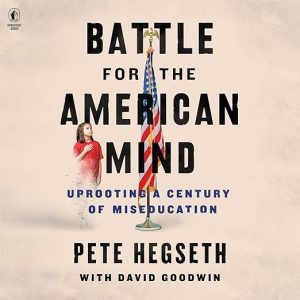
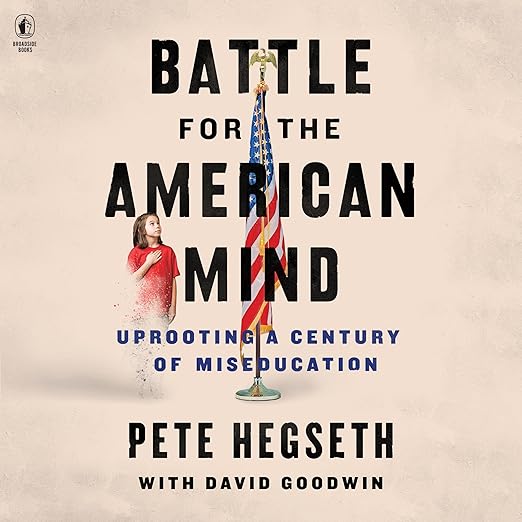
Pete Hegseth's Battle for the American Mind arrives at an audiobook listener's ears with a clear sense of its own purpose. Hegseth, co-authoring with David Goodwin, makes no claim to neutrality. This is a book written by advocates for a specific educational philosophy and addressed to parents who already share their concerns about the direction of American public schooling. Hegseth narrates the audiobook himself, and that authorial presence matters here. The argument is personal as much as analytical, and having one of its co-authors deliver it directly collapses any distance between the claim and the conviction behind it.
The central argument is historical rather than purely polemical, at least in structure. Hegseth and Goodwin trace what they identify as a deliberate early-twentieth-century project to replace classical, virtue-centered education with a progressive model oriented toward producing citizens who conform to institutional expectations rather than think freely. Reviewer E. Calvin Beisner described it as an explanation of the Western Christian Paideia, what it is, where it came from, and why its loss matters for the formation of the civic character that American ordered liberty depends upon. Reviewer Jewel Pickert noted that the educational history, dense with names, dates, and institutional actors, reads more like a story than a textbook, which is accurate to how Hegseth paces his narration through the argumentative passages.
What Pete Hegseth Delivers
The historical sections are the audiobook's strongest material. Hegseth and Goodwin have done serious reading in the history of progressive education reform, and they trace the lineage of figures like John Dewey and the influence of German educational philosophy on American schooling with more precision than most politically oriented books achieve. Reviewer JD Son of Richard noted expecting a review of the public school system but finding something that reached deeper into the roots of where government schools from kindergarten through university acquired their current shape and orientation. That depth is genuine, and it distinguishes the audiobook from simpler political critiques of education that stay at the surface of observable symptoms rather than digging into their institutional origins.
What the audiobook is less interested in is the complexity of competing perspectives. Hegseth and Goodwin are presenting a case, not surveying a debate, and the framework of Western Christian civilization and its preservation is the book's assumed shared value rather than a claim to be established through argument. For listeners inside that framework, the historical grounding will feel like revelation and orientation simultaneously. For those outside it, the same material will read as selective and tendentious. Both responses are honest, and both are foreseeable from the book's framing, which is not pretending to be something it is not.
What Pete Hegseth Gets Right
Self-narrated advocacy has its own audiobook logic. Hegseth's voice carries the energy of someone who believes what he is saying urgently and personally, and that conviction makes 9 hours of historical and philosophical argument feel propulsive rather than academic. Reviewer JD Son of Richard also noted that the book warranted both a repeat reading and a separate audio listen, which speaks to the density of the historical argument and to the value of hearing Hegseth's emphasis patterns when he considers certain points particularly important. Audio captures conviction in a way that a printed record of the same argument cannot fully reproduce, and in a book built on advocacy, that difference between reading and hearing is meaningful.
The book's explicit practical aim, to give parents a framework for evaluating their children's schooling and an entry point into classical Christian education as an alternative, is also well served by the audio format. Hegseth reads the practical and prescriptive sections with a directness that signals their importance within the book's larger argument. Parents listening in the car during school pickups will find that context unusually appropriate for the material.
Where Pete Hegseth Loses Some Ground
The book's framing around concepts like indoctrination, patriotism, and Western civilization is explicitly conservative and specifically Christian. Hegseth does not position this as a culturally neutral argument about educational quality, and listeners who do not share those baseline commitments will encounter the audiobook as advocacy rather than analysis. That framing is clearly legible from the title and synopsis, but it is worth naming plainly: the historical account here is curated to support a predetermined conclusion rather than to weigh competing interpretations of the same evidence. For listeners who share the conclusion, the curation feels like focus and clarity. For those who do not, it will feel like selection masquerading as comprehensive history.
At 9 hours and 23 minutes the audiobook is a committed listen but not an excessive one for the material it covers. The historical sections could accommodate more nuance than Hegseth and Goodwin give them, but the book is designed to activate its audience rather than to settle a scholarly question, and it does that with clarity and efficiency that reviewers consistently found satisfying.
Who Should Pick Up Battle for the American Mind
Hegseth's intended audience is explicit in the text: parents concerned about the direction of American public education who share a broadly conservative and Christian set of cultural commitments. For that audience, the audiobook delivers a coherent historical framework and a practical orientation toward classical Christian schooling as an alternative that will feel both validating and genuinely actionable. Homeschooling families evaluating curriculum philosophy will find specific and substantive material to engage with. Listeners looking for a balanced account of American educational history from multiple ideological perspectives, or those who disagree with Hegseth's premise, will find the argument too circular to persuade, though they may still find value in the historical account if they read it as advocacy rather than scholarship. Knowing what the book is before you start is the key to getting the right thing from it, and the book is admirably clear about what it is.
Questions Listeners Ask
How does Pete Hegseth's self-narration affect the audiobook experience?
It adds conviction and directness that a third-party narrator would not replicate. Hegseth reads with the energy of someone who believes the argument urgently and personally, which makes the runtime feel propulsive. The tradeoff is that there is no interpretive distance between the author's intent and the listener's ear.
Does this audiobook offer practical guidance for parents, or is it primarily historical analysis?
Both. The book devotes significant time to the history of progressive education reform and the Western Christian Paideia, but it is explicitly framed as a field guide for parents wanting to reorient their children's education toward classical Christian alternatives. The practical orientation is integrated throughout rather than confined to a conclusion.