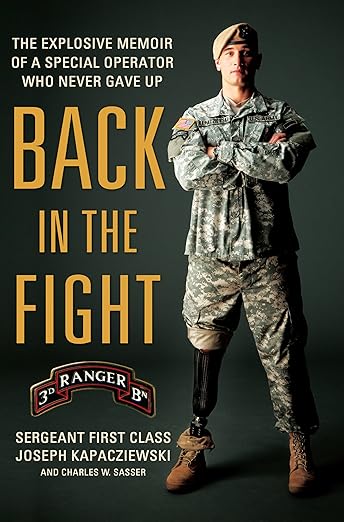
Sergeant Joseph Kapacziewski lost his left leg to a grenade in Afghanistan and then fought his way back into active Ranger combat - a story that could easily become a vehicle for inspirational cliche, and the audiobook of Back in the Fight, narrated by Johnny Heller and running just over nine hours, is at its best precisely when it refuses that temptation. This memoir covers the attack, the physical and psychological process of rehabilitation, and the extraordinary effort it took to become the only Army Ranger serving in direct combat with a prosthetic limb. Heller's narration is controlled and dry, which matches Kapacziewski's apparent register: a man whose self-expression defaults to action rather than reflection.
A Review That Undersells Its Granular Specificity
The memoir operates on a structural tension that gives it more texture than a straightforward recovery narrative. Kapacziewski is not simply trying to get better - he is trying to return to a specific kind of service that the Army had officially closed to him. Every step of the rehabilitation process is filtered through that goal: physical therapy is not about regaining function in the abstract, it is about meeting the specific demands of Ranger combat operations. The distinction matters because it shapes what counts as success and what counts as failure in the narrative, and Heller communicates the driven, goal-oriented logic of that framing without sentimentalizing it. The one available review calls Kapacziewski a True All American Hero, which captures the tone of broad public reception but undersells the book's actual interest, which lies in its granular specificity. The mechanics of adapting to prosthetic mobility under the physical demands of Ranger training, the bureaucratic obstacles within the Army's own medical system, the question of identity when a career defined by physical capacity faces catastrophic physical loss - these are the details that give the memoir its particular weight. A reader looking for a book about what it costs, in very concrete practical terms, to rebuild a military career after catastrophic injury will find more here than a reader looking for broad inspiration about resilience as a concept. Kapacziewski does not appear to be a man who processes through abstraction; he processes through the next physical objective, and that orientation produces a memoir that is more practically revealing than most books in this genre manage to be.
Heller Does Not Perform Heroism
Military memoir as a genre rewards the audio format when the narrator can carry the interior voice of someone trained to understate. Heller's performance does exactly that. He does not perform heroism. He reads Kapacziewski's account of the attack, the chaos that followed, and the long rehabilitation with the even delivery of a man reporting what happened rather than dramatizing it. That restraint is effective because the events themselves are dramatic enough - a grenade attack on a combat operation, an emergency amputation, the question of whether a career defined by physical capacity can survive catastrophic physical loss. The Army Commendation for valor that Kapacziewski received for subsequent missions, mentioned in the synopsis, lands differently in audio than it might in print because by that point Heller's measured delivery has established the full cost of the missions that earned it. The nine-hour runtime keeps the narrative tight - there is no padding, no extended digression into military history or policy that would dilute the personal account. Listeners get the shape of one man's experience rather than a general argument about resilience.
He Had to Generate the Evidence Himself
The section dealing with Kapacziewski's efforts to persuade the Army that he could meet Ranger standards on a prosthetic limb is the book's most interesting sustained passage. It is less about physical capability than about institutional assumptions - the Army's systems were not designed to evaluate what a prosthetic-equipped soldier could or could not do, which meant that Kapacziewski had to generate the evidence himself through demonstrated performance in real time. Heller reads these sections with a patience that suits their procedural character. The memoir does not offer a great deal of philosophical reflection on the wars in which Kapacziewski served - that is not the kind of book this is, and the absence is itself informative. The decision to return, and the scale of the effort required to make it happen, speaks without needing elaboration. Listeners expecting a broader meditation on military service or the ethics of combat should look elsewhere; this book stays close to the operational and the personal, which is simultaneously its limitation and its specific strength.
Easier to Re-Engage After Breaks Than Others
Listeners drawn to military memoir and the psychology of elite soldiering will find this audiobook specific and credible in ways that more broadly pitched inspirational accounts often are not. Those interested in disability and professional identity - particularly in roles defined by physical performance - will find the practical dimension of Kapacziewski's story more engaging than a motivationally framed account would be. Listeners who have themselves navigated institutional bureaucracy while trying to return to professional function after serious injury or illness will recognize the particular frustration that Kapacziewski describes with the Army's evaluation process, and Heller's narration gives those sections the weight they deserve. This audiobook is appropriate for mature teens and adults; the content includes combat violence and serious trauma recovery handled without sanitizing the reality, but also without gratuitous detail. The nine-hour runtime makes it accessible across a long weekend or a week of commute listening, and the linear structure of the recovery arc makes it easier to re-engage after breaks than more structurally complex memoirs.
Before You Listen
Does the audiobook cover the specific missions Kapacziewski completed after returning to combat with a prosthetic?
The memoir includes his return to active combat operations with the Rangers and the missions that earned his Army Commendation for valor, though operational security constraints limit some of the tactical detail. The focus is primarily on the personal rather than the classified.
Is this audiobook suitable for younger listeners interested in military service?
The content includes combat violence, serious injury, and the emotional weight of severe trauma recovery. It is appropriate for mature teens and adults, and the subject matter is handled without gratuitous detail but also without sanitizing the reality of combat injury.
Does Johnny Heller's narration add anything distinctive to this audiobook, or is it straightforward reading?
Heller's particular value here is restraint. He does not amplify the emotional stakes beyond what the text calls for, which suits Kapacziewski's own voice. For a story this raw, underplaying is more effective than performing.