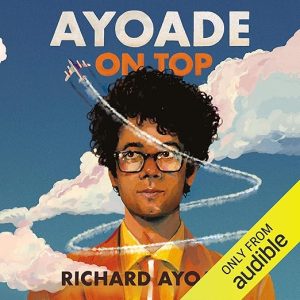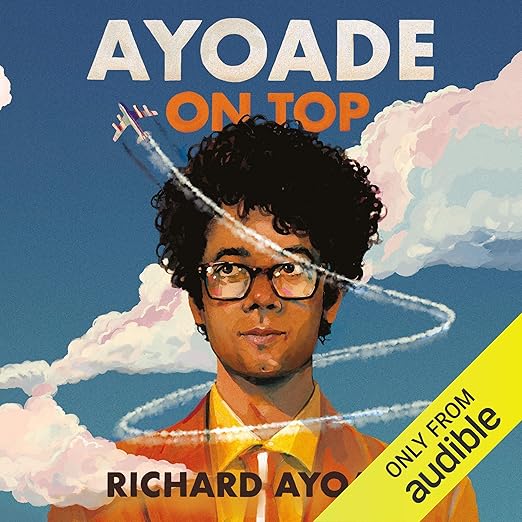
Richard Ayoade narrating Ayoade on Top is less an audiobook production decision than a definitional requirement. The text, ostensibly a serious critical defense of the 2003 cabin crew film View from the Top starring Gwyneth Paltrow, exists as a delivery vehicle for Ayoade's particular brand of hyper-articulate, self-undermining comedy, and that comedy is inseparable from his voice. Every hedged superlative, every mock-portentous claim about capitalism and cinema, every self-referential acknowledgment of his own insubstantiality arrives with the exact timing only its author can provide. Running just under four hours and forty minutes, this audiobook is among the more formally unusual comedy-adjacent releases you'll encounter.
Footnotes Written as if They Were Real
The setup is formally absurd and deliberately maintained: Ayoade argues, with apparent sincerity, that View from the Top, a film that received deeply mixed reviews on release and has never acquired the canonical status Ayoade implies it deserves, is a masterpiece. The argument proceeds through what looks like rigorous film criticism: close readings of specific scenes, theoretical frameworks about capitalism and aspiration, comparisons to canonical cinema. But the scaffolding is comedy. Every piece of critical apparatus is deployed slightly too seriously, and that excess of seriousness is the joke.
Reviewer Antonia Graham called Ayoade a modern poet in the process of stretching his legs into subversive prose, and while the phrasing may be florid, the observation is not wrong. The book does something genuine film criticism rarely does: it makes the act of criticism itself the subject. Ayoade is as interested in what it means to defend a film earnestly as he is in the film being defended. The Donald Trump passage in the synopsis, imagining Trump half-watching the film on his private jet while scanning the cabin with his other puffy eye, is representative: specific, unexpected, and funnier on re-listen because the image has been allowed to develop over several sentences before Ayoade abandons it.
What gives Ayoade on Top its particular texture is the quality of its commitment. This is not a book where Ayoade winks at the audience to confirm that he doesn't really mean any of it. He maintains his critical register throughout, the footnotes are written as real footnotes, the acknowledgments are written as if the acknowledgments matter, the apparatus of serious nonfiction publishing is replicated with care. The comedy operates entirely within the gap between what the form promises and what the content delivers, and that gap is sustained for the full runtime without slippage.
Every Pause Made Audible by Self-Narration
Reviewer "geek extraordinaire" identified exactly why this works in audio: you get every pause and inflection the author intended. This is maximally true of Ayoade's writing because the pauses are structural. The comedy depends on the gap between the claim being made and the tone in which it's made, and that gap only exists in delivery. A flat professional reading of the same text would neutralize most of the humor, because the humor is in the performance rather than in the words alone. Ayoade's self-narration means no translation is required between what he wrote and what you hear.
Reviewer Graham also notes the book is funny from cover to cover, and this is accurate within its register. The humor is consistent rather than episodic, the absurdist commitment is maintained from the opening pages to the closing sections. You don't get relief from the bit; the bit is the whole book. For the right listener, this is the highest possible recommendation. For the wrong one, it's four hours of sustained comedic register with no narrative release valve, no conventional story, and no resting point where the book is simply being a book.
Dead Inside Is the Only Warning Needed
This is explicitly not a book about View from the Top in any standard critical sense. Knowing the film helps, but it is not required, several listeners who had not seen the film found the book consistently funny. What matters is familiarity with Ayoade's mode: The IT Crowd, his film Submarine, or his interviews should give you a reliable sample of whether his register lands for you. If it does, the book will deliver without reservation. If it doesn't, no amount of appreciating the craft will make it enjoyable, comedy is one of the least transferable tastes.
The CAPS-heavy reviewer who submitted what amounts to a warning, it is simply a funny book by a super funny British man, do not get it if you are dead inside, has provided, in their way, the most accurate content guidance in the record. This is a book that refuses to be taken seriously on any terms other than its own. Approaching it as a genuine piece of cultural criticism will produce frustration; approaching it as a sustained comedic performance dressed in criticism's clothing will produce consistent pleasure for the duration.
Skip It for a Straightforward Critical Essay
This audiobook is for existing Richard Ayoade fans, listeners who enjoy film criticism as a genre being gently dismantled from the inside, and anyone who appreciated the comedic density of writers like David Sedaris or Simon Rich but wants something more formally strange and less directly confessional. Skip it if dry, self-aware British comedy is not your mode, if you want a straightforward critical essay, or if four hours of one sustained comedic register without narrative movement sounds exhausting rather than appealing. At under five hours, the commitment is low enough to sample, but the format really does require going all the way in.
Quick Take
- Voice: Richard Ayoade narrating his own book is the only possible casting, every pause, deadpan qualifier, and absurdist aside lands precisely because it comes from the voice that invented them.
- Big ideas: film criticism as performance, the comedy of earnestness, genre and taste as cultural construction
- Atmosphere: Drily hilarious and formally strange, like a director's commentary gone rogue
- Worth it?: Ayoade on Top is a four-and-a-half-hour comedy performance dressed as film criticism, and whether it works depends entirely on whether Richard Ayoade's specific register is your kind of thing.