Three days after this audiobook reached listeners, Susan Moellering posted a review that began by thanking the publisher for an advance copy. That is a small thing and also a revealing one, because the earliest enthusiastic response to Awake on this page came from someone the publisher had supplied ahead of release, before anyone could press play. Jen Hatmaker's account of the night her twenty-six-year marriage ended is a memoir with two lives, one on paper and one in a recording booth, and the review column collected here only ever describes the first of them.
She Had No Grasp of Her Own Bank Accounts
Hatmaker sets the clock at 2:30 a.m. on July 11, 2020, the moment she woke to her husband of twenty-six years whispering into his phone to another woman from their bed. The description does not soften that, and neither does the structure it promises: candid, surprisingly funny vignettes spanning forty years of girlhood, marriage and parenting. What follows in the publisher's own words is the aftermath, a shiny, funny, popular leader becoming a divorced wreck on antidepressants and antianxiety meds, parenting five kids alone with no grasp of her own bank accounts.
That last detail is the one I keep returning to. A woman who had spent over a decade urging millions of other women toward authenticity and radical agency did not know how her household money worked. On the evidence of its own description, Awake is less interested in the affair itself than in the arrangement that made the affair survivable for so long, and the copy says as much when it calls the book a critical analysis of the story handed to all of us: gender limitations, religious subservience, body shame, self-erasure.
Whether that lands depends on how much patience you have for a memoir that keeps stepping back to indict a system. Meg Delagrange, the first entry in the column, describes growing up conservative with a stack of limiting beliefs and finding the book liberating. The reviewer signing as TNScones opens with a spoiler alert and a warning list of everything a reader might judge Hatmaker for, from profanity to church attendance, before landing on four stars. Two people reading the same pages, measuring them against very different rulers.
Buying One Isn't Buying the Other
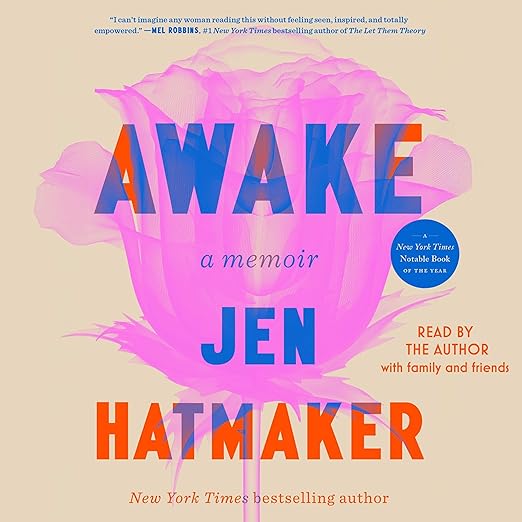
Read by the author with appearances from family and friends, says the opening line of the description, and then it goes further: bonus commentary, plus clips from the For the Love podcast. That is not a format note, it is a content difference. The printed book contains a memoir. This seven-and-a-half-hour program contains a memoir, other voices from inside the story, and archive audio from the show that built the audience the memoir is addressed to. Buying one of those is not buying the other, and the listing does not draw the distinction for you.
The self-narration carries more weight here than it usually does. A memoirist reading her own account of a marriage collapsing is making a second set of decisions in the booth, about which sentences to hurry past and which to sit inside, and the credit line confirms she made them, since author and narrator are one name. Simon & Schuster Audio also lets the people around her speak, which is rare. Most divorce memoirs keep the other participants safely on paper, where they cannot answer back.
What sits above the description is a wall of endorsement: named a best book of the year by the New York Times, Oprah Daily, Goodreads and Kirkus Reviews, a New York Times bestseller, plus blurbs from Mel Robbins and Elin Hilderbrand, the second of whom reports being riveted as if to a thriller. Publisher copy is publisher copy. Even so, that particular stack tells you exactly which audience this was aimed at, and the column suggests it found them, since the single dissent among the written responses still lands on four stars.
Praising a Recording Nobody Could Yet Hear
Nothing on this listing tells you whether the bonus commentary is threaded through the chapters or parked at the end, and that is worth knowing before you commit. A memoir that stops every so often for a podcast clip behaves very differently from one that runs clean and then hands you twenty minutes of extras. Seven hours and thirty minutes is the total. How much of that is the book, and how much is the apparatus built around the book, the record simply does not say.
Susan Moellering's entry is the one to read twice. It went up on September 26, 2025, three days after the release date shown here, and it opens by explaining that the copy was an ARC from the publisher, an early look. So the first voice praising Awake in this column was responding to something that reached one reader ahead of everyone else, and the listing has filed that praise under a recording nobody could yet have heard. Common enough on these pages, and still worth naming, because it changes what the column is evidence of.
If you are arriving from the podcast, you already know the register: fast, funny, self-deprecating, prone to a sudden serious turn. If you arrive cold, the tonal swings can feel abrupt. Hatmaker's own description promises vignettes, and vignettes do not accumulate the way chapters do. Writing as About Face Time, Lori Anderson-Woodard puts it more generously, describing a conversational voice that carries the reader through the destruction and then through the slow, brave work of rebuilding a life from the rubble.
Be Clear About Which Object You're Buying
Listeners who already trust Hatmaker's voice should take the audio without hesitating, because this is the edition with the extra material inside it. So should anyone who has left a religious community and wants a first-person account of what the leaving costs, since that is the spine of the book underneath the divorce. Women in the middle of an unwanted midlife rearrangement will find the specifics unusually concrete, right down to the bank accounts whose functioning she had no clue about.
Give it a pass if you want a tightly built narrative arc, because the form here is vignette and it circles. Give it a pass too if a memoir that turns to indict religious subservience and body shame reads to you as a lecture in place of a life, since this one does both and offers no apology for either. Beyond that, be clear about which object you are buying. Anyone who wants the memoir plus the voices and the podcast archive built around it should take the recording; anyone who wants the sentences alone can read them.