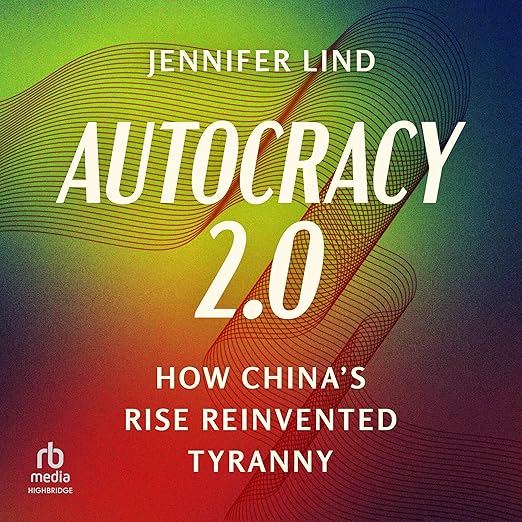
Two thousand and eight men pounded Fou drums in unison to open the Beijing Olympics in 2008, and Jennifer Lind starts there. The audiobook that follows is not about the spectacle. It is about the assumption almost everybody held while watching it: that a government capable of staging that could not possibly generate real innovation. Lind spends eight and a half hours taking that assumption apart, and she has the data to do it.
Smart Authoritarianism's Savile Row-Clad Progeny
The central term is smart authoritarianism, and Lind defines it tightly enough to be argued with. It names leaders who pair rigid political control with inclusive economic measures, running pro-innovation policy and the instruments of repression side by side rather than trading one against the other. The claim is that this combination is stable, productive, and nowhere near confined to a single country.
One phrase in the description does the work of an entire chapter. Today's autocrats, Lind observes, are not "the brass-knuckled dictators of the past"; they are "their polished Savile Row-clad progeny." That is a thesis dressed as a joke. If the new authoritarian is a well-tailored technocrat rather than a strongman with a militia, then every intuition built on the twentieth century mispredicts what happens next, which is precisely the point.
Coupling hard data with the argument is how the book intends to win, and it is also where the structural risk sits. A case built on numbers has to make those numbers audible, and the running time is not generous for a comparative claim spanning several regimes. Expect a tightly argued book rather than an exhaustive survey, and expect China to carry most of the evidence even where the thesis reaches further.
Sorvari's Line Between Analysis and Editorial
Devon Sorvari has a harder brief than the subject implies. The argument only functions if smart authoritarianism is taken seriously as a working system rather than sneered at, and the Savile Row line is exactly the sentence a reader could tip into sarcasm without noticing. Held straight, it reads as analysis. Performed, it becomes an editorial. That balance runs the length of the recording, because Lind's case depends on treating these governments as competent.
Audio suits the shape of this argument better than the shelf above it suggests. This is a thesis book: one claim, defended across chapters, with the Olympics ceremony recurring as an image to return to. Books built that way survive being heard while you move, because a listener who drifts for a minute can rejoin without having dropped a chain of reasoning. Reference-heavy books cannot make that promise. This one can.
Highbridge Audio produced it, and the January 2026 release puts the argument in front of listeners while the questions it answers are still open. Comparative politics ages quickly when the governments it describes keep moving, and a book about how autocrats innovate is worth hearing near publication rather than three years afterward. Buying it now means the examples still match the news you are reading around it.
Two Five-Star Votes, No Written Word
The public record here consists of two ratings. Both have to be five stars, since that is the only way a two-vote average reaches 5.0, and not one written word accompanies them. Nobody has described the pacing, the density, the balance between narrative and data, or the reading itself. On a title this recent that is expected. It is also, plainly, the situation you are buying into.
Classification here is wrong twice over, and the reason is guessable. This sits under computers and technology carrying a History and Culture tag. Neither matches a comparative-politics book about governance and repression, and the two do not match each other either. The 2.0 in the title and the innovation subject almost certainly did it: a record built by keyword lands on the technology shelf, then collects a history tag to compensate.
That cost is concrete. Somebody browsing technology gets a book about political institutions instead; somebody who wants precisely this book searches politics or international affairs and never sees it. On a catalog entry carrying two ratings and no responses, discovery is the only thing keeping a title visible at all, and the classification works against it from both directions at once.
The description is publisher copy throughout, closing on a sales imperative rather than on any account of method. Read it for the thesis and the Savile Row image, then disregard the final sentence. What it never tells you is how the evidence is organized: whether the regimes beyond China get chapters or paragraphs, and whether the hard data arrives as narrative or as tables read aloud. Neither question is answerable from this page.
Tech Professionals as a Secondary Audience
Anyone who watched the 2008 opening ceremony and formed an opinion about what it meant should hear this, because the book argues directly with that opinion rather than around it. It suits readers of comparative politics who want the innovation question handled with evidence instead of anecdote, and it suits anybody whose working model of authoritarian government still runs on twentieth-century strongmen in uniform.
Technology professionals are a genuine secondary audience, which is ironic given where the catalog filed it. If your work touches where research capacity and manufacturing capability actually accumulate, Lind's account of how political control and pro-innovation policy manage to coexist is directly relevant, and it is a far more rigorous version of an argument normally conducted through headlines and quarterly panic.
A poor match, though, for anybody who wants a history of modern China; the Olympics ceremony is a device here, not the opening of a chronology. It will also frustrate a listener who wants the moral question settled, since the method is to describe a system functioning rather than to condemn it. You are buying an argument, and two anonymous votes are the only company you will have while judging it.
- Performance: Devon Sorvari reads solo for Highbridge Audio, on a text whose irony has to stay dry for the analysis to stay credible.
- What it covers: Smart authoritarianism, innovation under political control, China's technological rise, the changing costume of autocracy.
- Feel: Cool, evidential, quietly unsettling.
- Our call: A precise argument against a comfortable assumption, filed on the wrong shelf and written up by nobody so far.