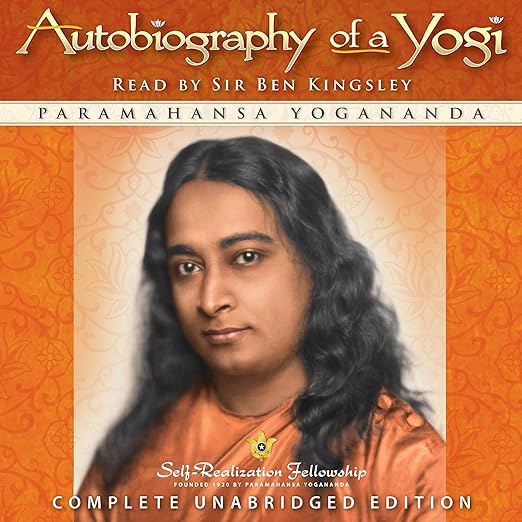
- Performance: Ben Kingsley's Academy Award-winning gravitas is exactly right for Yogananda's elevated prose. His delivery is unhurried and deeply respectful of the text, giving the spiritual claims weight without mockery or ironic distance.
- What it covers: Eastern mysticism and the science of yoga, the search for truth across religious boundaries, miracles, saints, and the nature of consciousness
- Feel: Meditative, wondrous, and at times genuinely otherworldly
- Our call: Kingsley's narration transforms an already remarkable spiritual autobiography into an immersive audio experience that honors the gravity of the source material at every turn.
Paramahansa Yogananda's Autobiography of a Yogi, narrated by Ben Kingsley, occupies a category almost entirely its own. First published in 1946 and continuously in print since, it is simultaneously one of the canonical texts of Eastern spiritual literature available in English, a riveting personal narrative of a life spent in search of truth, and a document that famously sat on Steve Jobs's iPad as reportedly the only book he returned to every year. This audiobook edition, at seventeen hours and forty-nine minutes, presents the complete text with Kingsley's narration, which is among the most consequential casting decisions in the spiritual audiobook catalog.
Those Who Came to Scoff May Remain to Pray
Yogananda's account of his own life is unlike any conventional autobiography. He writes with the conviction of a man who has witnessed miracles, and he describes them with the matter-of-fact precision of a man who considers them entirely natural occurrences within a coherent spiritual framework. His encounters with Indian saints and illuminated masters, his relationship with his own guru Sri Yukteswar, his journeys across India and eventually to the West, are narrated in prose that combines scholarly rigor about yogic philosophy with genuine spiritual wonder. The San Francisco Chronicle's observation that those who came to scoff may remain to pray is not hyperbole: the book's persuasive force operates on the reader's imagination rather than through logical argument.
Kingsley's narration makes that force audible in a way that reading silently cannot replicate. His voice carries a gravitas built over decades of performing Shakespeare and complex literary roles, and he brings that weight to Yogananda's prose without imposing an interpretive layer that would diminish the original's direct address. When he reads Yogananda's descriptions of levitation, of bilocation, of conversations with saints who have transcended death, he reads them straight, with the same measured authority he would bring to historical fact. That interpretive choice, to neither endorse nor ironize the miraculous content, is exactly correct for this text. It allows listeners to respond to the material from their own position rather than being directed toward credulity or skepticism.
From Teacher to Student, Now Through the Ear
The audiobook format does something specific for this text. Yogananda came from a tradition in which wisdom was transmitted orally, teacher to student, generation to generation, and there is something appropriate about receiving his life story through the ear rather than the eye. Reviewers note the book's capacity to produce strong emotional responses. One describes laughing and crying throughout. Another, Raj Dhawan, notes Yogananda's remarkable respect for and engagement with all world religious traditions rather than the narrowly sectarian advocacy one might expect from a devotional text. That interfaith quality is one of the book's most distinctive features and one Kingsley's narration honors.
George Harrison cited Yogananda among the influences he returned to most consistently throughout his life. The book's cultural trajectory, from a specialist spiritual text to a document that found its way onto the reading lists of technology pioneers and creative figures across multiple generations, speaks to the range of readers it has reached. One reviewer traces their discovery of the book through a George Harrison interview, which reflects how the text has moved through culture in ways its original publication could not have anticipated. At nearly eighteen hours, this is substantial listening, but the text rewards patience in ways that shorter spiritual works do not.
Kingsley's Pacing Lets Unfamiliar Material Settle
The book presents claims about physical phenomena, including miraculous healings, levitation, and the extension of life beyond biological norms, that fall outside what most Western-educated readers will consider empirically possible. Yogananda does not frame these as metaphor or symbol. He presents them as events that occurred. Listeners should know this before beginning. It is not a book that hedges its miraculous content, and readers who find that framing an insurmountable obstacle will not be able to set it aside: it is too central to the entire narrative architecture.
The book was written in English by Yogananda himself, but it was translated from his lived experience and cultural formation in Bengal and northern India. The cosmology, the names of saints and deities, the specific philosophy of kriya yoga that runs through the text, are all explained with care, but there is a density of reference that rewards patient engagement rather than quick comprehension. The audio format is forgiving in this regard because Kingsley's pacing allows time for unfamiliar material to settle before the next passage arrives.
The specific detail that Steve Jobs kept this as the only book on his iPad and returned to it annually has circulated widely enough that it functions as a cultural recommendation signal for readers who might otherwise not seek out a 1946 spiritual autobiography. That signal is accurate to the book's actual content: Yogananda writes about consciousness, perception, and the relationship between the material and immaterial world in ways that connect naturally to questions anyone working at the edge of technology and human potential would find resonant. The connection is not manufactured by marketing; it is present in the book's actual intellectual concerns, which makes the Jobs association a useful but not inflated pointer toward what the text actually offers.
An Insurmountable Obstacle for Empirical Verifiers
Listeners drawn to the intersection of spiritual autobiography and mystical philosophy will find this audiobook unlike anything else available in the format. Students of comparative religion, practitioners of yoga and meditation seeking the historical and philosophical roots of what they practice, and general readers interested in extraordinary lives will all find the text rewarding in different ways. Skeptics who are open to encountering a worldview unlike their own will find Yogananda a generous and intellectually serious guide even if his claims remain outside their framework. Listeners who require empirical verification for every assertion will find the book's miraculous content an insurmountable obstacle from the early chapters. For everyone else, Kingsley's narration is an eighteen-hour passage into one of the twentieth century's most remarkable minds.
Before You Listen
Does Ben Kingsley's narration of the audiobook add significantly to the experience compared to reading the print version?
Yes, materially so. Kingsley's delivery brings a gravity and measured respect to Yogananda's prose that suits the text's elevated register. His unflinching reading of the miraculous passages gives the book's spiritual claims their full weight without editorializing.
How does this audiobook handle the miraculous claims Yogananda makes about saints and yogic powers?
Yogananda presents miracles as factual events rather than metaphor, and Kingsley reads them with the same unqualified authority as the biographical sections. Listeners who are open to that framing will find it compelling; those who require skeptical distancing will need to bring it themselves.
How long is the Autobiography of a Yogi audiobook and is it abridged?
The audiobook is just under eighteen hours and contains the complete text of Yogananda's autobiography without abridgement. This is the full edition that has been in print continuously since 1946.