
- Narrator: Leanne Maskell reading her own memoir is an essential format choice; the moments of emotional overload and pattern recognition in her delivery are only possible because she lived what she is describing.
- Subjects: Co-occurring neurodivergence, late diagnosis and its costs, burnout and the road to self-awareness
- Tone: Honest and at times raw, with growing warmth as the narrative moves toward understanding
- Bottom line: AuDHD: Blooming Differently is among the most clinically grounded and personally honest accounts of co-occurring autism and ADHD available in any format.
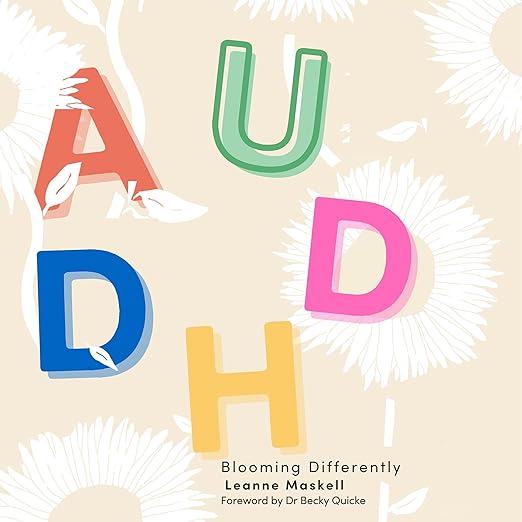
Leanne Maskell's subtitle, Blooming Differently, carries a kind of earned optimism that the early chapters of this audiobook do not yet support, and that gap is precisely the point. AuDHD, the full title of which is AuDHD: Blooming Differently, narrated by Maskell herself in a ten-hour-and-twenty-four-minute runtime, chronicles the years before she understood why the contradictions in her behavior were not character flaws but the predictable output of two neurotypes working at cross-purposes inside the same brain.
The diagnostic history Maskell describes is one that many listeners will recognize: an ADHD diagnosis at twenty-five, followed by seven more years before the autism piece was identified. The delay was not unusual; until 2013, dual diagnosis was not possible under standard criteria, and the co-occurrence rate of approximately fifty to seventy percent that Maskell cites means there is a large population of people who have spent years with an incomplete picture of their own neurology. The book is written for that population specifically, and it speaks to them with the authority of someone who navigated the same incomplete map. The opening framing of AuDHD as being like a unicorn, misunderstood, contradictory, and often invisible to others, is not a marketing metaphor but a precise emotional description of the experience the book documents.
ADHD Says Yes While Autism Says No
Maskell structures the book as what she calls "part memoir, part life coach," and that formulation captures its dual function accurately. The memoir sections cover her childhood vulnerability and trauma, her time as a model and lawyer, and the slow accumulation of burnout that eventually forced the recognition that something fundamental needed to change. These sections are written with the kind of unflinching specificity that distinguishes genuine self-examination from therapeutic narrative performance. Maskell does not present her past self sympathetically at the expense of truth; she is direct about behaviors and coping strategies that were damaging, and she names the external factors that made those behaviors adaptive rather than simply excusing them.
A reviewer who describes the book as feeling "like looking in a mirror" is describing the effect that precision has on readers with similar neurological profiles. The emotional spirals, the sensory overwhelm, the oscillation between hyperfocus and paralysis, these are rendered in enough detail that AuDHD listeners will find their own experience reflected rather than merely represented. Another reviewer, a gay man, notes that he "saw myself in these pages again and again" despite the memoir centering a woman's experience, which speaks to Maskell's skill at identifying the neurological patterns beneath the individual life circumstances. The book earns that cross-gender resonance by maintaining analytical rigor; it is not just a personal narrative but a systematic account of what AuDHD actually produces at a behavioral and emotional level.
The opposition pairs Maskell uses to describe the ADHD-autism tension are introduced at the outset but developed at length in the audiobook. ADHD craves novelty while autism resists change; ADHD misses details while autism hyper-focuses on them; ADHD says yes while autism says no. These oppositions are not just illustrative; they are the analytical framework through which Maskell examines her own behavior, and tracking how they interact in specific situations is one of the most useful exercises the audiobook offers. The burnout sections are particularly relevant for professional listeners; Maskell's analysis of what happens when a high-masking neurodivergent person sustains peak performance long enough to deplete their compensatory reserves is one of the clearer accounts of this phenomenon in accessible literature.
Maskell's Self-Narration Is a Structural Necessity
The self-narration is not a stylistic choice but a structural necessity. Maskell's delivery carries information that no third-party narrator could access: the particular cadence of someone recounting a period of their life they have processed but not entirely put behind them, the slight shift in pacing when she moves from analytical observation to lived memory, the precision with which she reads the bullet-point contrasts between ADHD and autism behaviors as though she is still testing them against her own experience. At ten hours and twenty-four minutes, this is a substantial listening commitment, but Maskell's voice sustains attention because it is never performing recollection; it is enacting it.
The practical sections, the key takeaways for readers and for their loved ones that appear at the book's end, are described by a reviewer as "one of the best parts." This is where the life coach dimension of the book becomes most explicit. Maskell, who holds the title of National Specialist Coach of the Year, understands the difference between insight and application, and she builds the practical content directly from the memoir rather than appending a generic self-help chapter. The advice for psychiatric professionals, educators, and family members is specific enough to be actionable and grounded in the lived experience the memoir documents rather than drawn from general frameworks.
Naming the Pattern Becomes a Relief
The sequence where Maskell traces the arc from high-functioning outward success to total burnout collapse is the emotional and analytical center of the audiobook. She does not treat this as a cautionary tale or a narrative of rescue; she treats it as evidence of a predictable pattern, one that many late-diagnosed neurodivergent people have experienced without having the framework to understand it. The naming of the pattern is itself a form of relief, and that relief is audible in how Maskell's reading changes register in the chapters that follow the burnout account.
The Quintessential Book for Loved Ones Too
This audiobook is essential listening for anyone who has been diagnosed with one of the two conditions and suspects the diagnosis may be incomplete. It is equally valuable for the parents, partners, teachers, and therapists of AuDHD individuals who want to understand the specific contradictions that co-occurring autism and ADHD produce. Listeners seeking purely clinical information will find the memoir format somewhat personal; those seeking purely personal narrative may find the analytical sections more systematic than expected. The combination is the point, and for the audience Maskell is writing for, it is precisely what is needed. The reviewer who describes it as "the quintessential book for AuDHD both for you and your loved ones" is identifying the audiobook's most valuable quality: it works in both directions simultaneously.
Is the audiobook self-narrated, and does Leanne Maskell's reading add to the experience?
Maskell narrates her own memoir throughout. Her delivery carries the particular authority of someone recounting their own experience with analytical distance, and the precision with which she reads the diagnostic contrasts and behavioral descriptions is only possible because she is testing them against her own memory as she reads. This is one of those audiobooks where the self-narration format genuinely serves the material.
How clinical is this audiobook? Is it accessible to listeners without a mental health background?
The book is accessible to general listeners. Maskell does not assume clinical knowledge; she explains both conditions and their interaction from the ground up, using her own experience as the primary illustration. The practical sections at the end are more structured, but they do not require any specialist vocabulary to follow.
Does the audiobook address how AuDHD presents differently in women and girls compared to the general clinical picture?
Maskell's memoir is grounded in her own experience as a woman, and the female presentation of both conditions, including the additional masking pressure that women and girls typically face and the diagnostic delays that follow from it, is a significant strand throughout the book. She is clear that her account is one individual's experience, but the patterns she identifies have strong resonance for other women with co-occurring diagnoses.







