- Narrator: Virtual Voice handles list-driven, practical business content more comfortably than it would handle warmer material.
- Subjects: Attention and trust in marketing, authenticity over polish, higher education visibility
- Tone: Urgent, practical, framework-driven
- Bottom line: A focused, actionable listen for higher-ed marketers, less essential outside that specific world.
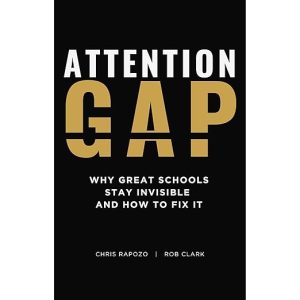
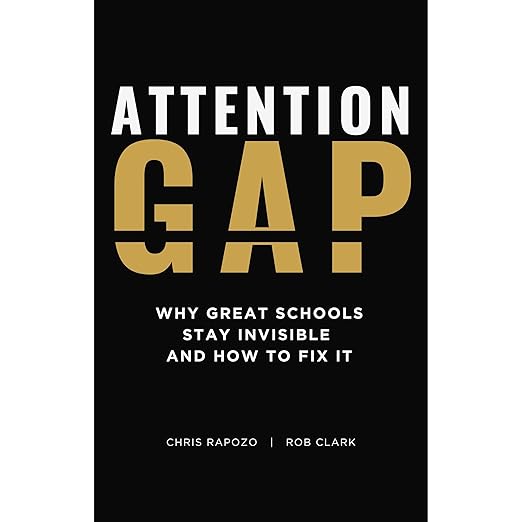
Prospective college students give a new piece of content three seconds before deciding whether to keep watching or scroll past, and Rob Clark builds this entire audiobook around that unforgiving window. Attention Gap argues that most colleges and universities have a visibility problem rather than a quality problem: strong faculty, real outcomes, transformed lives, all invisible to the students who never stick around long enough to notice. Clark draws on more than 130 conversations with higher education marketers from his Education Marketing Leader podcast, plus his own experience building a social media presence the book credits with generating over five billion views, to argue that authenticity beats polish and institutions need to earn attention rather than assume it.
The three-second window concept anchors a book that stays genuinely practical throughout, moving from frameworks for content and social media into a stated ninety-day quick start plan rather than lingering in abstract theory. Reviewers Chance and Ginger Newingham put it plainly, noting that Clark's ideas are "not just interesting, they actually work" in the real world, a distinction that matters a great deal in a genre crowded with marketing books heavy on inspiration and light on execution.
Clark's own credibility runs through the argument as its backbone, and reviewer Gjergj Dollani specifically appreciated hearing directly from people who were in the trenches, the 130-plus marketers whose conversations shaped the book's frameworks rather than relying on secondhand theory alone.
A recurring thread throughout is the gap between what institutions want to say about themselves and what Clark argues students genuinely need to hear from a school reaching out to them, and Clark treats that gap as the real product to fix rather than a communications inconvenience to smooth over with better copywriting. Authenticity beats polish is not just a chapter heading here; it structures the book's entire argument about why glossy institutional messaging keeps failing to convert distracted attention into actual enrollment.
Web experience gets its own dedicated framework alongside content and social media, addressing what happens once a prospective student's three seconds of attention actually convert into a visit to an institution's website. That third leg matters because a compelling social post that dead-ends into a confusing, outdated admissions page wastes exactly the attention the rest of the book works so hard to earn in the first place.
Chance and Ginger Newingham's review also praised how the book "clearly explains why so many good schools struggle to be seen" and then offers "practical, realistic ways to fix that problem" across its later chapters, a sequencing choice that mirrors the diagnostic-then-prescriptive structure running through the rest of Clark's argument.
Narration Handles List-Driven Content Comfortably
Virtual Voice narration tends to handle list-driven, practical business content more comfortably than it handles warmer, character-driven material, and Attention Gap's framework-heavy structure, built around numbered lists and concrete steps, sits closer to the format's strength than its weakness. The content stays clear and easy to follow even without a human narrator's interpretive choices.
At four hours and nineteen minutes, the runtime is genuinely digestible for a practical business listen, comfortable for a single commute-length binge or a couple of shorter sessions. The intended audience, named directly in the book itself as CMOs, VPs of marketing, enrollment leaders, marketing directors, and social media managers, keeps the content focused rather than diffuse.
Trust forms a second major thread, with Clark arguing plainly that trust in institutions has collapsed and that rebuilding it takes more than a rebrand or a new tagline. That argument connects directly back to the three-second window concept, since a viewer who does not trust an institution has even less reason to give it those three seconds in the first place, tightening the book's overall case into a single coherent argument rather than a loose collection of separate marketing tips.
Reviewer Jenielle described finding herself underlining more than she expected, a small but telling detail for an audiobook, and one that suggests the material rewards active engagement rather than passive listening. Pairing the audio with notes or a physical copy may genuinely deepen how much of the ninety-day plan actually gets implemented afterward.
Six Ratings Mark This as Early-Stage
Reviewer Gjergj Dollani, while calling the guide practical overall, expressed a wish to see more data behind some of the claims, a fair point for listeners who want harder evidence beyond practitioner experience and anecdote. The book leans on Clark's own track record and his conversations with other marketers more than on independent research or citations.
With only six listener ratings recorded despite a strong average among them, this is clearly an early-stage, niche release rather than an established bestseller, and the intended audience is genuinely narrow: higher education marketing specifically, not business marketing in general. Listeners outside that world should expect some of the specific examples to require translation to their own context.
Higher education marketing faces constraints most corporate marketing does not, slower institutional decision cycles, multiple stakeholders across departments, and a genuinely skeptical audience of prospective students who have grown up saturated with polished advertising. Clark's frameworks are built around those specific constraints rather than adapted from generic corporate marketing advice, which is part of why practitioners in the field describe the material as immediately usable rather than requiring translation.
The podcast conversations behind the book give Clark's frameworks a breadth of real-world testing that a single consultant's individual experience alone would not provide, even though it also means the book synthesizes other people's insights as much as it presents entirely original research.
That combination of diagnosis and prescription is part of what separates Attention Gap from purely inspirational marketing content, since every framework ties back to the same core three-second constraint rather than drifting into generic branding advice untethered from the book's central thesis.
Smaller Colleges Competing Against Bigger Budgets
Higher-education marketing professionals working inside colleges and universities, especially those managing enrollment or communications directly, are the clearest audience here, especially smaller institutions competing against bigger budgets for the same three seconds of attention. Anyone managing an institution's content or social strategy will find the frameworks immediately applicable to their own work.
Smaller colleges and universities specifically worried about competing against larger institutions with far bigger marketing budgets will find the three-second framework especially useful, since it argues attention is earned through authenticity rather than simply bought through spend.
General audience marketers outside higher education will find plenty of transferable advice about earning attention quickly, but the examples and the ninety-day plan are built specifically around enrollment and campus marketing, so the fit narrows quickly outside that world. Readers wanting a broader marketing book not tied to one sector should look elsewhere first.
Frequently Asked Questions
Is the Attention Gap audiobook only useful for higher education marketers?
It is built specifically for that audience, naming CMOs, VPs of marketing, enrollment leaders, and social media managers directly, though general marketers may still find some of its attention-focused frameworks transferable.
Does the Attention Gap audiobook include the ninety-day quick start plan mentioned in the book?
Yes, the ninety-day implementation plan is part of the audiobook's core content, following the frameworks for content, social media, and web experience that make up the earlier chapters.
How does Virtual Voice narration work for a practical, list-driven business audiobook like Attention Gap?
Reasonably well. List-driven, framework-heavy content tends to survive AI narration better than warmer, character-driven material, and this book's structure leans toward that more favorable end of the spectrum.
Is Rob Clark's credibility in Attention Gap backed by real experience or just theory?
The book leans on his own social media track record and more than 130 conversations with working higher education marketers, which reviewers specifically credited for keeping the advice grounded rather than theoretical.