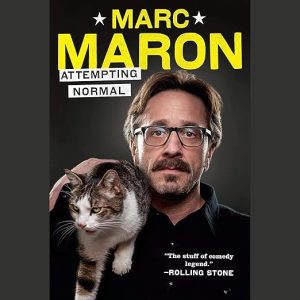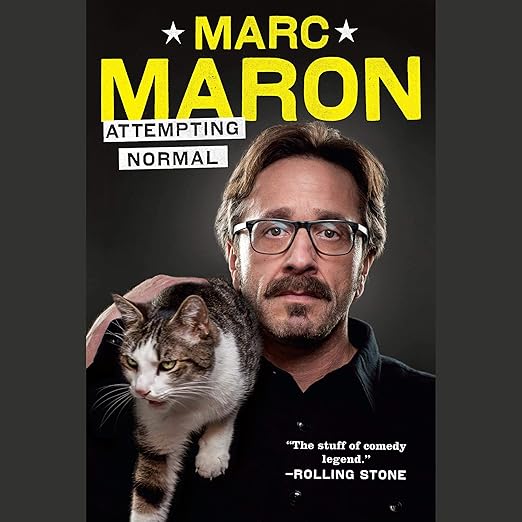
Marc Maron reads his own memoir on this audiobook, and for a comedian whose entire method is confession, that single casting decision is the strongest argument the recording makes. Attempting Normal arrived in 2013, with the podcast already running and the stand-up already built out of the same raw material, so the book had nowhere new to hide. What it offers instead is the inventory: a parent-scarred childhood, a firing, a divorce that wrecked him financially, a house filling up with cats, and a man who cannot stop examining himself in public. Random House Audio put it out at a length that is short for the form and, as it turns out, exactly right for what this is.
Five and a half hours buys you a set of essays rather than a life. Maron moves through the childhood, the marriage that ended badly, a stretch of what the description calls minor-league hoarding, the cats, the flying-airplanes-with-his-mind period, and he does it in pieces that mostly finish where a stand-up bit would finish. SB, reviewing in February 2016, named the appeal exactly: the book answers the two questions people actually have for comedians, which are why are you like this and what happened to you. The answers, that account says, are doozies. That is the shape of the thing. It is not a chronology, it does not pretend to be one, and anyone waiting for the tidy arc from mess to recovery will wait the whole way through.
Before anything else, deal with the figure printed above the reviews, because it will mislead you. The listing reports a 4.3 average drawn from exactly one rating. A single vote lands on a whole number of stars or it lands nowhere, so 4.3 is not a figure one person can produce. Five written accounts sit underneath that count of one, which means the arithmetic and the evidence on this page are contradicting each other in public. Ignore the score and read the accounts instead. They are more useful anyway, and they disagree with each other in ways no average would preserve.
Why Listen to Attempting Normal
Confession is the engine, and this format sharpens it. Phil Keeling, writing weeks after publication, described Maron's audiences splitting into two camps on the way out of a show, one thinking the guy was hilarious and the other hoping he is all right, and then called the book "the perfect companion piece to his stand up comedy." That is precisely the register. The prose does not perform wellness or arrive at a lesson. It reports the mess, keeps reporting, and trusts you to find the funny in the reporting rather than in a punchline. I came away thinking less about the jokes than about the cats, which the description files among the symptoms and the book treats as a genuine relationship. That is the tell. A lesser comedian would have made the cats a bit; Maron makes them a fact and lets the sadness sit where it falls.
What the audio edition changes is the chain of custody. On the page, a comedian's memoir is a comedian doing prose, and any reader has to reconstruct the delivery from memory of the act. Here the credit line removes that step: the sentences come back from the person who wrote them, on a book whose recurring subject is the gap between the performed self and the private one. That is a structural fact about the edition rather than a compliment, and it is why this particular memoir belongs in audio more than most celebrity books do. The comedy shelf it sits on undersells the second half of the bargain, though. Attempting Normal is filed under comedy and humor, and a great deal of it is about being unwell.
What to Watch For in Attempting Normal
The praise block on this listing does two separate jobs and announces only one. A first run of quotes covers the book, with David Sedaris, the Los Angeles Times, The New York Times and Sam Lipsyte all named and all responding to these chapters. A second run, headed as praise for Maron and WTF, covers the podcast: Judd Apatow's contribution is "For a comedy nerd, this show is nirvana," which grades a program rather than a set of chapters. Rolling Stone, Louis C.K., David Cross and Entertainment Weekly sit in that same second block. Read at speed, the two runs merge into one wall of endorsement for a book that only half of them were describing.
Reviews on the same page carry a related problem, which is that they are not describing this edition. A three-star account from February 2014 works through why the book got bought at all, having caught Maron on Real Time with Bill Maher and then tracked down an older HBO special, and mentions that this was the first ebook that reader had picked up. The verdict is the most measured on the listing: "not a great work of art, but if you want to get to know Marc better, I highly recommend it." That is a fair statement of the ceiling. Nobody here is claiming a masterpiece, and the book is not asking to be treated as one.
Who Should Listen to Attempting Normal
Anyone who has spent time with the podcast will recognize the method immediately, and will get the origin story behind it. The listener this suits best already likes Maron's discomfort and wants more of it in a form he controls from end to end. One November 2025 review boils the appeal down to eight words: "These stories have heart, grit, and great humor." A March 2016 account makes the sharper observation, noting how strange it is that a person can write a whole memoir diagnosing his own foibles and blind spots and still describe himself as struggling with them daily. That gap between insight and behavior is the actual subject, and it is why the book keeps working after the jokes land.
What you will not get is a set list, a joke book, or a comedian being funny on command. Attempting Normal is a memoir written by someone with professional timing, and its best stretches are the ones where the timing steps aside and the reporting takes over. If your interest in Maron is strictly as a stand-up, this will feel like a detour through somebody's worst decade. If your interest is in why the act sounds the way it does, and why the podcast landed the way it did, then this is the document that explains both.