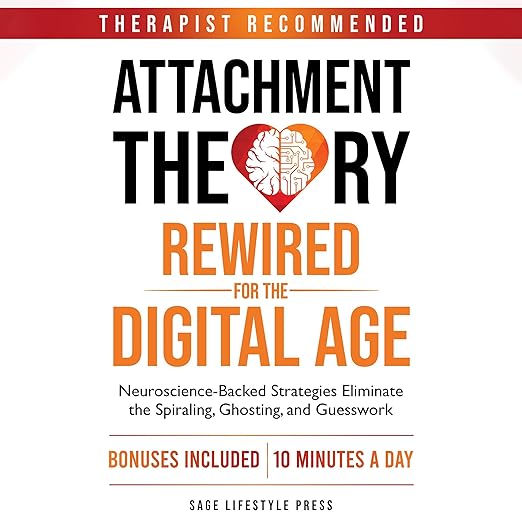
The publication date on this edition is October 27, 2025, and every written review attached to it predates that day. The five comments run from September 10 to October 26 of the same year. That does not make them worthless, but it does mean none of them can have been written about this audiobook, and it neatly explains a silence you would otherwise find odd: not one of the five says anything at all about the narration.
What they are describing is the book, and on the book they agree closely enough to be useful. This edition runs four hours and forty-six minutes and is credited to Sage Lifestyle Press, which is also the publisher. No individual clinician is named anywhere on it. Hold that thought, because the central vocabulary here is neuroscience.
Ghosting Fears and Anxious Texting Cycles Explained
Attachment theory itself is old, well-tested and not remotely controversial: anxious, avoidant and secure patterns, formed early, replayed in adult relationships. The proposition here is that a phone changes how those patterns express themselves. The publisher is blunt about it, offering help with "anxious texting cycles, ghosting fears, or emotional overwhelm every time your phone buzzes". I find that framing genuinely useful, because the behaviors really are new even when the psychology is not. A read receipt is a new object in the world. Waiting for one is not.
The organizing device is a named method, the REWIRED framework, and the copy asks for ten minutes a day. Spread the runtime across a daily practice at that rate and you get roughly a month of short sittings, which is a far saner way to use the recording than treating it as a single evening. The reviewer catherine milam lists the ground covered: "Your brain on attachment, Installing new Neural pathways, Secure communication in the digital age." That is offered as a sample of topics rather than a full contents list, but the arc is visible: mechanism first, rewiring second, application to messaging last.
Naming Ghosting and Texting Anxiety Without Judgment
What the reviewers converge on is the overlay rather than the theory. Nitzan levi credits the book with showing "how they play out in today's digital world" and names the behaviors: "ghosting, texting anxiety, or second-guessing relationships online". Robyn, the one four-star voice here, describes a book that "bridges timeless emotional needs with the complexities of modern digital relationships" and reports being challenged "to become more intentional in how I connect, communicate and care in an age of constant distraction". Shaikh points at the same seam, praising "neuroscience-backed strategies to help with common relationship issues like ghosting and guesswork".
E Booth is the most concrete about how it works page to page: "The book gives short, doable exercises that help you become more aware of your patterns and gently shift your reactions", with each style "broken down in a non-judgmental way". That non-judgmental register is worth more than it sounds. Attachment material slides very easily into diagnosis, and a listener who decides at hour one that they are the avoidant one and their partner is the anxious one has already stopped learning.
Chris Kiefer's Untested Even-Tempered Register
Chris Kiefer holds the narrator credit. Instructional psychology of this kind asks for an even, unhurried register: no motivational lift, no therapy-room hush, just a steady voice that can read a list of exercises without making them sound like commandments. I have no way of telling you whether that is what the recording delivers, since the review pool closed before it existed, and the sample is the only honest test available to either of us.
Neuroscience-Backed Claims With No Clinician's Name
Start with the credits. A book leaning this hard on neuroplasticity, nervous-system regulation and "neuroscience-backed" tools carries no clinician's name; the byline and the imprint are the same. That is not disqualifying, and plenty of useful practical psychology comes out of editorial teams rather than consulting rooms, but it should change how you hold the science. Treat the exercises as prompts that either work for you or do not, and treat the brain talk as framing rather than as findings you could go and look up.
Then the bonuses. The copy advertises downloadable extras, and catherine milam names them: "bonuses, download of personalized attachment, pattern, mapping, and the self-love challenge". Anything downloadable is a warning sign in audio, because the working part of the product lives outside the recording. If the mapping exercise is where the value sits, a listener who never opens the companion material has bought the introduction rather than the book.
Then the numbers. A 4.6 average across 128 ratings is a respectable showing for something this recent, and I have no reason to doubt the enthusiasm behind it. It simply does not attach to the recording. The copy's own "2025 Edition includes downloadable bonuses" phrasing implies an earlier version was already circulating, which is the simplest explanation for a review pool that closed before release day. Read the score as a verdict on the text and nothing more.
Rereading a Sent Message Four Times
If your phone is where your relationships go wrong, this is aimed squarely at you. Someone who rereads a sent message four times, who reads meaning into a delayed reply, who has been ghosted and has not stopped rehearsing it: the book names those behaviors outright instead of making you translate general attachment theory into your own situation. Under five hours, cut into short daily pieces, is also the right size for that reader, who probably does not want a semester of homework.
It suits a second group as well: people who already know their attachment style and want to think about how technology amplifies it. That is a more analytical use, and the only four-star review here reads like it came from exactly that reader, wanting intention rather than rescue. The book's own promise of breaking "the anxious-avoidant cycle that keeps you stuck" is aimed at exactly that reader, who has usually identified the pattern long before finding a way out of it.
Give it a miss if you want clinical depth with citations you can chase, or if a named practitioner behind the argument matters to you, because that name is not here. Give it a miss too if your difficulty has nothing to do with screens, since the digital frame is the whole point of this edition rather than a chapter inside it. And if the exercises are what you are buying, plan on opening the downloads. My own test would be to try one exercise from the sample and see whether it asks something of you or merely describes a problem you already knew you had.
Quick Take
- Narration: Chris Kiefer is the credited reader on material that needs an even, unhurried register; the entire written review pool predates this edition.
- Themes: Anxious and avoidant patterns, read receipts and ghosting, nervous-system regulation, daily habit change.
- Mood: Even-tempered and instructional, sized for a month of short sittings.
- Verdict: A clear, well-aimed practical guide whose neuroscience vocabulary outruns the credentials printed on it.
Good to Know
Can I follow the REWIRED method from the audiobook alone?
Mostly, with one precaution. A named framework is harder to hold in audio than on a page, because you cannot flip back to the step you missed. Write the steps down the first time through and the ten-minute daily pattern the copy describes becomes workable without stopping the recording every session.
Does this audiobook work if my partner will not listen to it?
It should. The exercises described by reviewers are self-directed, aimed at noticing and shifting your own reactions rather than negotiating someone else's. Shaikh recommends it for relationships with a partner, family or friends, which suggests the material is not built around a couple working through it together.