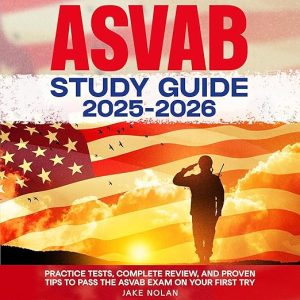
Jake Nolan's ASVAB Study Guide 2025-2026 does what a good test-prep audiobook should do: it covers every scored section of the actual exam, from Arithmetic Reasoning and Mathematics Knowledge through Mechanical Comprehension and Electronics Information, without padding the runtime with filler material. Narrated by Tom Brooks across six and a half hours, the audiobook is built around hundreds of practice questions with detailed answer explanations, organized into manageable lessons rather than one undifferentiated wall of content. What makes this particular guide worth considering over the dozens of similar titles competing for the same shelf space is its stated emphasis on reasoning through problems rather than pure memorization, plus a companion PDF included with purchase for the sections that genuinely need visuals.
The guide's emphasis on practical application over rote memorization runs through its structure: rather than presenting isolated facts to memorize, each lesson walks through the reasoning process for a given problem type, then reinforces it with practice questions modeled closely on the ASVAB's actual format and difficulty level. That approach matters because the ASVAB tests reasoning under time pressure as much as raw factual recall, and a study method built purely around flashcard-style memorization tends to underprepare test-takers for the actual exam experience they'll face on test day.
No listener reviews are attached to this title yet, which makes a rating of 4.7 from fifty-five early listeners worth noting as a reasonably strong signal even without individual testimonials to quote directly. What the synopsis promises, and what the structure of the book itself suggests, is a fairly standard but competently organized test-prep format: broken into the ASVAB's actual scored categories, each with its own lessons, practice questions, and explanations of why a given answer is correct rather than simply marking it right or wrong and moving on.
That explanatory approach matters more than it might seem for audio specifically. A study guide that just reads questions and answers aloud is nearly useless in audio form, since listeners can't see diagrams or work through equations visually while driving or exercising. This guide's structure, built around explaining the reasoning behind each answer, translates more naturally to listening than a pure question-bank format would, even though math-heavy sections still benefit enormously from having the companion PDF open alongside the audio track.
Brooks's Specialization Shows in His Measured Register
Tom Brooks has narrated a range of exam-prep and professional certification audiobooks, and that specialization shows in the register he brings here: measured, unhurried, and appropriately serious without tipping into the dryness that makes some study guides genuinely hard to sit through. His pacing on this title accommodates the kind of note-taking or pausing a listener actually studying for the ASVAB, rather than just listening for entertainment, needs in order to absorb specific formulas or mechanical concepts properly. That specialization is worth something in a crowded category where plenty of narrators simply read generic content aloud without any particular feel for how test-prep material actually gets studied and reviewed.
The ASVAB itself determines career and enlistment options across every branch of the military, which means the stakes for getting Mechanical Comprehension or Electronics Information wrong aren't abstract; they translate directly into which military occupational specialties become available to a test-taker afterward. A guide organized specifically around the real exam's actual scored sections, rather than generic standardized-test advice, has a clearer, more direct value proposition than broader study skills content might offer instead.
Independent study guides like this one exist alongside the free official practice materials the military itself provides, and the case for choosing a dedicated audiobook version comes down largely to format preference: listeners who retain information better through hearing explanations aloud, rather than reading static text or clicking through an online practice test, get something the official free resources don't offer in quite the same way. That's a real, if narrow, value proposition rather than a claim that this guide's content is dramatically more comprehensive than what's freely available elsewhere already.
Detailed information about author Jake Nolan's specific background isn't included in the available listing, which is fairly typical for the crowded ASVAB and military test-prep category, where authorship often matters less to buyers than whether the content maps accurately onto the current exam format. What the synopsis does establish clearly is scope and structure: every major ASVAB subtest gets dedicated coverage, and the promise of tracking progress across practice questions suggests a study method built for repeated use rather than a single pass through the material.
Treat Audio as Explanation, the PDF as Reference
The absence of listener reviews means no outside confirmation yet exists of how well the audio format alone handles the more visual sections, geometry problems, mechanical diagrams, circuit questions, that traditionally favor a printed or PDF format over pure audio. The included companion PDF is clearly meant to bridge that gap, and listeners should plan on using both formats together rather than treating the audiobook as a standalone study method for every section of the exam.
At six hours and twenty-eight minutes, this is a relatively compact guide for an exam that covers as much ground as the ASVAB does across its multiple subtests. Listeners aiming for a top-tier composite score, rather than simply passing the minimum threshold for enlistment, may want to supplement this guide with additional targeted practice, particularly in whichever specific subtest determines their desired job placement down the line.
Audiobook listings for study guides like this one frequently bundle a PDF specifically because publishers recognize audio alone can't fully serve visual subject matter, and the note included with this title, that the accompanying PDF appears automatically in your library alongside the audio, confirms that's the intended way to use it. Listeners who skip downloading that companion document are effectively using only half the product for the sections that need it most, particularly Mechanical Comprehension's diagrams and any geometry-heavy Mathematics Knowledge questions on the exam. Treat the audio as the explanation layer and the PDF as the reference layer, rather than picking one format over the other.
One Listen Won't Guarantee a Top Score
Prospective enlistees studying for the ASVAB, particularly those who learn well through audio explanation and want to review material during a commute or workout rather than only at a desk, are the direct audience for this guide. Parents or recruiters looking for a study aid to recommend to a young person preparing for the test will also find the organization straightforward enough to point someone toward with real confidence.
Anyone counting on a single pass through six and a half hours of audio to guarantee a top score should recalibrate that expectation now, since the guide is built for repeated review across weeks of preparation rather than a one-time listen the night before test day.
Good to Know
Can you actually study for the ASVAB using only the audiobook?
For most sections yes, but the more visual content, like geometry and mechanical diagrams, benefits enormously from the companion PDF included with purchase, so treating the audiobook alone as a complete study plan isn't recommended.
Does the ASVAB Study Guide audiobook cover all sections of the real exam?
Yes, it covers Arithmetic Reasoning, Mathematics Knowledge, Mechanical Comprehension, and Electronics Information among the exam's scored categories, organized into manageable lessons with practice questions for each.
Is Tom Brooks's narration suited to math and mechanical reasoning content?
Yes, his measured, unhurried pacing accommodates note-taking and processing formulas, a register he has used across other exam-prep and certification audiobooks with similar technical content.
Do I need the companion PDF to get value from this audiobook?
You'll get the most value using both together. The PDF handles visual material like diagrams and equations that audio alone struggles to convey, while the audiobook works well for reasoning through concepts and reviewing on the go.