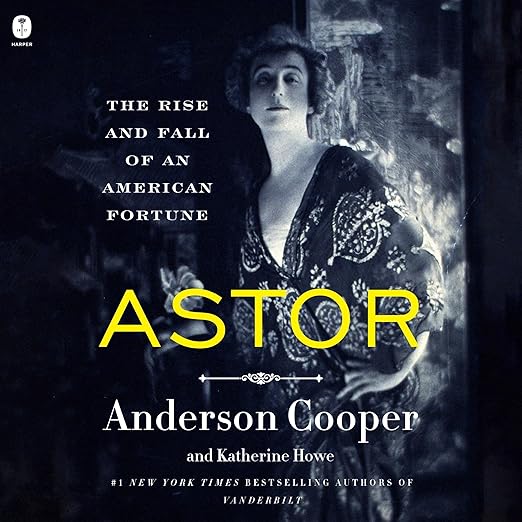
Katherine Howe is named in the description of this audiobook as a co-author, and nowhere in the credit. The summary says authors, plural, twice over: the bestselling authors of Vanderbilt return, and the two of them chronicle the Astors. Both names appear in full. The author field on this listing says Anderson Cooper, and nothing else. Eight hours and nineteen minutes of history has two writers behind it and one name attached to it. Two of the readers underneath it caught the discrepancy anyway.
Two Readers Catch a Co-Author the Field Misses
Two readers caught the omission without any prompting, which tells you it is visible. R. Jones opens by comparing this to the earlier book on the Vanderbilts and writes that Cooper and Howe selected key family members and key events to tell the story of the Astors, naming both. Another entry recommends taking it in combination with their book, Vanderbilt, reaching for the possessive plural. The people who bought this know it is a collaboration. The listing does not say so anywhere.
Cooper is credited twice on this page, once for the writing and once for the reading, and Howe is credited once, in prose, where no field can see it. For an eight-hour family history that arrangement matters: one of the two writers delivers the work of both, so the reading carries the authority of a person who wrote half of it. Whether it shifts the emphasis anywhere is unknowable from a listing, and it is still the strongest structural reason to take this in audio.
1783 to 2009, Beaver Pelts to a Courtroom
The Astors themselves supply more than enough. The description runs from 1783, when John Jacob Astor arrived in the United States as a German immigrant, to 2009, when Brooke Astor's son Anthony Marshall was convicted of defrauding his elderly mother. Beaver trapping became an empire, the empire became Manhattan real estate, and the family bought its way into Gilded Age society, politics and culture before suffering the most famous loss on the Titanic. Two and a quarter centuries, one surname, and a courtroom at the end of it.
Footnotes This Time, and a Promised Family Tree
Marita L. Marley-villanueva's three-star entry is the most useful thing on this page, and not because it is negative. It says the book is carefully researched and written, then says what the research produced: that the famous Astor family were horrible people, with William Astor partially redeemed by the charities William Astor established. It adds that the first half carries a lot of interesting historical information, praise with a clear boundary attached. The entry breaks off before naming what the second half does, which is the exact spot where a prospective listener would want it to keep going.
R. Jones supplies the structural read. The book selects key family members and key events rather than marching through a genealogy, which Jones calls entertaining and well researched, and credits the authors with adding sociological context that makes the result deeper and more relevant. That is the difference between a family chronicle and a book about American money, and it is why a listener with no particular interest in the Astors might still want this one. Jones also notes, in parentheses, that they even have footnotes this time.
The audio edition ships with a supplemental enhancement PDF, which the description states outright. That normally means images, family trees or source notes that could not be read aloud, and on a book covering two centuries of one dynasty a tree is the single most useful object a listener could be handed. The listing never says what the file contains. It does say the file exists, more than most audio pages bother with. Anyone trying to keep John Jacob, William and Brooke Astor in their right generations by ear should find it first.
Every Entry Describes Reading Over Listening
Numbers first, because the counter and the entries disagree. Four votes are tallied at the top while five signed responses sit below, so either somebody wrote without the tally registering it or the tally is measuring something else entirely. The displayed average is 4.3, and spread across four votes that figure depends on which rounding convention the page applies, which means no honest arithmetic claim can be built on it. What you can count is three fives, one four and one three, spread across entries dated between December 2023 and March 2026.
Nearly every entry describes reading rather than listening. One counts footnotes. Another reports finishing it for a book club and then planning a trip to The Tenement Museum in the lower east side. A third calls it a page turner. A fourth recommends reading this first and their book Vanderbilt second. The handle on the fifth is Kindle Customer. None of that makes their judgments wrong about the book. It does mean this column is about a text while the page is selling a performance, and a listener has to translate every observation across that gap.
Small errors elsewhere reinforce the impression of a page assembled quickly. One review headline spells history as Hisrory. Another opens with a stray exclamation mark ahead of its first word. The subject tag reads Professionals and Academics, which fits a book about beaver pelts and Manhattan landlords only if you squint. None of that touches the recording. The uncredited co-author is the same category of failure at a scale that actually counts, and it is the one item on this page a publisher could fix in a minute.
Cooper's Own Voice Is the Reason for Audio
American money and how it was made is the real subject, so the audience runs wider than people who care about one family. Anyone who liked the Vanderbilt book is the obvious first call, and two entries say so explicitly, one recommending the pair be taken together and one comparing the method directly. Listeners drawn to Gilded Age New York, to Manhattan real estate, or to the long slow route by which a fortune arrives in a courtroom in 2009 will find the arc satisfying.
The wrong purchase here is for someone who wants a complete dynastic history, since one entry states plainly in its headline that this is readable though selective, and the method is selection by design. It is also the wrong purchase if you cannot easily reach the accompanying file, because a two-century family story leans on a visual aid the description promises without describing. Cooper's own voice is the reason to choose the audio over the page.
Good to Know
What is the supplemental PDF that comes with this audiobook?
The description states only that a supplemental enhancement PDF accompanies the recording, without saying what it holds. On a history running from John Jacob Astor's arrival in 1783 to a fraud conviction in 2009, a family tree or a set of images would be the obvious contents. Locate the file before starting.
Why is Katherine Howe missing from the author credit?
The page never explains it. The description uses the plural authors twice and prints both names in full, and two written responses discuss Cooper and Howe as a pair, one comparing the method to their earlier Vanderbilt book. The author field carries a single name anyway, which reads as a metadata failure.
Does the audiobook work without having read Vanderbilt first?
Yes, though two entries recommend the pairing. One suggests taking this first and the other second; another compares them directly, saying the same approach of selecting key family members and key events is applied here. The Astor story stands on its own from 1783 forward, so no prior reading is needed.