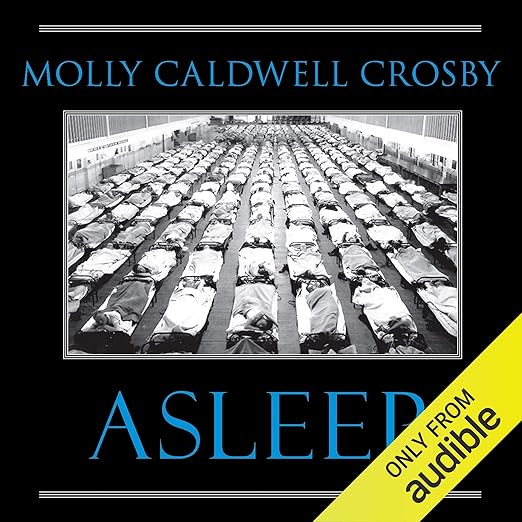
Molly Caldwell Crosby's craft, on full display in the audiobook Asleep, narrated by Christian Rummel, is the ability to write about medicine without letting the science flatten the humanity of the people it touches. The book reconstructs the encephalitis lethargica epidemic of the early twentieth century, a disease that swept through Europe and the United States between 1917 and the late 1920s, left millions dead or institutionalized, and then vanished as completely and mysteriously as it had arrived. Crosby follows the neurologists at New York's Bellevue Hospital and other institutions who spent years trying to understand it, and the patients whose fates those neurologists could barely influence.
Surviving the Disease Was the Real Horror
The particular horror Crosby excavates is not the dying but the surviving. Encephalitis lethargica did not always kill its victims; it often locked them into states of suspended consciousness, leaving them technically alive but unreachable, warehoused in asylums for years. The patients who could communicate described what they experienced as a kind of enforced paralysis, aware of the world but unable to engage with it. That premise gives Asleep its moral center: what does medicine owe to people it cannot cure, only contain? It is a question that the neurologists of the 1920s faced without the benefit of the antibiotics and antivirals that would come later, and their partial, improvised answers make for genuinely uncomfortable reading.
Rummel's Narration Anchors a Convergence of Catastrophes
Rummel's narration captures the period atmosphere of 1920s and 1930s New York hospital wards without sliding into pastiche. He handles the medical terminology with authority, which matters in a book where the vocabulary of early neurology is both dense and important. A neurologist reviewer praised the book as an excellent historical account, which tells you something about the research rigor; this is not popular science in the watered-down sense but genuinely informed medical history that holds up to professional scrutiny. The epidemic's setting alongside the 1918 influenza pandemic and the First World War gives the disease a specific historical texture that rewards the attentive listener.
Crosby situates the sleeping sickness within a convergence of catastrophes that shaped how Western medicine understood the nervous system. What these neurologists did and did not know, what tools they had and lacked, and how their limitations shaped their patients' outcomes gives the book a dimension that stretches beyond a single disease's biography. One reviewer noted the likely flu-related connection, which modern research has since investigated seriously, and Crosby's account of early neurological uncertainty reads now as a story about the limits of scientific certainty as much as a story about one epidemic. That double relevance makes it unusually durable for a book about an almost-forgotten disease.
Six and a Half Hours Paced for Atmosphere
The audio format works particularly well for a book built around atmosphere. Crosby's prose style leans documentary, with the kind of accumulated detail that benefits from being heard at a consistent pace rather than skimmed visually. Rummel's steady delivery lets the strangeness of the material accumulate over the 6-hour-and-31-minute runtime, and the epidemic's inexplicability becomes more haunting through sustained listening than through a quicker read. The book's relatively compact length makes it a natural choice for a week of evening listening or a long-weekend commitment.
Rummel is particularly effective in the patient-focused passages, where Crosby describes individual lives disrupted or ended by the disease. These portraits are the emotional core of the book, and they require a narrator who can give them weight without overplaying them. Rummel threads that line well, allowing the circumstances themselves to carry their own gravity. The clinical passages between these portraits are delivered with matching evenness, which creates a rhythm that serves the documentary quality of the overall work and prevents the listening experience from becoming relentlessly bleak.
No Climax, Because the Disease Just Stopped
The narrative structure is loose. Crosby works through the epidemic by following multiple doctors and patients across roughly two decades, and the book does not build toward a climactic resolution because there was none: the disease simply stopped. One reviewer observed that it does not hold together well as a narrative work and is not a tightly-woven tapestry, which is an accurate description. Listeners expecting a story with a traditional arc of discovery and solution will need to adjust their expectations significantly. This is closer to a series of intensely rendered portraits than a procedural medical mystery with a satisfying resolution.
The writing quality is also variable. Crosby is clearly working to generate atmosphere and dramatic momentum in a true-history format, and some passages succeed fully while others feel slightly strained. The audiobook format helps absorb those rougher passages within the flow of narration, but the prose inconsistency that print readers notice is present and audible if you are paying close attention. These are limitations of the source material that even a skilled narrator cannot fully paper over.
Honest History That Refuses a Tidy Ending
Listeners with an interest in medical history, epidemic narratives, or early twentieth-century neurology will find this audiobook rewarding. Readers who connected with Crosby's own The American Plague will recognize the same documentary sensibility and historical seriousness at work here, applied to a different disease with a different, stranger shape. Those who require narrative fiction conventions, a mystery that resolves, a protagonist who prevails, will find the book's structural openness frustrating. Asleep is honest history, which means it ends in the same uncertainty the neurologists themselves were left with when the epidemic disappeared without explanation or scientific closure.