Quick Take
- Voice: Tom Brooks delivers steady, unfussy professional narration, consistent with his other certification exam-prep audiobooks.
- Big ideas: Diesel engine diagnostics, modern emissions systems, exam-focused practice questions
- Atmosphere: Focused, practical, no-frills
- Worth it?: A solid review supplement for working technicians studying for ASE T2, not a standalone or beginner resource.
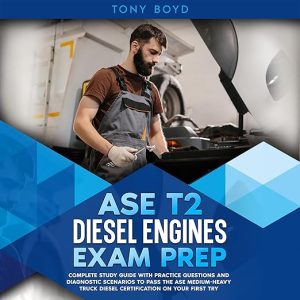
This is a focused, no-frills study tool for a specific, high-stakes professional certification, and it does that one job well rather than trying to be a general diesel-mechanics primer. The ASE T2 Diesel Engines exam is one of the credentials that separates a working technician from a certified specialist in medium- and heavy-duty diesel work, and this audiobook is built entirely around getting a listener through that specific test, not around teaching diesel repair from first principles for a hobbyist or general audience. Tom Brooks narrates with the same measured, professional register he's brought to other technical certification guides, no dramatization, no filler, just steady delivery of dense material.
The content moves from foundational concepts, the four-stroke cycle, compression ignition, and the core differences between diesel and gasoline engines, through to genuinely advanced diagnostic territory: turbochargers, electronic controls, and modern emissions systems including EGR, DPF, SCR, and DEF. That range matters for anyone gauging whether this fits their current level; a total beginner may find the pacing brisk, while a technician who already has hands-on diesel experience and just needs to close a knowledge gap before test day will likely find the pace exactly right.
Diagnostic Reasoning Beats Memorized Component Facts
The troubleshooting sections are where this earns its keep. Rather than just listing facts about engine components, the guide walks through actual diagnostic reasoning: symptom-based diagnostics, reading smoke and noise as evidence, compression testing, boost testing, and how to interpret what a scan tool is actually telling you. That's the harder, more valuable skill the ASE T2 exam is really testing, not memorized facts about parts but the ability to reason from a symptom back to a probable cause, and building that reasoning process into the audio content itself, rather than just describing components in isolation, is a real strength.
Two hundred exam-style practice questions with detailed explanations round out the material, and the explanations matter as much as the questions themselves; getting an answer right or wrong is far less useful for real learning than understanding why the correct answer is correct and, just as importantly, why the tempting wrong answers are wrong. Structuring practice this way, question, pause, explained answer, works reasonably well even in audio-only format, though it asks more active listening than a straightforward lecture chapter would.
T2 Targets a Narrow, Higher-Earning Specialty
The synopsis frames this explicitly as building diagnostic reasoning skills needed for long-term career growth, not just short-term test success, and that framing is borne out in how the material is organized. Rather than teaching to the test narrowly, the guide connects individual facts, what a specific DPF sensor reading means, for instance, back to the larger diagnostic logic a working technician needs on the job long after the ASE T2 exam itself is behind them. That's a meaningfully higher ambition than a pure cram guide, even within a fairly narrow, specialized subject.
The T2 designation situates this within ASE's broader medium- and heavy-duty truck certification series, distinct from the automotive A-series tests most consumer-facing mechanics pursue, which is worth knowing for anyone comparing this guide against a more general automotive study product by mistake. Diesel engine specialization commands real earning potential precisely because fewer generalist technicians carry this specific credential, and the guide's narrow focus reflects that specialized, higher-stakes territory rather than a general audience's curiosity.
Brooks Brings the Same Neutral Tone Everywhere
Brooks has narrated a run of certification and exam-prep material across very different professional domains, from law-enforcement testing to IT certifications, and the throughline across all of it is a kind of dependable neutrality: he doesn't editorialize, doesn't rush, and paces information in a way that seems built for someone who might be taking notes rather than just listening passively. For dense technical material like diesel emissions architecture, that restraint is exactly the right choice; a more theatrical narrator would actively work against comprehension here.
The audio format has a genuine advantage for technicians specifically: this is content that fits naturally into drive time, shop downtime, or a commute in a way that sitting down with a printed study guide doesn't always accommodate for people working full shifts around heavy equipment. Seven hours and nineteen minutes breaks down into digestible chunks that suit exactly that kind of fragmented study schedule, a chapter during a lunch break, another during a drive home, rather than requiring one long, dedicated sitting.
Real value also comes from how the guide handles the regulatory side of modern diesel work specifically. EGR, DPF, SCR, and DEF systems exist because of emissions regulation, not just engine design, and understanding that context helps a technician reason about why these systems fail the way they do rather than just memorizing component names. For anyone whose diesel experience predates the current emissions-heavy generation of engines, this section alone justifies a chunk of the runtime.
Multiple-Choice Questions Are Harder to Study by Ear
Studying multiple-choice questions purely by ear is genuinely harder than doing it on a page, since flipping back to compare one answer choice against another, or rereading a tricky question stem, is much easier with text in front of you than with audio alone. Technicians who learn best visually, or who want to mark up specific questions to revisit later, may want a print or digital study guide alongside this one rather than relying on the audiobook as a sole resource.
It's also worth being clear about scope: this is exam preparation specifically, not a comprehensive diesel-engine repair manual or a substitute for hands-on shop training. Technicians without at least some practical experience under a hood may find the diagnostic sections assume more baseline familiarity with actual engine work than a true beginner brings, since the book is written to sharpen and organize existing knowledge for a specific test rather than build that knowledge from zero.
The absence of any written listener reviews attached to this title is itself worth naming honestly, even with the strong average rating behind it; a niche certification title like this one simply doesn't generate the volume of public feedback a mainstream nonfiction title would, so the rating should be read as encouraging rather than exhaustively vetted by a large, vocal community of past listeners.
Forty-Eight Ratings Reach a Perfect Five
Working diesel technicians preparing specifically for ASE T2 certification are the exact, narrow audience this was built for, and within that audience it should serve well, especially for anyone who wants to review core diagnostic reasoning during downtime rather than sitting down with a textbook. A perfect 5.0 average across forty-eight ratings, even without individual written reviews attached, is a meaningfully strong signal for a niche technical title like this one.
Studying multiple-choice practice questions sticks better on a page than purely through the ear for most learners, so anyone planning to lean heavily on the two hundred practice questions should treat this as a supplement to written review, not a replacement for it. General audiences curious about diesel engines without a specific certification goal in mind will also find this narrower and more test-focused than a general-interest mechanical audiobook.
A Few Questions About ASE T2 Diesel Engines Exam Prep
Is this audiobook enough on its own to pass the ASE T2 exam?
It's a strong supplement, not necessarily a sole resource. The two hundred practice questions work better paired with written review material for anyone who studies visually.
Does this audiobook require prior diesel mechanic experience?
Some baseline familiarity helps. It's built to sharpen and organize existing knowledge for a specific certification exam rather than teach diesel mechanics from zero.
Is Tom Brooks a reliable narrator for technical exam-prep audiobooks?
Yes. He's narrated several certification guides across different professional fields, consistently bringing a measured, no-dramatization delivery suited to dense technical material.
What topics does this audiobook actually cover for the ASE T2 exam?
Engine fundamentals, fuel systems, turbochargers, electronic controls, modern emissions systems like EGR, DPF, SCR, and DEF, and symptom-based diagnostic troubleshooting.