At a Glance
- Narrator: Osama Abu Eledum's native pronunciation is the real draw, essential for Arabic sounds English speakers rarely encounter elsewhere.
- Subjects: Beginner language learning, Modern Standard Arabic basics, travel-ready phrases
- Tone: Brisk, orientation-paced, low-pressure
- Bottom line: A genuinely useful three-and-a-half-hour foundation in courtesy Arabic, best for absolute beginners who understand this is a starting point, not a full course.
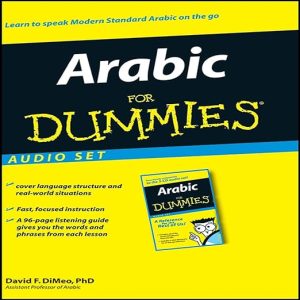
Three discs' worth of material and a slim companion booklet are what stand between an absolute beginner and functional courtesy Arabic in this audiobook edition of David F. DiMeo's course, and the ambition is refreshingly modest. No promise of fluency comes with this course, just greetings, directions, basic requests for help, and a working sense of how the language actually sounds. For anyone who has ever bought a language course expecting a full curriculum and instead gotten lost in grammar tables, that modesty is a genuine selling point rather than a limitation.
Modern Standard Arabic Skips the Street Dialects
The course covers Modern Standard Arabic specifically, the formal register used in media, education, and pan-Arab communication, rather than any single spoken dialect like Egyptian, Levantine, or Gulf Arabic. That distinction matters more here than it would for most European languages, because Modern Standard Arabic can differ meaningfully from the everyday spoken varieties a traveler would actually hear on the street in Cairo, Amman, or Dubai. Listeners hoping to prepare for a specific regional trip should know upfront that they are getting the formal foundation, not the colloquial version locals actually use in casual conversation.
At three hours and thirty-four minutes, this is squarely an orientation rather than a course in the fuller sense, and DiMeo structures it accordingly: basic greetings, essential vocabulary, direction-asking, and a set of expressions meant to get a traveler through the first uncomfortable days in an Arabic-speaking country. It moves briskly through material that a longer, more academic course would spread across many more hours.
The For Dummies franchise has built its whole identity on demystifying intimidating subjects without condescending to beginners, and that promise holds up here. DiMeo never assumes prior exposure to Arabic or its writing system, and the course's ambitions stay matched to its runtime rather than overreaching into material that would need a companion textbook to actually land.
A rating of 4.2 stars from 60 reviews is a modest sample by the standards of mainstream audiobook fiction, but that is normal for a niche language course rather than a warning sign; language-learning audio in general draws a smaller, more self-selecting audience than fiction or popular nonfiction, and the reviews that do exist here are detailed and specific rather than vague, which counts for more than raw volume.
Eledum Models Sounds English Doesn't Have
Osama Abu Eledum's narration is the audiobook's real asset. Arabic phonology includes sounds that do not exist in English at all, emphatic consonants and pharyngeal fricatives among them, and getting these right requires a native speaker's ear in a way that a competent non-native narrator simply cannot replicate convincingly. Listeners genuinely trying to reproduce the pronunciation, not just recognize it passively, are getting a reliable phonetic model here.
Reviewer Tamie B. has bought four language sets in this same audio format, covering Italian, Chinese, Japanese, and Arabic, and describes the format generally as an inexpensive way to pick up spoken basics, planning to keep working through more languages. Nancy N.'s review is shorter but points to a specific real-world use: she found it valuable working with transcultural patients in her nursing practice, a use case the course's practical, courtesy-first approach clearly supports even though it was likely never the publisher's primary target audience.
Modern Standard Arabic carries real practical weight despite not being anyone's home dialect: it is the language of news broadcasts, official documents, and formal education across the Arab world, understood by educated speakers everywhere from Morocco to Iraq even when their everyday spoken Arabic differs significantly from it. A beginner course built around this register is not choosing the flashiest option, but it is choosing the one most likely to be understood broadly rather than in one country alone.
Kiwi's Review Finds No Arabic Script Included
One detail worth flagging directly: reviewer kiwi, whose review breaks down the physical booklet in some depth, notes explicitly that the companion material includes no Arabic script at all. That means listeners hoping to come away able to recognize Arabic letters, not just reproduce spoken phrases, will not get that from this particular course. Everything here is oriented toward listening and speaking, using transliteration rather than the Arabic alphabet itself, which is a completely reasonable design choice for an audio-first product but a real gap for anyone with reading ambitions.
The booklet itself runs ninety-six pages plus a mini-dictionary and is divided into three sections, according to kiwi's review, which also praised the narration as consistently clear. Given the short overall runtime, that print companion is doing real structural work, and listeners who skip it entirely are getting a thinner experience than the course was designed to provide.
Three and a half hours is genuinely short next to the more comprehensive audio language systems on the market, multi-level programs that can run well past twenty or thirty hours across a full curriculum. That comparison is not entirely fair to this course, though, since it was never positioned as a comprehensive system in the first place; it is closer to a single orientation module than a full program, and judged against that narrower ambition, the runtime fits the content rather than shortchanging it.
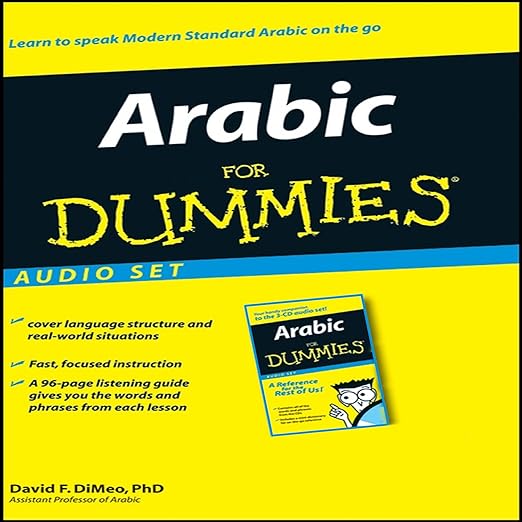
The For Dummies brand's familiar yellow-and-black cover design signals exactly what the content delivers before a listener even presses play: approachable, non-intimidating instruction aimed at total beginners rather than a polished academic language program. That branding promise and the actual course content match up honestly here, which is not always true of franchise-branded educational material.
Tamie B Collects Languages Like a Toolkit
This fits complete beginners heading toward an Arabic-speaking country who want functional courtesy phrases rather than academic depth, and professionals in fields like healthcare, hospitality, or social services who occasionally need a basic conversational bridge, much like Nancy N. describes in her own review. Anyone who has never studied Arabic and wants an accessible, low-pressure entry point will find exactly that here.
Tamie B.'s review is worth a second look for what it reveals about how this format actually gets used: buying multiple different language sets from what reads as the same publisher line suggests a real audience treats these less like a single course to master and more like a rotating toolkit for picking up basic courtesy phrases across several languages as travel or interest demands. That same flexible, modular approach is exactly what makes it a poor fit for anyone chasing genuine fluency or literacy, a limitation worth stating plainly rather than treating as a hidden catch.
Learners with a specific regional dialect in mind, or anyone whose main goal is learning to read and write Arabic script, should look elsewhere, since this course covers neither the colloquial spoken varieties nor the alphabet itself, staying instead within the narrower lane of Modern Standard Arabic listening and speaking basics.
Can I learn to read Arabic script from this audiobook alone?
No. A reviewer confirms the companion booklet contains no Arabic script; the course teaches listening and speaking through transliteration, not reading or writing the alphabet.
Is three and a half hours enough audiobook content to hold a real conversation in Arabic?
Not for full conversation. It covers greetings, directions, and basic requests for help, a genuine orientation rather than a path to fluency.
Who narrates the Arabic pronunciation in this audiobook, and are they a native speaker?
Osama Abu Eledum narrates, and his native command of Arabic phonology, including sounds with no English equivalent, is the course's strongest asset.