At a Glance
- Read by: Selma Blair carries the credit alone, with no dramatization, no second voice and no note of which text that reading follows.
- At its heart: hiding and confinement, adolescence under occupation, ordinary friction between people who cannot leave.
- Vibe: Domestic and terrifying at once.
- Short version: The reading is worth having, but settle which edition of the diary this actually is before you spend a credit on it.
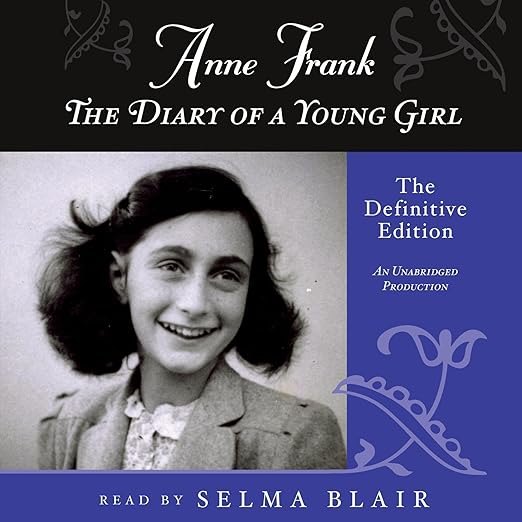
Copy attached to this audiobook announces that the edition accompanies a 2009 BBC television series written by Deborah Moggach, then quotes the Guardian, the Times, the Daily Mail, the New York Times Book Review and the Mail on Sunday, then reports that the book has sold over twenty-five million copies worldwide. All of that describes a printed tie-in edition. What is actually on sale is a Listening Library recording running nine hours and fifty-five minutes, credited to Selma Blair, released in May 2010, and none of the material above was written about it.
Moggach's television adaptation has nothing to do with what a listener receives here, and the confusion matters more than it usually would, because this particular text exists in several forms and the page never says which one it is using. Somewhere behind the description sits a specific edition with specific editorial decisions about what stays in and what comes out. A buyer choosing between the versions on offer gets no help at all. The runtime is the only clue, and a runtime alone cannot distinguish a complete text read briskly from a shortened one read slowly.
Eight people hid in the rooms behind an Amsterdam warehouse for two years, and one of them was keeping a record. That is the whole of the situation, and it produces a book whose power comes from proportion rather than from event: hunger and the daily threat of discovery sit in the same paragraph as petty misunderstandings between adults sharing too little space. A 2014 five-star out of the United States lands on exactly the right note of disbelief, calling the writing insightful and witty and then pointing out that the person producing it was thirteen and fourteen years old.
Blair Must Age With the Text, Unbroken
Amsterdam under occupation is the setting, but the diary is not primarily a document about the occupation. A July 2023 response quotes the passage most people carry out of the book, the one about still believing that people are truly good at heart while hearing the approaching thunder that will destroy them too. Heard aloud, that passage lands differently than it reads, because a voice has to decide whether it is defiance, consolation or a fifteen-year-old talking herself into something. The sentence contains all three and the reading has to choose.
Selma Blair carries the sole performance credit, and the assignment is stranger than the credit line suggests. A diary is a sequence of dated entries addressed to nobody in particular, written by someone who ages from thirteen to fifteen across the manuscript and whose register shifts from schoolgirl comedy to something much older. A reader has to age with the text without announcing it, handle entry headings without turning them into furniture, and sustain a single unbroken interior voice for the better part of ten hours. Very few recorded texts ask for that combination.
Innocence explains the impact, according to a November 2014 response from a British marketplace, which praises the way the writing states what is happening to Jewish families in a matter of fact manner rather than laboring the injustice of it. That is a genuinely useful piece of reading guidance for anyone approaching the book through audio, because the plainness is easy to miss when a performance is available to supply emphasis the sentences deliberately withhold.
No Note on Which Manuscript This Follows
Credits on this record stop at the byline. No editor, no translator, no author of the introduction, no note about which manuscript version the recording follows. For most books that would be housekeeping; for this one it decides what a listener actually hears, since the differences between available texts are the subject of decades of publishing history. The copy compounds it by misspelling its own title mid-paragraph, where "The Diary of a Yong Girl" survives in the description as shipped.
Categories on this listing run four deep at once: biography and memoir, children's audiobooks, history, and teen and young adult, with a Historical tag on top. The reach is real, but the effect is a page that cannot tell a parent whether this is being sold to a nine-year-old or an adult, and the copy's own line about "young readers and adults" was written for a bookshelf rather than for a listening app. Fifty-two ratings support the 4.7 badge, which is a small pool for a book of this stature and a good sign that ratings here are split across many separate editions.
Blurbs occupy roughly a third of the description, five press quotations in a row, every one of them written about the book at large rather than about any particular edition of it. The written column spans three marketplaces, among them an entry filed in Brazil in 2014 and written in Portuguese, which describes the diary as the record of a girl's passage into adolescence under persecution. That entry says more about the book's reach than any of the pull quotes above it.
Settle the Edition Question Before Pressing Play
Households planning to discuss this rather than assign it have the strongest case for an audio version, and a June 2025 five-star makes the case plainly, calling the book a real view of war, antisemitism and prejudice and quoting the passage about families torn apart and children coming home from school to find their parents gone. Heard together, that material starts conversations that a silent read tends to postpone. Younger listeners will need an adult nearby, and not because of anything explicit.
Bergen-Belsen gets one sentence at the very end of the description, three months short of a sixteenth birthday, with no elaboration. The recording gives a family just under ten hours with a voice that was thirteen when it started keeping the record. What this page cannot tell you is which version of that record you are buying, and for a text this heavily edited across its publishing life, that is the question to settle before pressing play.
Good to Know
Does the audiobook say which edition of the diary it follows?
It does not. The description belongs to a printed tie-in edition and stops at the byline, with no editor, translator or manuscript note attached. Since the diary circulates in more than one authorized version with different amounts of material, that omission decides what you hear, and only the publisher can answer it.
Is this audiobook suitable for a child, given the children's category?
The listing files it under children's audiobooks, history, memoir and young adult simultaneously, with no age band. The subject is eight people hiding from deportation, and the description ends with a death at Bergen-Belsen. Most families will want a reader old enough to ask questions, which is younger for some children than others.