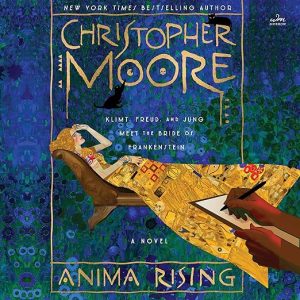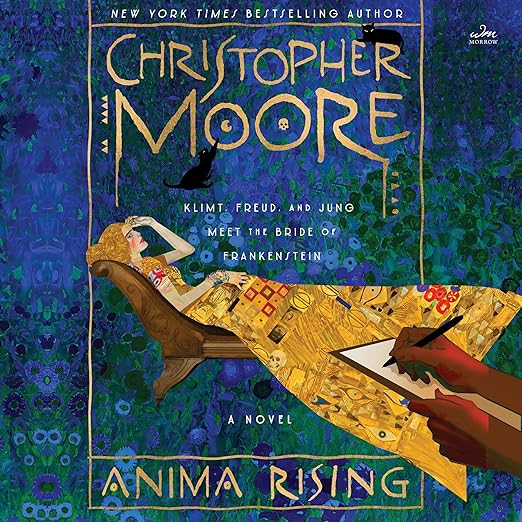
Vienna in 1911, and the most famous painter in the Austrian Empire is standing over a woman's body in the Danube canal, working out whether to fetch a policeman or make a sketch first. Gustav Klimt chooses the sketch. Then, while he is drawing, she coughs. Christopher Moore opens on that, and this audiobook edition arrives with something on its listing that most do not: an AudioFile Magazine Earphones Award.
Klimt hauls her back to the studio, where he and his model-turned-muse Wally look after a woman who is nearly feral and remembers nothing. He names her Judith after one of his own paintings. With Sigmund Freud and Carl Jung assisting, Judith starts recovering memories that should not be possible: the arctic, a hundred years ago, a crate, and a man called Victor Frankenstein. Something is also chasing her, including a giant croissant-eating devil dog named Geoff.
Klimt, Freud, and Jung Share One Comic Cast
Michael J lists the guest register better than any summary could, counting up "Freud, Jung, Robert Walton, Victor Frankenstein and his Creature, with the Bride of Frankenstein, Gustave Klimt, his model Wally, a pastry-loving Wolf Dog, et al." A cast assembled like that could easily have been a stunt, and I expected one. What stops it being one, according to the same reviewer, is that "Moore employs excellent research on which to base his novel," so the historical figures behave like people rather than like cameos.
One Frogs puts the appeal more bluntly, imagining that no novel has previously gathered Freud, Frankenstein, Jung, turn-of-the-century art masters and a great many naked women into "a classic comic romp," and reports that "The ending was just perfect!" S. J. Chatwin, who reports having "caught all his writing since Coyote Blu," praises the same synthesis, admiring an ability "to weave together so many different threads" while still managing to "amplify our knowledge of these historical figures."
Bu Hao supplies the necessary corrective, and it is a useful one because it is comparative rather than dismissive. Four stars, with the verdict that "This one is a slow starter for Moore" and that the book is "not as full of funny similies as his best works." Then a placement inside the author's own catalog: better than the pseudo Shakespearean books, not as good as the vampire novels or the Pine Cove trilogy. If you are new to Moore, that is a favorable ranking and tells you nothing you need to act on. If you have read a dozen of them, it is a warning about exactly which shelf this one lands on, and a returning reader should weigh it above everything else here.
Wells Voices a Painter, Two Analysts, and a Dog
An Earphones Award is the reason to choose this edition, and it is worth being precise about what that is and where the claim comes from. The honor is awarded by AudioFile Magazine, an outside publication rather than the publisher, and it is named at the top of this listing. The sentences around it, praising "an impressive range of character voices, accents, and tonal shifts," are marketing copy and should be read as such. The award is the part with an independent source behind it.
Range is genuinely what this text requires, which makes the credit meaningful rather than decorative. Mary Jane Wells is handling a Viennese painter, his model and muse, two founding figures of psychoanalysis, a resurrected woman carrying a century of buried memory, and a devil dog with a pastry habit. Comedy at this density collapses if the voices blur, because half the jokes depend on knowing instantly who just said the ridiculous thing.
Eleven hours and forty-eight minutes is generous for a comic novel, and Bu Hao's slow-starter warning is the thing to weigh against it. A reading buys you patience that reading yourself does not, since a listener who would have skimmed the opening stretch on the page simply keeps going instead. On a book whose payoff at least one reviewer places right at the ending, that difference is not trivial.
Five Reviews Sit Under Exactly One Rating
Take the star rating off the table entirely. Five people have posted written reviews of this book. The listing says one person has rated it, and displays 4.6 as the average of that single rating. A lone rating produces a whole number or nothing at all, so the figure and the count cannot both be describing the same population. Read the five paragraphs; ignore the score above them.
Source material is the second consideration, and my honest answer is that you need less of it than you would think. Michael J enjoyed recognizing "well-known characters from Shelley's novel," and vegasbill describes the book as "a reimagining of the Bride of Frankenstein story" set over a century after the original. That recognition clearly adds something. But the synopsis pitches it as Poor Things meeting Bride of Frankenstein, and both halves of that comparison are strong enough on their own that a listener arriving cold will still follow the plot.
Content register deserves a word too. This is Moore, so the comedy is broad and the irreverence is total. One Frogs, listing what the novel throws together, includes both Hitler and "a bunch of naked women" in the same breath as Freud and Jung, which tells you how far the book is willing to go with real people. Nothing here is handled delicately. Anyone whose tolerance for irreverence about real people is limited should treat that as the deciding factor.
Range Rewards This Century-Spanning Cast of Absurdities
Moore's existing readership is the obvious audience, with Bu Hao's ranking as a calibration tool rather than a deterrent. People who like literary mashups, where invented characters and documented ones share a room, will find this an unusually well-researched example of the form. And anyone who enjoys comic novels that also want to be about something will notice that underneath the devil dog and the psychoanalysts, this is a book about a woman assembling an identity out of memories she was never supposed to have.
Where this will not land is with readers who want their historical fiction reverent, or their comedy tidy. It is also a poor introduction to Moore if you want his sharpest work first, on the evidence of the pool's own comparative ranking. As a piece of audio, though, it carries the strongest independent credential on this listing, and the material it is built from, a crowd of accents, eras and absurdities crossing a century, is precisely the kind of thing that rewards a performer with range and punishes one without it.
Quick Take
- Read by: Mary Jane Wells is credited on an edition the listing names as an AudioFile Magazine Earphones Award winner, which is the one independently sourced audio claim on the page.
- At its heart: Literary mashup across two centuries, identity assembled from stolen memory, irreverence toward real historical figures
- Vibe: Deranged and warm, with a serious question underneath the farce
- Short version: A well-researched comic mashup with a genuine audio credential, though the pool ranks it below Moore's best.