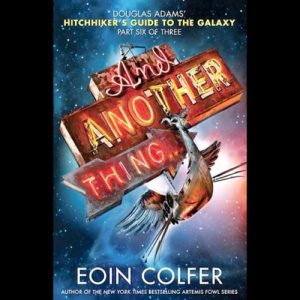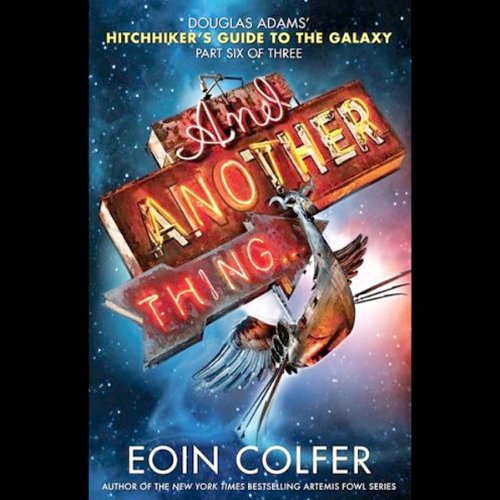
Douglas Adams left five books in a trilogy, and this audiobook is the sixth, written by somebody else eight years after his death. Eoin Colfer took the job with the approval of Adams's widow, Jane Belson, who said she could not think of a better person to transport Arthur, Zaphod and Marvin to pastures new. Adams himself had once said he suspected he would eventually write a sixth Hitchhiker book, on the grounds that five seems to be a wrong kind of number and six is a better kind of number. Ten hours and twenty-two minutes later, the argument about whether that reasoning held up is still running.
Is And Another Thing... Worth Your Time?
The description on this page is a press release rather than a synopsis, and it is worth naming that plainly. It is written in the future tense, announcing what the book will be. It walks through the approval, quotes Belson on her choice of writer, quotes Colfer comparing the assignment to being handed the superpower of his choice, and signs off by telling you to prepare to be amazed. What it never does, in a single sentence, is tell you what happens inside the novel. Somebody buying on the strength of this page is buying a transaction between an estate and a novelist, not a story, and that copy has sat unrevised since a release date in 2009. The one piece of useful information it does supply is who Colfer is: the description introduces him as the internationally bestselling children's writer behind the Artemis Fowl novels, and a fan of Hitchhiker since his schooldays, which tells you the hand on this book belongs to someone who grew up inside the material.
The ratings make even less sense. The listing shows 4.0 from exactly one rating while carrying five written reviews graded from two stars up to five, which means the count and the written record cannot both be describing the same page. Treat the average as broken and read the reviews instead, where the spread is the interesting part. Kenny's four-star line is the pool compressed into a sentence: a good read, not as good as the original author's work, and recommended anyway. That conditional endorsement turns out to be the majority position on this page rather than an outlier, and it is a more honest summary than any number here.
The Best Parts of And Another Thing...
The most persuasive thing on this page is a conversion. PJM arrived with fond memories of the original books, real sadness at Adams's death, and a specific grievance about the ending of Mostly Harmless being far too depressing, then felt betrayed on hearing that a continuation was coming at all. That account went on to give the book five stars under a title claiming it is as good as, if not better than, the originals. A hostile starting position that reverses is worth more than an enthusiastic one that never moved, and it is the clearest argument this listing offers for why a skeptic might still press play.
The five-star account from E sets the terms even more usefully, in a review titled around the idea that this is a worthwhile conclusion if you accept that it isn't written by Douglas Adams. That reviewer knew Adams personally and met him roughly once a year when he visited Seattle, and argues that his style has never been replicated, naming other writers who developed their own voices instead of inheriting his. Coming from somebody with that kind of attachment, the acceptance clause carries real weight. The familiar cast does return as promised, and the estate's own quote names Arthur, Zaphod and Marvin as the reason the project was allowed to exist at all.
Before You Commit to And Another Thing...
C. Fusner, at three stars, files the sharpest objection under the title Mostly harmless, but not really essential, and the review delivers exactly that: the old favorites come back, but the addition was not essential and the whole thing reinforces a suspicion that the series had already gone on a little too long. That account also sorts the earlier books into groups, treating the first two as inseparable halves of one story rather than as separate volumes. If your attachment to Hitchhiker is structural, meaning you believe the sequence has a shape that was finished, this is the objection to take seriously before buying.
The pool also crosses a border, and the crossing matters. A two-star review posted from the French store, written in French, argues that the writing is still as wild as ever but that what has gone missing are the scientific, philosophical and psychological references that gave the saga its flavor, leaving descriptions of situations without the satire underneath them. Ramolet's is the lowest grade on the page and the most specific literary complaint in the pool, and it arrives from a different market's edition, stacked here under a single average alongside everything else. A pool assembled that way tells you less than its size suggests, and this particular objection is the one aimed squarely at the sentences rather than at the succession.
The Right Listener for And Another Thing...
Completists come first, along with anyone who wanted more time with Arthur, Zaphod and Marvin and can hold two ideas at once: that this is genuinely a sixth book, and that it is not by the man who wrote the first five. This is a proper novel rather than a curiosity, and the range of grades here, running from two stars to five, suggests it produces real reactions rather than polite indifference. If you enjoy watching a writer work inside somebody else's rules, part of the interest is technical: what carries over, what cannot be copied, and what a different hand adds to furniture it did not build. Colfer had a fan's answer ready long before anyone offered him the job.
Newcomers should start at the beginning instead. The description calls this the sixth novel outright and takes the characters as given, and every account on the page reads it against the earlier books rather than on its own terms. Anyone offended by the idea of a continuation can save themselves the ten hours, since nothing in the execution of it is ever going to settle that argument. Nothing on this listing will tell you what you are actually getting either, because the copy describes the deal that produced the book and never once describes the book.
The Short Version
- Narration: Simon Jones is credited alone on ten hours of a comic novel whose characters listeners have been carrying around in their heads for decades.
- Themes: literary succession, an estate's blessing, satire without its author, series fatigue
- Mood: Familiar furniture, unfamiliar hand
- Verdict: For completists who can accept the condition one five-star reviewer set out, and not the place to begin the series.