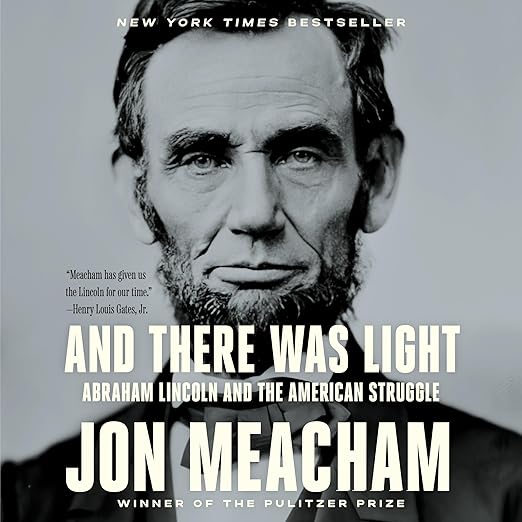
Genesis Language for Lincoln's Moral Clarity
Abraham Lincoln is born on the Kentucky frontier in 1809 within the first chapter of this audiobook, and Jon Meacham spends the next seventeen hours tracing exactly how that frontier childhood became a presidency. Meacham, a Pulitzer Prize winner for his earlier biography of Andrew Jackson, brings the same narrative-momentum approach to Lincoln here, following him from self-education and early political failures through the presidency's defining crisis: secession, the Civil War, and slavery's abolition.
The book's real argument is that Lincoln's antislavery conviction was not a late political calculation but something that started forming in the antislavery Baptist community he grew up inside, well before he held any office. Meacham traces that thread deliberately across decades, and it reframes Lincoln less as an inevitable icon and more as a specific person whose moral positions developed gradually and imperfectly, shaped by depression, political defeat, and a faith he kept wrestling with rather than resolving cleanly.
This is not the first major Lincoln biography, and Meacham knows it; the book positions itself explicitly against both the remote-icon version of Lincoln and the more cynical calculation-over-conviction read some historians have offered. What results is a portrait that tries to hold both readings at once: a president capable of real moral clarity who was also, constantly, a working politician navigating an impossibly divided country.
The title itself draws on the opening of Genesis, and there was light, following the command let there be light, a deliberate framing choice that positions Lincoln's moral clarity on slavery as something closer to a creation narrative than a simple political biography. Meacham leans into that framing throughout rather than treating it as a one-time title flourish.
Beyond the political and moral throughlines, the synopsis promises attention to Lincoln's more private life as well, his loves, his bouts of depression, his self-education, material that rounds out the presidential figure into someone with an interior life independent of the office he eventually held. That personal dimension keeps the book from reading as pure political history.
Meacham's Oratorical Rhythm Closes an Authorial Gap
Meacham narrates his own work, and that choice extends a pattern worth noting across his career: this is someone whose prose already carries an oratorical, speech-built rhythm, and hearing him deliver his own sentences aloud closes a gap that a hired narrator, however skilled, simply cannot close on someone else's material. For a book this focused on Lincoln's own use of language and rhetoric, that authorial voice reading the analysis feels especially appropriate.
The book's critical reception backs up the scale of the achievement: it won the Gilder Lehrman Lincoln Prize, was longlisted for the Biographers International Plutarch Award, and made best-of-year lists at both Kirkus Reviews and The Christian Science Monitor. Reviewers quoted in the listing describe it as a truthful, unbiased nonfiction account, language that matters given how contested Lincoln's legacy remains in current political discourse.
Meacham's broader bibliography backs up the authority he brings here: American Lion, his biography of Andrew Jackson, won the Pulitzer Prize in 2009, and he has also written extensively on Jefferson and on the wartime partnership between Franklin Roosevelt and Winston Churchill. That sustained focus on how individual presidents wielded moral and political power specifically positions him well to tackle Lincoln's more contested legacy.
Meacham's own career path, moving from journalism, he served as Newsweek's editor before turning to biography full time, shapes the book's accessibility. His prose favors narrative momentum and clear throughlines over the denser academic apparatus a university historian might default to, which suits listeners who want serious scholarship without needing a background in Civil War historiography to follow the argument.
Faith, Race, and Democracy, Threaded Together
At 17 hours and 49 minutes, this sits solidly in the range of a serious, comprehensive single-volume biography rather than a quick survey, and listeners should budget accordingly. Meacham's approach is explicitly analytical and thematic as much as chronological, threading arguments about faith, race, and democracy through the narrative rather than simply marching through dates, which rewards sustained attention more than background listening.
One review notes reading the hardback alongside listening, which suggests some listeners may want the print edition on hand for names, dates, and source references even while using the audiobook as the primary experience. That is a reasonable approach for a biography this dense with historical detail spanning a fifty-six-year life and a defining national crisis.
Lincoln has been the subject of more biographies than perhaps any other American president, from Carl Sandburg's sweeping early-twentieth-century volumes to Doris Kearns Goodwin's Team of Rivals decades later, and any new entry has to justify its own existence against that crowded shelf. Meacham's specific angle, tracing the antislavery Baptist roots of Lincoln's convictions in detail, is the clearest answer this book offers to that challenge.
The Gilder Lehrman Lincoln Prize specifically recognizes the year's best work on Lincoln or the Civil War era, an established, competitive award within the field, which adds real institutional weight behind the book's more enthusiastic reader praise.
American Lion Fans Will Feel at Home
This fits readers of serious presidential history and biography generally, existing Meacham readers who know his American Lion or his other work, and anyone specifically interested in how Lincoln's antislavery convictions actually formed rather than simply accepting the finished, iconic version of his legacy. Listeners interested in the intersection of faith and political leadership will find that thread especially well developed.
Skip it if you want a brisk, entry-level introduction to Lincoln rather than a dense, argument-driven scholarly biography; this rewards patience and existing interest more than casual curiosity. Everyone else looking for a rigorously researched, self-narrated account of one of America's most consequential presidencies gets one of the stronger single-volume options available.
Readers who have already worked through Goodwin's Team of Rivals or Sandburg's earlier volumes will find genuine new material here rather than a simple retread, particularly around the religious formation angle Meacham foregrounds more than most prior biographers have.
At just under eighteen hours, the audiobook asks for a real time commitment, though Meacham's own narration pacing, unhurried and reflective rather than brisk, suits a book meant to be absorbed gradually rather than raced through.
Key Details
- Narration: Jon Meacham narrates his own biography, and his prose's oratorical rhythm benefits directly from his own delivery.
- Themes: moral conviction under political pressure, the making of Lincoln's antislavery stance, democracy in crisis
- Mood: Sweeping, analytical, historically grounded
- Verdict: A rigorous, self-narrated single-volume Lincoln biography for readers ready to invest in serious presidential history.
A Few Questions About And There Was Light
Does Jon Meacham narrate this audiobook himself?
Yes, he self-narrates the full biography, and his own oratorical prose style benefits noticeably from his own delivery rather than a hired narrator's interpretation.
Is this audiobook a good introduction to Lincoln for a casual listener?
Not especially. It is a dense, argument-driven scholarly biography better suited to readers with existing interest in presidential history than to someone wanting a brisk entry-level overview.