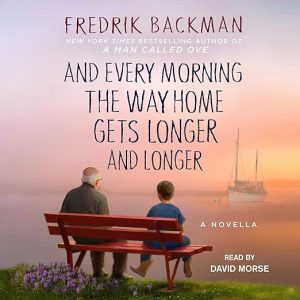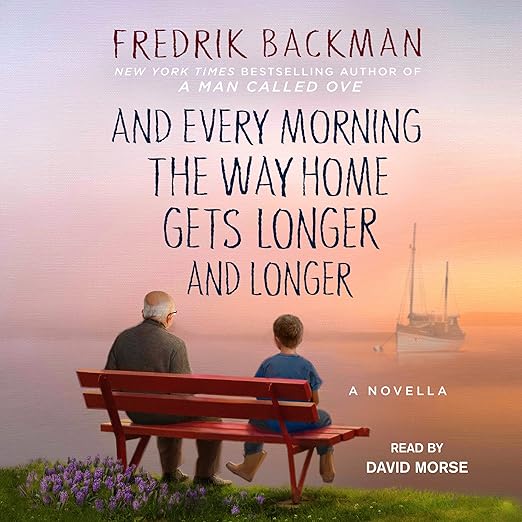
- Narrator: David Morse brings quiet gravity to Backman's prose, his delivery is measured and warm without reaching for sentimentality, which is exactly what this delicate material requires.
- Subjects: memory loss and aging, the love between fathers and sons, letting go
- Tone: Tender and unhurried, quietly devastating
- Bottom line: A 69-minute audiobook that accomplishes more emotionally than most full-length novels, and Morse's narration is the ideal vehicle for it.
Fredrik Backman's prose in this audiobook novella operates in a register that is entirely its own: precise, unsentimental on the surface, and capable of landing emotional weight with a restraint that makes the impact arrive delayed, as though the air around you has changed temperature. And Every Morning the Way Home Gets Longer and Longer runs 1 hour and 9 minutes in David Morse's narration, barely longer than a lunch break, and accomplishes what most full-length novels spend four hundred pages working toward.
The Review
The formal challenge of this novella is extraordinary: Backman is writing about memory loss from inside a memory that is dissolving. The elderly Noah is losing his grip on his past, and the bench where he sits with his grandson exists simultaneously in the real world and in Noah's fading interior landscape. The father who joins them there, already gone in the world of the story, arrives whole and present in Noah's version of the bench. What the novella does with that structure, letting the reader understand gradually that certain conversations are happening in only one of the two planes, is the kind of literary maneuver that risks being clever and ends up being devastating instead.
Backman has built his career on novels that locate profound human tenderness inside structures that initially appear comic or gruff. Think of the social misanthrope in A Man Called Ove, or the baffling grandmother in My Grandmother Asked Me to Tell You She's Sorry. Here there is no comic scaffolding at all. This is Backman working with almost nothing but feeling and structural intelligence, and the result is, as one reviewer described it, a tiny gem with a message worth treasuring for a lifetime.
Why Listen to And Every Morning the Way Home Gets Longer and Longer
David Morse is one of those narrators whose voice fits literary fiction the way a specific key fits its lock. His instrument carries age without performing it, and the scenes between grandfather and grandson, some of the most delicate in the novella, benefit enormously from the way he modulates the difference between the characters' voices and registers. A lesser narration would push for emotion; Morse trusts the text to do that work and simply inhabits the material. At 69 minutes, there is no room for a single wrong note, and he does not play one.
Listeners familiar with Backman's longer novels will find this audiobook a useful companion to the broader catalog: one reviewer specifically recommended reading it before Britt-Marie Was Here, as it lays a foundation for that book. The novella also stands alone for listeners who have never encountered Backman before, though it may send them immediately toward A Man Called Ove or Anxious People when they finish. The brevity of the runtime is not a limitation; it is the form doing its job. Lisa Genova, author of Still Alice, described reading it in one sitting, utterly wowed, which captures the single-session quality that the audiobook format makes even more natural and seamless.
The subject matter, cognitive decline and the grief of watching someone's past slip away from them before they are gone, is handled with more precision than most fiction brings to it. Backman does not sentimentalize the condition or rush toward consolation. The bench scenes are bittersweet rather than tragic in the conventional sense, and that tonal accuracy is part of what makes the novella resonate long after the listening ends.
The Caveats
The novella's brevity means the emotional payoffs arrive quickly and without the warming-up period that longer books allow. Listeners accustomed to more gradual narrative investments may find the opening pages moving faster than expected before the emotional weight arrives. This is not a structural flaw; it is the novella doing what novellas do. But the experience differs from a longer Backman novel, and the comparison is worth resetting before you start listening.
Because the book operates on two temporal and spatial planes simultaneously, it asks for full attention. The audiobook format is actually ideal for this: Morse's delivery makes the transitions between planes legible in a way that the eye on the page might gloss over on a first encounter. If you are planning to listen while doing something else that requires cognitive attention, the investment will not land fully. This is a headphones-in, full-attention listen that rewards the commitment with something rare.
The novella was originally published in Swedish before English translation, and the translation quality is worth acknowledging: the emotional precision of the original is preserved in ways that speak to the care taken with the English text. Nothing in Morse's narration suggests a text that has lost something in translation; the sentences land as though they were written in the language he is reading them in.
Should You Listen to And Every Morning the Way Home Gets Longer and Longer?
Anyone who has watched a parent or grandparent lose ground to cognitive decline will find this audiobook lands with particular force. Backman writes about the grief of a slow departure with more precision than most novelists bring to sudden loss, and Morse's narration honors that precision throughout. Backman fans who have exhausted the full-length novels will find this essential. Listeners new to literary fiction will discover here how much emotional work great prose can accomplish in a very short time. One honest caveat: this is not a light listen despite its length. It is 69 minutes, but you will want to sit with it afterward.
Before You Listen
Is the audiobook of And Every Morning the Way Home Gets Longer and Longer the complete novella, or is it abridged?
At 1 hour and 9 minutes, this audiobook represents the complete novella. The source text is short by design, Backman wrote this as a novella, not a full-length novel, so the brief runtime reflects the complete work rather than any abridgement.
Does David Morse's narration of this audiobook work for a story about an elderly man and his grandson?
Morse is an excellent match for the material. His voice carries the necessary gravity without overplaying the sentiment, and he renders the difference between the grandfather and grandson registers clearly. The narration elevates an already strong text rather than simply conveying it.