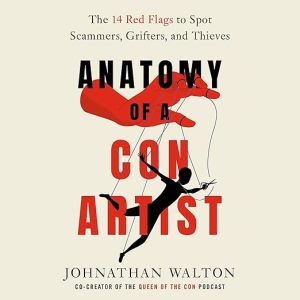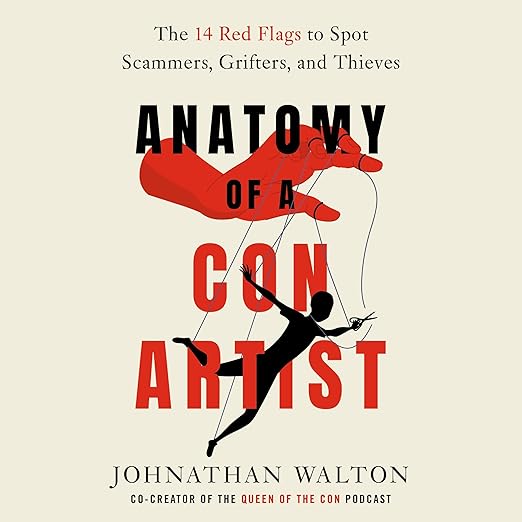
Fourteen red flags carry this audiobook, and the man reading them out did not see them coming the first time. Johnathan Walton lost close to $100,000 to a con artist, went to the police, and was turned away. What he did next is the reason the book exists: he used the investigative skills he had built during years as a television reporter to assemble a case the authorities could not ignore, saw the con artist who defrauded him charged, prosecuted and convicted, and then made a second career out of helping other people do the same thing. Nine and a half hours later, the argument he has been building is that con artists do not outsmart their marks, they out-feel them.
Beak Wetting and Thirteen Other Warning Signs
Alternation between a list and a life is the source of both the book's usefulness and its main defect. The list is the fourteen tells, drawn from hundreds of cases Walton has investigated, of which the description shows three: a stranger offering help who insinuates themselves into your life, constant manufactured emergencies, and the faux generosity Walton labels beak wetting, where gifts and favors arrive early to lower your guard. Those three alone reframe a lot of ordinary social behavior, which is precisely the intended effect.
One five-star listener describes the consequence better than any summary: the book "should come with a warning because it will give you flashbacks", because you will start inventorying the relative who borrowed money, the friend with the fast fortune scheme, the new acquaintance who bragged about a career. That reviewer also lands the observation that distinguishes this from screen depictions of fraud, namely how much time real con artists are willing to spend before they take anything. Patience is the tell that fiction never dramatizes, and it explains why the fourteen signs work as a checklist rather than as a portrait: no single item convicts anybody, and the pattern accumulating over a long stretch is what does.
Walton Reads His Own Story of Being Conned
Testimony is what raises this above the advice-book shelf. A five-star reader who had already read widely about psychopaths says this one operates on another level because it comes from somebody who was scammed and then got justice, and calls the red flags list brilliant. The same notice supplies its own numbers, having lost $5,000 years earlier and recovered $2,000, which is the kind of detail that shows the book is reaching people who already know what this feels like and still learned something.
Walton reads his own work, and the decision is close to necessary here. This is testimony as much as instruction, and a hired voice reading somebody else's account of being humiliated by a con artist would put a pane of glass between the listener and the material. He is also a podcast host, which the description states plainly, so the microphone is not unfamiliar territory. One five-star listener says as much sideways, reporting a willingness to consume anything he writes, reads or produces on the strength of the podcast alone.
Credibility outside the story comes from the front of the book, where a blurb from retired FBI special agent Joe Navarro, credited as the author of Dangerous Personalities, calls this a master class on spotting scammers and compares the storytelling with a crime novel. Endorsements are marketing, but that one is at least from somebody whose day job was reading people for a living, and it points at the book's real ambition: not a warning, a taxonomy.
Jumping Timelines Are Harder to Follow in Audio
Chronology is the weak point, and a four-star reviewer names it precisely, noting that the story "jumps around a bit and can be difficult to follow the timeline of events". A linear audio file punishes that more than a printed page does, since you cannot flick back a chapter to check when something happened relative to something else. The same reviewer flags a moment some listeners will find uncomfortable, when Walton admits he should have taken his husband's advice about the con in his life, which reads as honesty to most and as an irritant to a few.
Every framework of this kind carries a built-in problem, and this one is left largely unaddressed. Behavioral tells describe things ordinary generous people also do, and a listener who finishes the whole file will spend the following week auditing a colleague who simply happens to be helpful. The description makes it worse with a line that cannot be argued with, holding that anyone who believes it could not happen to them is precisely the mark a professional is looking for. That rhetoric is effective and unfalsifiable at once. Walton's own case is the counterweight, since he shows a real pattern accumulating over a long period rather than a single suspicious act.
Category placement on this listing is odd enough to mention. A first-person account of criminal fraud, sold with an FBI endorsement, sits under health and wellness with a safety and emergency preparedness tag. The reasoning is presumably that this is protective information, and in a sense it is, but a listener browsing for mindfulness and well-being will be startled. Behind that filing sit 91 ratings averaging 4.4, and five written notices markedly warmer than the number implies.
Aimed at Anyone Already Being Worked On
People who have been defrauded, or who suspect somebody close to them is being worked on right now, are the primary audience, and the reviews are full of people arriving in exactly that condition. It also suits listeners who care for elderly parents, run small businesses or manage other people's money, since the tells are behavioral rather than technical and transfer to any setting where trust gets extended.
Podcast listeners are an obvious secondary group, and the five-star notice quoted earlier makes that crossover explicit. Another describes finishing the book in three days and being struck by the strangeness of a man grateful to have been scammed because it let him help other people. That is the tone throughout, and it is the reason the memoir half survives its structural problems: the generosity is legible on every page.
Avoid it if you want true crime as entertainment, because the case is a vehicle for the framework rather than the other way around, and think twice if a jumping timeline will frustrate you over a long file. Listeners who want clinical distance from the subject will find the anger here undisguised. That anger is the point. Walton was failed by the people whose job it was to help him, went and did their work himself, and turned the result into a method other people can use, which is where the practical value of these nine and a half hours actually sits.
The Short Version
- Narration: Johnathan Walton delivers his own testimony rather than handing a stranger an account of his own humiliation.
- Themes: Fraud detection, manipulation tactics, victim advocacy, self-directed investigation.
- Mood: Angry, practical, unexpectedly warm.
- Verdict: The red flags alone justify the purchase; the memoir wrapped around them is messier but more convincing for it.
Frequently Asked Questions
How many of the fourteen red flags does the audiobook actually explain?
All fourteen appear in the book; the product description previews only three of them, numbers one, three and eight. Those three cover a stranger offering unsolicited help, manufactured emergencies, and early gifts designed to lower your guard, which gives a fair sense of the register.
Is this a memoir or a practical guide?
Both, braided together. A $100,000 loss and the private investigation that followed a police refusal supply the story, while fourteen behavioral warning signs supply the method. One reviewer found moving between the two strands hard to follow as a sequence of events.
Does the author narrate the audiobook himself?
Yes. Walton reads his own account, which suits testimony about being defrauded and humiliated far better than a hired voice would. He hosts a podcast on the same subject, and one reviewer says outright that hearing him deliver the material is part of the appeal.
Why is this filed under health and wellness?
A puzzling classification. The content is first-person true crime with a protective method attached, and the page reinforces it with a preparedness tag. Read the category as a shelving decision rather than a description, and expect nothing resembling mindfulness or general well-being material.