At a Glance
- Voice: Kay Redfield Jamison reads her own memoir, which puts the clinician and the patient in one voice, exactly as the book's structure intends.
- Big ideas: bipolar illness, ambivalence about medication, a career in academic medicine, the line between healer and patient
- Atmosphere: Lucid and unsparing, and shorter than you expect
- Worth it?: Jamison reading her own case history is the entire argument for this edition, so check the running time against the book you think you are buying.
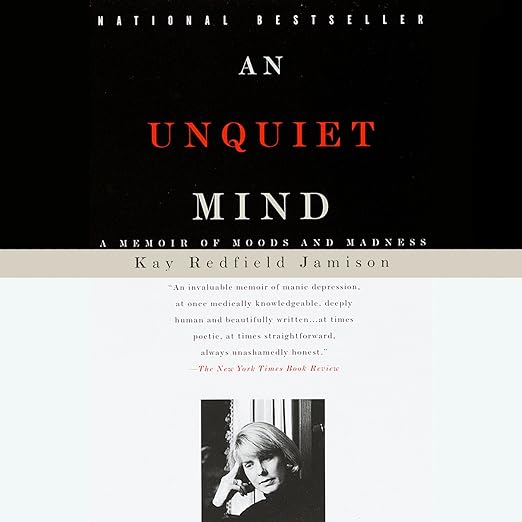
A memoir that runs two hours and forty-six minutes is either unusually disciplined or unusually incomplete, and this audiobook gives a buyer no way to tell which. Kay Redfield Jamison reads her own account of living with bipolar illness while treating it professionally, issued by Random House Audio in January 2010. The description mentions a new preface by the author. About what else the recording contains, it says nothing at all.
How An Unquiet Mind Holds Up
Jamison is described as one of the foremost authorities on manic-depressive illness and as someone who has experienced it firsthand, and the copy refuses to soften what that meant: ruinous spending sprees, episodes of violence, an attempted suicide, all of it running alongside a career in academic medicine and patients whose symptoms matched her own. The book examines the illness from what the description calls the dual perspectives of the healer and the healed, including the cruel allure that at times made her resist medication. The copy claims the memoir has "both transformed and saved lives," a large statement that the response column quietly supports, and notes a new preface written by the author for this version of the text.
Jeff, writing in March 2026, restores something this listing lost. The response opens by naming the book in full, as An Unquiet Mind: A Memoir of Moods and Madness, while the title field here carries only the first three words. The rest of that response is testimony from a reader with the same diagnosis, describing a memoir that is terrifying and affirming at once, and noting that the episodes behind that response have been milder than the ones Jamison records.
Connie's five-star note is the one to read carefully on a self-narrated recording, because it looks like praise for a performance and is not. It admires how Jamison portrays her information and her writing, says a reader can almost feel the highs and lows through that writing, and refers to the book twice as a novel. The enthusiasm is real and it is entirely about the page. On a listing where the author and the narrator are the same person, that distinction is easy to lose.
Why An Unquiet Mind Works as an Audiobook
Claudia G. does the most practical thing any reviewer can do, which is point at a specific chapter. The instruction is to pay particular attention to the one titled An Officer and a Gentlemen, spelled that way in the response, and the surrounding sentence calls the book one of the most gentle and poignant reads a person will find. A named chapter beats a star rating, and it gives a listener something to listen for.
Pat McKim's four-star response is arguing with reviews that do not appear on this page. It engages a claim that the author has not really suffered from the illness, half concedes it, and answers from personal experience as someone cyclothymic who has likely never been hypomanic. The underlying dispute matters: whether a high-functioning account of bipolar illness represents the people it is read as representing. You get one side of that argument here and only a reference to the other.
Harry Littell's five stars praise the book for advocating something the response describes as often shunned, meaning well-prescribed medication for a legitimate mental illness, and connect it to a personal calculation about side effects. That note carries a July 2007 date, two and a half years earlier than this recording's January 2010 release, so it was written about a copy of the book that existed before this recording did. The subject it lands on is exactly the one the description names as the book's hardest thread.
Weak Spots in An Unquiet Mind
Two hours and forty-six minutes is the number to weigh before anything else. A memoir spanning a childhood, a medical career, a diagnosis, hospital work, and decades of treatment fits into that runtime only through real compression, and this listing carries no contents note, no chapter list, and no statement in either direction about what was included. Anyone who needs certainty about completeness should confirm it elsewhere before buying, particularly given that reviewers discuss individual chapters by name. The reading habits described in the column point the same direction: one response recalls reading it a long while ago and returning to recommend it, which is the behavior of someone who spent real time in a text rather than an afternoon.
Clinical honesty is the book's whole reputation, and the description does not hedge about violence or an attempted suicide. Readers with the same diagnosis report the recognition Jeff describes, which is valuable and can also be difficult, and audio takes away the reader's usual defense of letting the eye skate past a paragraph. Anyone in an unstable stretch should think about timing rather than about whether the book is good.
Memoir is what this is, though the listing files it with a tag reading Professionals & Academics, which fits Jamison's dual identity and misdescribes the audience. The badge sits at 4.5 across seven votes, with five responses written out and only one of them grading below five stars. That is a thin pool for a book the description calls a national bestseller, and it says more about how this particular page was assembled than about how the memoir was received. One response also treats it as a gateway, closing on an intention to move next to the author's other titles, which is worth knowing if you want more than three hours of her company.
The Right Listener for An Unquiet Mind
Anyone living with bipolar illness who wants an account written from inside both the diagnosis and the profession that treats it will find no closer match, and clinicians, medical students, and psychology readers get the rarer thing: an authority describing her own symptoms without the distance her training would normally provide. The brevity works in its favor here, since the book can be taken in one sitting.
Families and partners are the other clear audience, and one response describes recommending it to exactly that reader. Anyone who wants the complete text with its apparatus, or who needs to move slowly through difficult passages, may prefer the printed version alongside this one. Her own voice is the reason to choose this edition over the page.
Common Questions
Does Kay Redfield Jamison narrate the audiobook herself?
Yes. Author and reader are the same person on this listing, which counts for more here than on most memoirs. The book is built on holding two positions at once, the clinician who treats manic-depressive illness and the patient who lives with it, and both of them reach you through a single voice.
Why is the audiobook only two hours and forty-six minutes long?
The listing never explains, and the answer matters. A memoir covering a childhood, a medical career, and decades of treatment compresses hard to fit that runtime. No chapter list or contents note appears anywhere here, so anyone needing assurance about what the recording includes should verify before purchase.
What is the book's full subtitle?
A Memoir of Moods and Madness, though you will only find it inside a reviewer's opening sentence. The title field on this page stops at three words. That omission matters for anyone searching by the full name or trying to confirm they have the right edition among several printings.