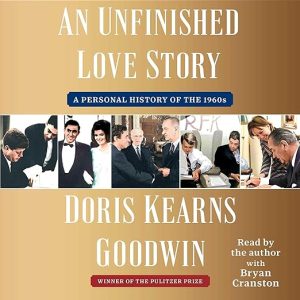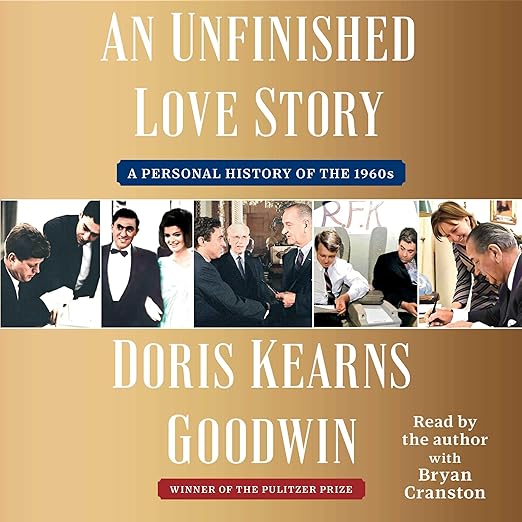
The craft problem Doris Kearns Goodwin set herself in An Unfinished Love Story is audacious: write a history of the 1960s filtered entirely through the perspective of two people who were present at its center, held together by a love story that is itself both subject and method. As an audiobook, this production gains something that print cannot provide. Goodwin's own narration brings the personal material a weight of lived experience that no actor could approximate, and the inclusion of archival recordings of John F. Kennedy, Lyndon B. Johnson, and Robert F. Kennedy, along with Bryan Cranston's contributions, creates an audio experience that genuinely earns the word immersive without becoming a stunt.
Three Hundred Boxes Became an Occasion for Accounting
Richard Goodwin was a singular figure in mid-twentieth century American life. In his twenties he was one of Kennedy's most trusted young intellectuals; in his thirties he named the Great Society, helped design its legislative program, and served as a speechwriter and close advisor to Robert Kennedy during the 1968 campaign. Doris Kearns was a twenty-four-year-old White House Fellow who worked directly for Lyndon Johnson and later assisted on his memoir. Together they accumulated a relationship to the decade that was simultaneously professional and intensely personal, and the three hundred-plus boxes of letters, diaries, and documents Dick had saved over fifty years became, in the last years of his life, the occasion for an accounting.
The book's structure is dual in the most productive sense. Goodwin is working through history and through grief simultaneously, and the two processes illuminate each other. Her assessments of Kennedy's calculation, Johnson's genius and cruelty, and the unfinished arc of the civil rights movement are sharper for being filtered through decades of intimate argument with Dick about what these men actually accomplished and what they left undone. The freshness of those assessments, arriving via a historian who was a participant rather than simply an observer, is the book's central gift.
The archival recordings are deployed with editorial judgment. You hear Kennedy's private telephone conversations alongside the public addresses, and the distance between those two registers clarifies how political language actually works: what it reveals and what it conceals. Johnson's recordings are the most emotionally volatile, which is appropriate given what Goodwin has described as his volcanic and contradictory character. RFK's voice in these recordings carries the specific quality of someone who has not yet been turned into a symbol, and that distinction is worth more than any secondary analysis could provide.
The 300-plus boxes of Dick Goodwin's papers function in the book as a kind of time machine with unpredictable settings. Some of what Doris and Dick find inside is what they expected: drafts of speeches, memoranda from the New Frontier years, correspondence with Kennedy and Johnson and their advisors. Some of it is genuinely surprising, correspondence that shifts their assessment of figures they thought they understood, documents that complicate positions they had both held for decades. The listening experience of following them through that process has the quality of watching someone read a letter in real time; the surprise is authentic because Goodwin is writing from inside it rather than from retrospective certainty. That quality is rare in historical nonfiction, and it is one of the things that makes this audiobook specifically worth your time rather than just another account of the 1960s.
Goodwin's Own Voice Carries Emotional Authority
Self-narrated audiobooks succeed when the author's voice carries the emotional authority of lived experience and fail when the author is audibly uncomfortable performing their own prose. Goodwin is the former. Her pauses in the more personal passages feel genuine rather than theatrical, and her delivery of the historical analysis has the cadence of someone who has been talking about these events, arguing about them, for fifty years. Bryan Cranston's contributions add texture without overshadowing; he understands his role as a supporting presence rather than a co-star.
The 17-hour runtime is substantial, and it earns it. The book does not have the compressed efficiency of a 6-hour nonfiction title that makes every sentence carry maximum information density. It breathes, circles back, reconsiders. That quality is part of what the subject demands.
Thirty Years of Argument, Still Figuring It Out
This is not a balanced historical accounting of the 1960s. It is a deeply personal one, shaped by two people whose professional and emotional lives were intertwined with the Kennedy and Johnson administrations. Goodwin is a careful historian and intellectually honest about Dick's relationship to Johnson's failures as well as his achievements, but readers who want a more detached or structurally comprehensive account of the decade will find this approach limiting.
The book also assumes significant familiarity with the figures and events of the 1960s. The New Frontier, the Great Society, the 1968 campaign, and the specific legislative battles of the civil rights era are discussed in the context of the Goodwins' relationship to them rather than from scratch. Listeners new to this period will want some background before starting.
The personal material in An Unfinished Love Story also illuminates the professional in ways that pure historical biography cannot. Goodwin writes with candor about the arguments she and Dick had over the years about figures they both knew well, the ways those arguments changed as the historical record expanded, and the moments when one of them had to admit the other was right about something they had been disputing for thirty years. That honesty about the ongoing nature of historical interpretation, the sense that even the participants were still figuring out what had happened and what it meant, is one of the book's most valuable contributions to the literature on this period.
More Personal and More Elegiac Than Her Others
The ideal listener is someone who already knows the major figures of the 1960s and wants a more intimate, insider-adjacent account of how the policies and speeches and campaigns of that decade were actually made. Readers who have enjoyed Goodwin's previous books, including Team of Rivals and Leadership in Turbulent Times, will find this different in register, more personal and more elegiac, and likely more affecting. History listeners who want the experience of primary voices alongside scholarly reflection will find the archival recordings alone worth the price of this listen. This is one of those productions that is substantially better in audio than it would be on the page.
Does this audiobook include the archival recordings of JFK, LBJ, and RFK mentioned in the description?
Yes. The audio edition incorporates actual archival recordings of all three figures, including Kennedy's private telephone conversations and Johnson's recorded calls. These recordings are a significant distinguishing feature of the audio production.
How does An Unfinished Love Story compare to Goodwin's earlier audiobooks as a listening experience?
This is more personal and elegiac than Team of Rivals or Leadership in Turbulent Times, both of which are more conventionally structured historical narratives. Listeners who want that register will find this a departure. Listeners who want to hear Goodwin reflect on her own participation in history will find it uniquely valuable.